


Welcome back to Asia Tech Review, your curated digest to keep up to date with tech news across Asia.
I wrote that Grab has become a boring company last week. It was a compliment after a solid quarter of earnings that showed profitability and growth, but no X factor. Now we have some of that pizzazz after the ride-hailing firm committed $750 million to developing two AI infrastructure projects in Malaysia. Let’s dig in.
To keep up with our issues, follow us on LinkedIn or WhatsApp. Please do share Asia Tech Review with people you know who want to get smart about Asia tech.
For news as it happens, follow ATR Bulletin, our real-time news site that keeps you in the know.
A big bet out of the blue
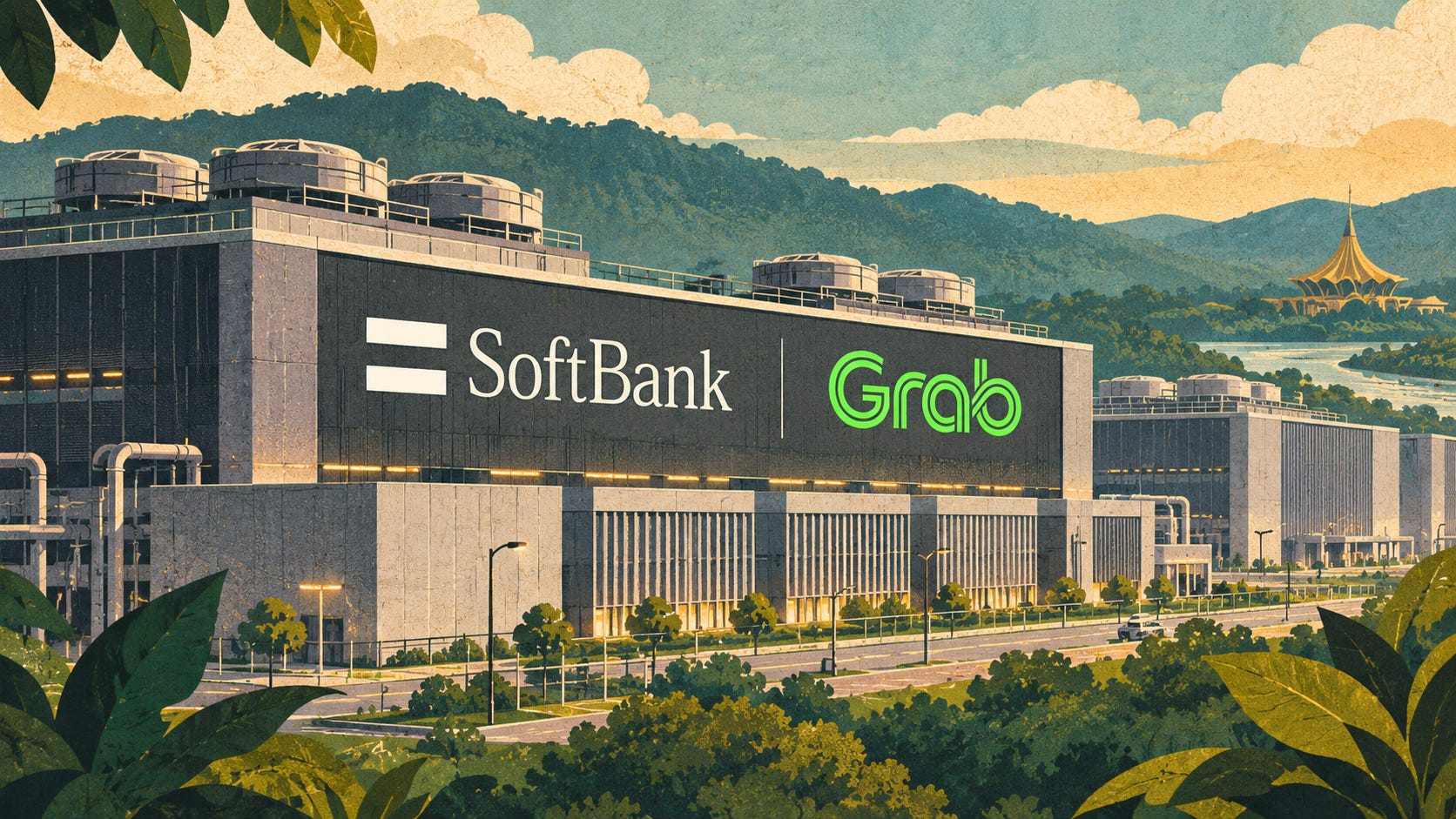
Grab is getting into data centres after it announced a joint investment with SoftBank to spend $1.85 billion on two AI infrastructure projects in Malaysia, the country where the ride-hailing company originates from.
In what is a rather confusing development alongside one of its key investors, Grab will contribute $650 million to the project in Peninsular Malaysia, with SoftBank providing a further $200 million. The second project will be located in Sarawak and that will be financed by SoftBank ($800 million) and Grab ($100 million) alongside PETROS, the state-owned oil and gas company, which is chipping in $100 million.
The involvement of PETROS indicates that the initiative is very much government related, and part of Malaysia’s national AI plan. The announcement claims the project will be one of Asia’s largest AI infrastructure developments once it comes online, with a plan to target at least 5GW in capacity.
The initial investment is described as being seed funding, and notably Grab CEO Anthony Tan will oversee both projects, but there will be an appointed team to run the day-to-day business. Future investment from outside parties appears to be the target so these initial backers won’t be fronting it all.
So why is Grab doing this, and what even is Grab doing here?
Let’s start with what Tan said in a quote:
This infrastructure will allow us to accelerate the development of localized AI solutions for our communities. Through this partnership, we can drive faster regional AI development and adoption, bringing its transformative benefits to many millions of people, while contributing to Malaysia’s economy through the creation of high-value jobs and AI upskilling.
So this appears to be an investment in Malaysia as a location for AI services and facilities. We wrote on Monday that it has pulled ahead on data centres in Southeast Asia, but this project potentially goes a step further with dedicated AI facilities with government ties, not just facilities for US hyperscalers.
Grab has had a war chest to spend. It currently has $2.85 billion in cash or cash equivalents, and that’s after a year of serious spending.
It made a series of investments in automotive tech last year. This year, it acquired fintech startup Stash and is buying lending business Atome for an initial $1.5 billion, while a move to enter Taiwan by purchasing the local Foodpanda business for $600 million just fell through. The next leg of its spending appears to be infrastructure and doing so in Malaysia, the country “where Grab began,” as Tan himself noted.
How much of this will be used for Grab services? We don’t know.
But if there’s future funding and financing, Grab might make returns that offset its initial investment whilst also having the benefits that come with owning infrastructure.
It’s all too early to tell, but this is certainly a left field move. We recently wrote (perhaps negatively) that Grab is a transportation company that’s struggled to convince investors it can do tech, or fulfil its fintech potential. Whereas rival Sea is jumping into cloud computing services and potentially listing its fintech business.
This news runs contrary to that. Grab is putting a good chunk of change into a very futuristic project that’s unlikely to yield any returns in the short to medium term. That makes it a little more exciting but investors aren’t lapping it up yet. Grab’s price dropped 2.5% on the news, but it is up 6% over the last month thanks to its recently announced solid financials.
The Offline Network: $5B AI startup Wonderful is betting on Thailand
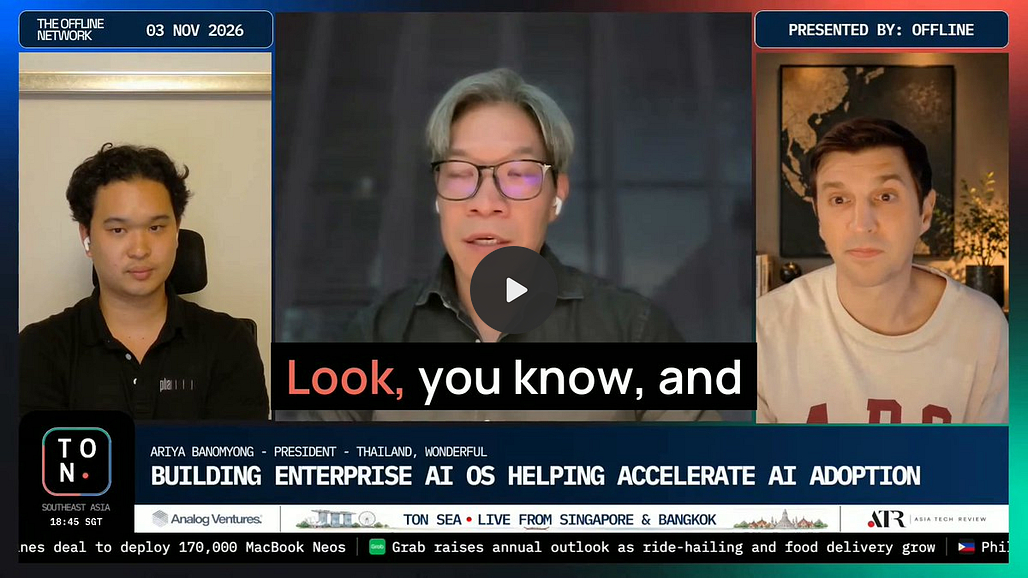
On last week’s episodes of The Offline Network (TON) Southeast Asia, the live-stream show I co-host with long-time VC Wing Vasiksiri, we got the inside take on Wonderful, the $5 billion-valued company that builds AI infrastructure for businesses.
Ariya Banomyong, the former head of Google Thailand and Line Thailand, explained why he joined the company, why it is focused on Thailand and how it operates like a startup in new markets despite that huge valuation and its day-to-day work with corporations.

Catch highlights on our LinkedIn page, X account and YouTube channel.
Goodnight, Jensen
Coverage of Jensen Huang is wall-to-wall as his position as CEO of Nvidia hangs in the balance after reports of a second affair, this time with an Nvidia executive who reports to him, emerged following the explosive news of his relationship with alleged PRC spy Alice Huang.
Huang is said to have had an extramarital relationship with Kimberly Powell, Nvidia’s vice president of health care, according to a New York Times report that cites five sources and claims the couple were caught on video earlier this year.
In March, Ms. Powell appeared at GTC, Nvidia’s annual developer conference in San Jose, where she spoke about using A.I. to aid in breakthroughs in health care and biology. Her presentation used cartoon depictions of Mr. Huang.
During the conference, Nvidia executives were at a nearby hotel for meetings. Mr. Huang and Ms. Powell were seen being affectionate at the hotel. One bystander captured the interaction on their phone, three people briefed on the incident said.
Mr. Huang’s security workers witnessed the bystander with the phone and sequestered the person, the people said. The workers then asked the person to sign a nondisclosure agreement.
With a second affair now public, there’s plenty of context behind why Jensen Huang hired crisis PR firm Heller, well known for handling sex scandals, one year ago, as Wired reports.
Added to this, further details around his relationship with Alice Huang, who helped run Singapore-based Megaspeed, have surfaced suggesting how his relationship enabled avoidance of US sanctions.
The FT reported that Alice Huang previously sought Chinese investment in a Southeast Asian data centre project in 2025, claiming she could secure Nvidia GPUs and citing Alibaba as a prospective client. Megaspeed has since seen its balance sheet jump from $33 million in 2023 to $3 billion one year later thanks to its relationship with Nvidia and customers like Alibaba. Beijing, however, rejected the allegations that (Alice) Huang spied on (Jensen Huang) and passed information to China.
Nvidia general counsel Tim Teter is said to have contacted a senior US Commerce Department official in 2025 to ask whether the agency was involved in Singapore’s detention of Megaspeed executive Alice Huang. Singapore police had questioned Huang and barred her from leaving the country amid a probe into suspected AI chip smuggling.
What else slipped through the cracks? Reuters reports that Northwestern Polytechnical University, a Chinese institution with close ties to the People’s Liberation Army, bought two Nvidia H200 AI chips for 874,700 yuan ($123,000) last month, according to an October 21 procurement record. The university is part of China’s sanctioned “Seven Sons of National Defense” group and it purchased the chips through a local supplier.
Deals
Airwallex plans to invest more than S$2 billion ($1.56 billion) in Singapore over five years and grow its local workforce from 750 to more than 1,000, strengthening one of its two global headquarters [TechNode]
Singapore chip startup Staera Semiconductor raised $4.6 million in a pre-seed round led by Openspace Capital to integrate optical data links into silicon chips, with SGInnovate among the other investors [TechNode]
Thailand’s SKY ICT and Thoresen Thai Agencies are looking to acquire food delivery app Robinhood’s brand and software for 100 million baht ($3 million), after the previous operator struggled with losses; a deal is expected by the end of November [Bangkok Post]
Markets
Chinese memory chipmaker YMTC is targeting a Shanghai STAR Market listing as early as the first quarter of 2027 despite an earlier report that the IPO was on hold; it has planned to raise 33 billion yuan ($4.9 billion) [Bloomberg]
Alibaba’s chipmaking unit T-Head has filed for a Hong Kong listing as the company moves to spin off its data centre processor business [Bloomberg]
Japanese AI startup Sakana AI is preparing for a potential listing in Tokyo or New York as early as autumn 2027, targeting a valuation above $4.3 billion and hiring Goldman Sachs as an adviser [Nikkei Asia]
Earnings
South Korea’s Naver reported a 45% fall in third-quarter net profit to 402.5 billion won ($300.6 million), missing analyst expectations as AI investment costs rose [WSJ]
Sea reported a 29% rise in adjusted EBITDA to $931 million in the September quarter, missing analysts’ $990 million estimate as AI and cloud spending increased, while revenue rose 43% to $8.6 billion [Bloomberg]
SoftBank reported a 1.1 trillion yen ($7 billion) net loss for the quarter ended September, its first in nearly two years, after a 597.2 billion yen ($3.7 billion) charge related to US data centre procurement and financing costs [FT]
AI and Chips
ByteDance is reportedly preparing an AI assistant similar to Meta’s Muse for release in the coming weeks, while co-founder Zhang Yiming has told staff it could take until 2029 or 2030 to compete with OpenAI and Anthropic at the frontier [Bloomberg]
Six leading Chinese AI firms had a combined annualised revenue run rate of $11 billion in September, versus $105 billion for OpenAI and Anthropic, according to Epoch AI estimates; ByteDance led the Chinese group with $4 billion [Nikkei Asia]
Dutch chipmaker Nexperia could still reunite with its Chinese operations after a year-long split, interim CEO Stefan Tilger says, adding that Chinese parent Wingtech should be compensated if the separation becomes permanent [Reuters]
TSMC’s board approved investments of up to $500 million each in Anthropic and OpenAI, with plans to acquire Anthropic shares at its IPO price and OpenAI preferred shares [TSMC]
Chinese AI companies MiniMax and Moonshot AI are hiring in the US to tap Silicon Valley talent and get closer to enterprise customers [Rest of World]
Elon Musk’s Terafab chipmaking project is in procurement talks with Japanese equipment makers as the proposed Texas facility draws interest and questions about its feasibility [Nikkei Asia]
Meituan released the weights for its LongCat-2.5 AI model under the MIT licence, allowing developers to run and modify a model that can analyse images and video and work across codebases [VentureBeat]
Japan’s Rapidus is reportedly months behind on a key step towards producing 2-nanometre chips, putting its March 2028 mass-production target in doubt [Bloomberg]
Moonshot AI reportedly signed a deal to rent 32 Nvidia B300-equipped servers that filings value at 432 million yuan ($64.8 million) and list as being in China, raising questions about potential breaches of US export restrictions; Moonshot denies the report [Bloomberg]
Policy
Malaysia plans a separate wholesale electricity market for large users such as data centres by 2029 or 2030, while keeping the existing single-buyer market for households and other businesses [New Straits Times]
Thai officials met Apple after several politicians received warnings that they may have been targeted by mercenary spyware, part of a wave of alerts sent to users in 99 countries [Bloomberg]
Meta, TikTok and Google are pushing back against proposed Indonesian copyright rules that would make platforms pay publishers for news links and introduce AI-content disclosure requirements [Reuters]
Microsoft is pressing the Trump administration to drop a proposed ban on Chinese optical transceivers, warning that it could slow US data centre expansion [Reuters]
Thailand has approved environmental rules for data centres that set limits on noise, heat and water use as AI investment drives the sector’s expansion [Bloomberg]
In other news:
China’s Singles Day shopping festival is putting AI shopping assistants to the test, with chatbot links driving around 5% of Douyin purchases in October and over 20% for considered products such as supplements [Reuters]
Huawei’s electric vehicle alliance is showing signs of strain as October deliveries fell 50% year on year and its partner brands increasingly pursue their own strategies [Nikkei Asia]
Sea is entering cloud services with an asset-light business aimed at AI demand, though the venture has yet to secure enterprise contracts or set an expansion timeline [Nikkei Asia]
Indian AI startup Sarvam AI appointed former Google Cloud India head Sashikumar Sreedharan as president and chief business officer, with responsibility for its enterprise and government business [Economic Times]
Japan plans an AI-powered Japanese-learning app featuring anime and manga characters, with the Japan Foundation targeting completion in fiscal 2028 [Nikkei Asia]
Three contract workers died after inhaling gas during maintenance at a Tata Electronics iPhone-parts factory in Tamil Nadu, prompting company and state government investigations [Reuters]