


Welcome back to Asia Tech Review, your curated digest to keep up to date with tech news across Asia.
There’s a stark contrast between Grab and Sea, Southeast Asia’s two major listed companies. One recycles profits and is diving into cloud computing and considering an IPO for its thriving fintech business. The other made a loss-making business profitable, but is struggling to find explosive growth. Can you guess which one is Grab?
To keep up with our issues, follow us on LinkedIn or WhatsApp. Please do share Asia Tech Review with people you know who want to get smart about Asia tech.
For news as it happens, follow ATR Bulletin, our real-time news site that keeps you in the know.
Is this the ceiling for Grab?
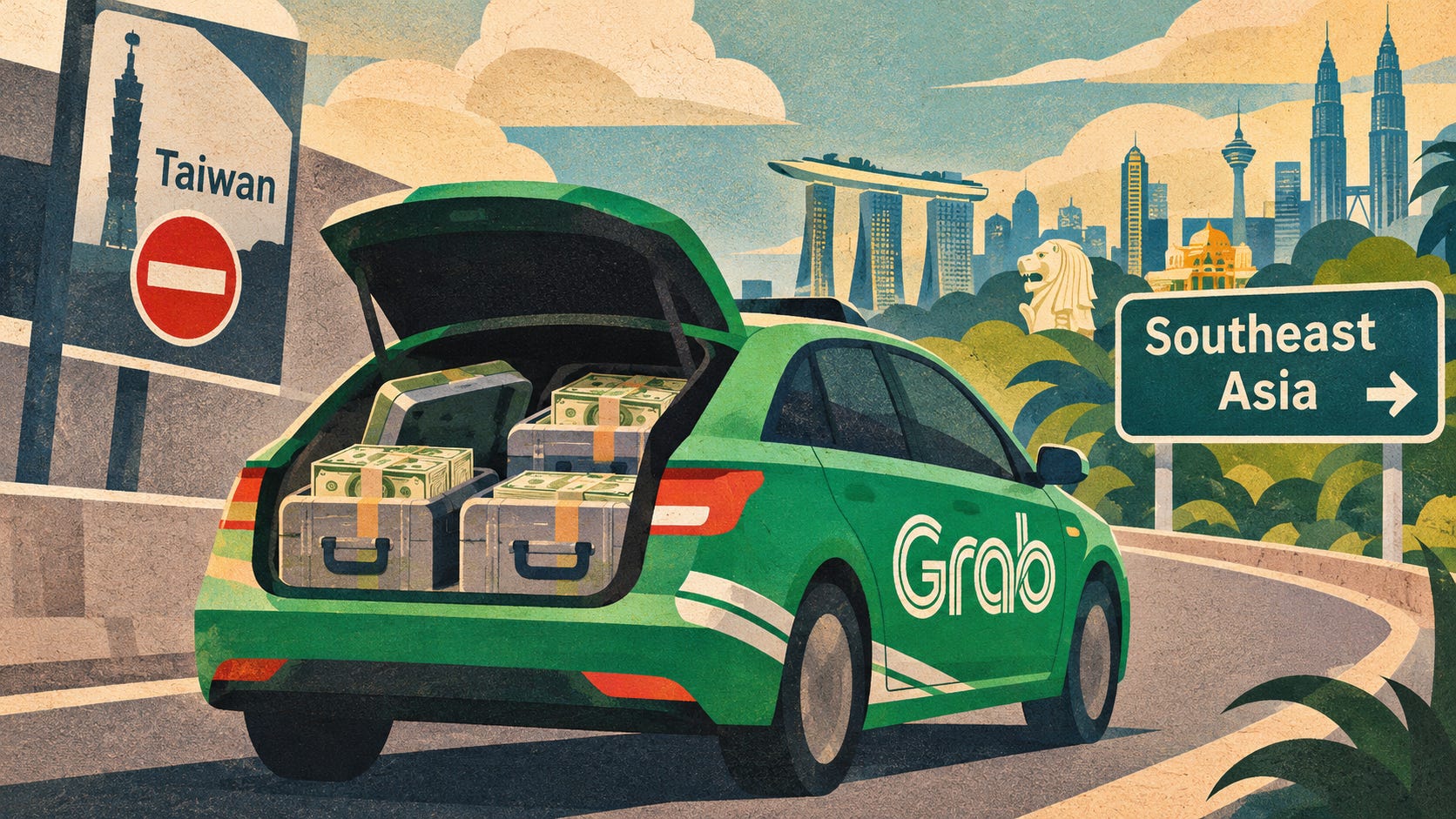
Grab produced what is probably its best quarter of earnings as revenue rose 27% to reach $1.11 billion in Q3 2026 with a net profit of $18 million.
The company has had stronger growth, revenue grew 30% one year ago, and its profit has been higher but it was EBITDA positive across its three divisions as its financial services unit stopped losing money. That’s likely because it now includes results from Grab’s digital banks and Stash, the US-based fintech it acquired earlier this year, but that is still a notable milestone. Its financial business now generates more than half of the revenue of its mobility segment, thanks to 124% growth.
Buoyed by its progress, Grab increased its revenue forecast by 1.2% to $4.15-$4.2 billion, which is 23-25% annual growth, and its adjusted EBITDA guidance was raised by 8.9%.
Grab’s share price rose by over 10% after the results, but the question is whether Grab has another gear to move into.
Its bid to enter Taiwan failed, which means it won’t get the opportunity to tap growth in a more lucrative market outside of Southeast Asia. CFO Peter Oey said the company will go back to focusing on Southeast Asia.
Grab’s fintech division now includes all its banking and investment assets, which contributed to that doubling of revenue making it tough to replicate again without further acquisitions.
Income from mobility and delivery segments is solid with 21% and 10% annual growth respectively, but they’re not particularly exciting in the age of AI and hockey stick jumps. Plus Grab is having to spend significantly to generate the revenue ($737 million in three months on customer and driver incentives) and that spending is growing faster than the income it helps generate
AI is, of course, the big bet for all companies, and it is catnip for investors. But it’s tough to see where that comes from for Grab. Oey said it is driving a higher spend from customers, but that’s not playing out in the numbers yet. In contrast to Sea’s audacious move into cloud computing and potential IPO for its fintech division, Grab looks like a solid but boring business.
Grab’s plight is all the more remarkable when you consider that it has baked itself into the fabric of Southeast Asia, where it is a key part of transportation and consumption. But turning that value into profit and growth is proving to be a tough challenge.
The Offline Network: Fifth time lucky for fintech founder who got acquired
On last week’s episodes of The Offline Network (TON) Southeast Asia, the podcast I co-host with long-time VC Wing Vasiksiri, we talked about funding and exits.
Hiro Kiga, who sold payments startup Wallex to MDaq in 2022, walked us through the process and how it was fifth time lucky when it came to his exit having seen four previous deals collapse. He also shared how FOMO led him to leave venture capital to get back to building again.


Catch highlights on our LinkedIn page, X account and YouTube channel.
ChatGPT and western apps are flying in India
My former colleague Manish Singh put together 18 charts on India’s digital development with fascinating insights including:
Spotify and YouTube Music are utterly dominant
More than 200 apps have 10 million or more monthly users
ChatGPT users are stickier than those on Telegram or Gmail, but behind Facebook, WhatsApp, Instagram, YouTube and payment apps
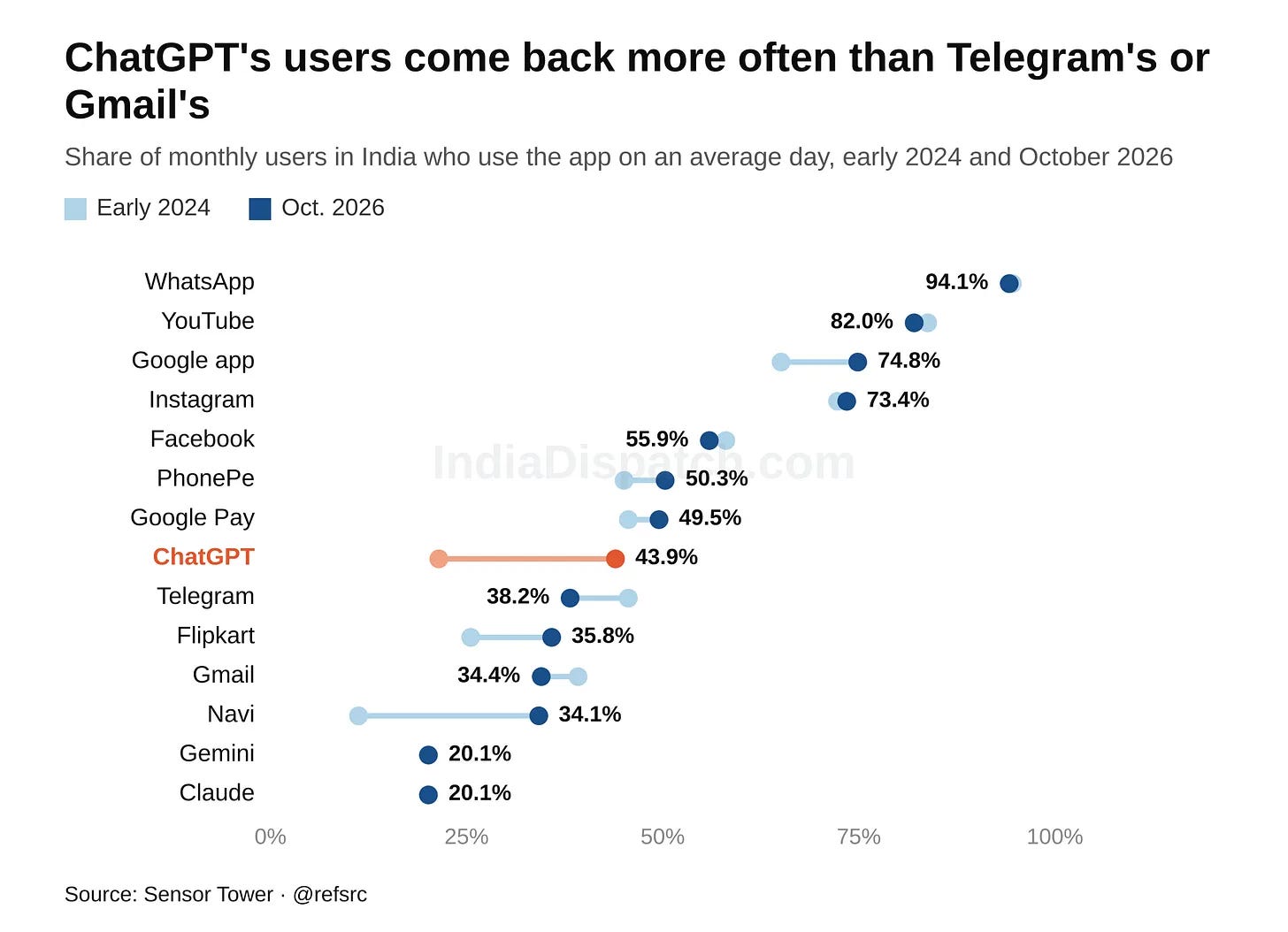
Check out his India Dispatch post for more.
In related news: India has become ChatGPT’s largest market by weekly active users after its user base doubled since January, OpenAI India MD said [Economic Times]
Deals
Japan’s SBI Holdings will invest $100 million in US digital bank Erebor as it looks to expand its US presence [Nikkei Asia]
Singapore-based NeoSci Ventures raised S$70 million ($53 million) for its first institutional venture fund which is focused on biotech deals [WSJ]
Singapore-based data centre operator STT GDC is reportedly in talks with banks for a S$3.1 billion ($2.4 billion) syndicated loan [Bloomberg]
Meanwhile, KKR, Singtel and Tata Communications are preparing to sell STT Global Data Centres India at a valuation of more than $5.5 billion [The Economic Times]
Chinese embodied AI startups raised 93.5 billion yuan ($13 billion) across 322 deals in the first half of 2026, five times the year-earlier total [Reuters]
South Korea plans to invest 21.3 trillion won ($15.97 billion) in AI, chips and data centres next year, nearly double this year’s spending [Reuters]
Bengaluru-based chip startup Agrani Labs is in talks to raise $100 million, with Google and Stargazer among the investors [Moneycontrol]
Thailand-based Amity secured investment from a Krungsri Finnovate-managed fund, extending its Series D round beyond $100 million [TechNode]
Markets
Anthropic plans to sell up to $3.5 billion of shares to Japanese investors as part of its US IPO [Reuters]
Earnings
Uber rival Rapido has reportedly crossed $4 billion in annualised gross order value, quadrupling its scale in two years, with daily volumes reaching 8.3 million orders. Ride-hailing accounts for more than 95% of transactions as the company expands into food delivery. [Economic Times]
Japan’s Kioxia saw its shares fall as much as 17% after forecasting December-quarter operating profit of 2 trillion yen ($12.7 billion), roughly flat on the previous quarter [Bloomberg]
AI and Chips
HSBC plans to open an AI and emerging technology institute in Hong Kong in the first quarter of 2027, following a similar initiative in Singapore [Reuters]
DeepSeek introduces a creator mode that lets users build custom plugins from plain-English instructions, including tools for 3D rendering and video editing [Bloomberg]
Japan’s Aisin and Tohoku University have developed a magnetic-memory chip that they say consumes about 98% less power than comparable semiconductors [Nikkei Asia]
MIT researchers used OpenAI’s GPT-6 Astra to directly edit an open-source Qwen model’s weights, improving its maths score roughly sixfold [VentureBeat]
US export rules allow high-bandwidth memory to reach China bundled with lower-performance server processors, creating a smuggling route. Huawei has reportedly told clients its upcoming Ascend 960DT will rely heavily on Samsung and SK Hynix HBM [The Information]
Samsung plans to produce high-bandwidth memory base dies for AMD and Nvidia at its second Texas foundry, which is set to begin construction this month. The 2.7-million-square-foot plant will use 2-nanometre technology and has secured orders for its full output, mostly from AMD. [Reuters]
Alibaba chairman Joe Tsai said open source is the only viable path to a sustainable AI industry, as the company deepens its open-source strategy amid rising demand for computing power and persistent supply constraints. [SCMP]
Crypto
In an update following its massive hack, Binance says attackers used fake job interviews, malware and an internal AI tool to compromise employee devices and gain access to wallet-signing systems before the $6.3 billion theft [Binance]
Policy
China’s Communist Party plans to use big data to monitor members’ online activity and detect corruption under a governance document approved at its fifth plenum [Nikkei Asia]
Japan is considering standardised safety certification for self-driving vehicles without steering wheels or pedals, a step aimed at supporting mass production of robotaxis [Nikkei Asia]
China is accelerating plans for AI safety rules covering the full lifecycle of models, from development and training to deployment and use [Bloomberg]
Nvidia has told data centre partners to direct at least 51% of cloud services to non-Chinese customers, limiting access to its advanced chips through overseas leases [FT]
In other news:
Bloomberg has a profile story on Jeff Yan, the reclusive founder of Hyperliquid, which may be the most exciting company in crypto [Bloomberg]
Hundreds of apparently ordinary AI apps and websites linked to Chinese-language developers conceal tools for making sexually abusive deepfakes, an investigation found [WIRED]
Apple has secured a deal with the Philippines’ Department of Education to deploy 170,000 MacBook Neo laptops [X]
South Korea’s Krafton is expanding its India operations as it looks for a global gaming hit beyond PUBG, with a 12-person Bangalore development team and another studio acquisition in advanced talks [Bloomberg]
Singapore’s MoneySmart suffered a data breach that exposed customer information in Singapore and Hong Kong [The Business Times]
Vietnam’s Government Cipher Committee and Viettel claim to have developed the VGC v1.0 security chip, which encrypts and decrypts data about 15 times faster than software-based solutions. Using RISC-V architecture, the chip integrates a locally developed cryptographic algorithm and has been certified for use in secure USB storage. [Vietnam.vn]