


Welcome back to Asia Tech Review, your curated digest to keep up to date with tech news across Asia.
Grab’s planned expansion into Taiwan, its first move outside of Southeast Asia, is dead after its deal to acquire Foodpanda was blocked by the competition commission. Grab and Uber are rivals, but their close links, including ownership and board membership, raise sufficient concern that the impact would be negative.
To keep up with our issues, follow us on LinkedIn or WhatsApp. Please do share Asia Tech Review with people you know who want to get smart about Asia tech.
For news as it happens, follow ATR Bulletin, our real-time news site that keeps you in the know.
Grab’s past with Uber comes back to haunt it
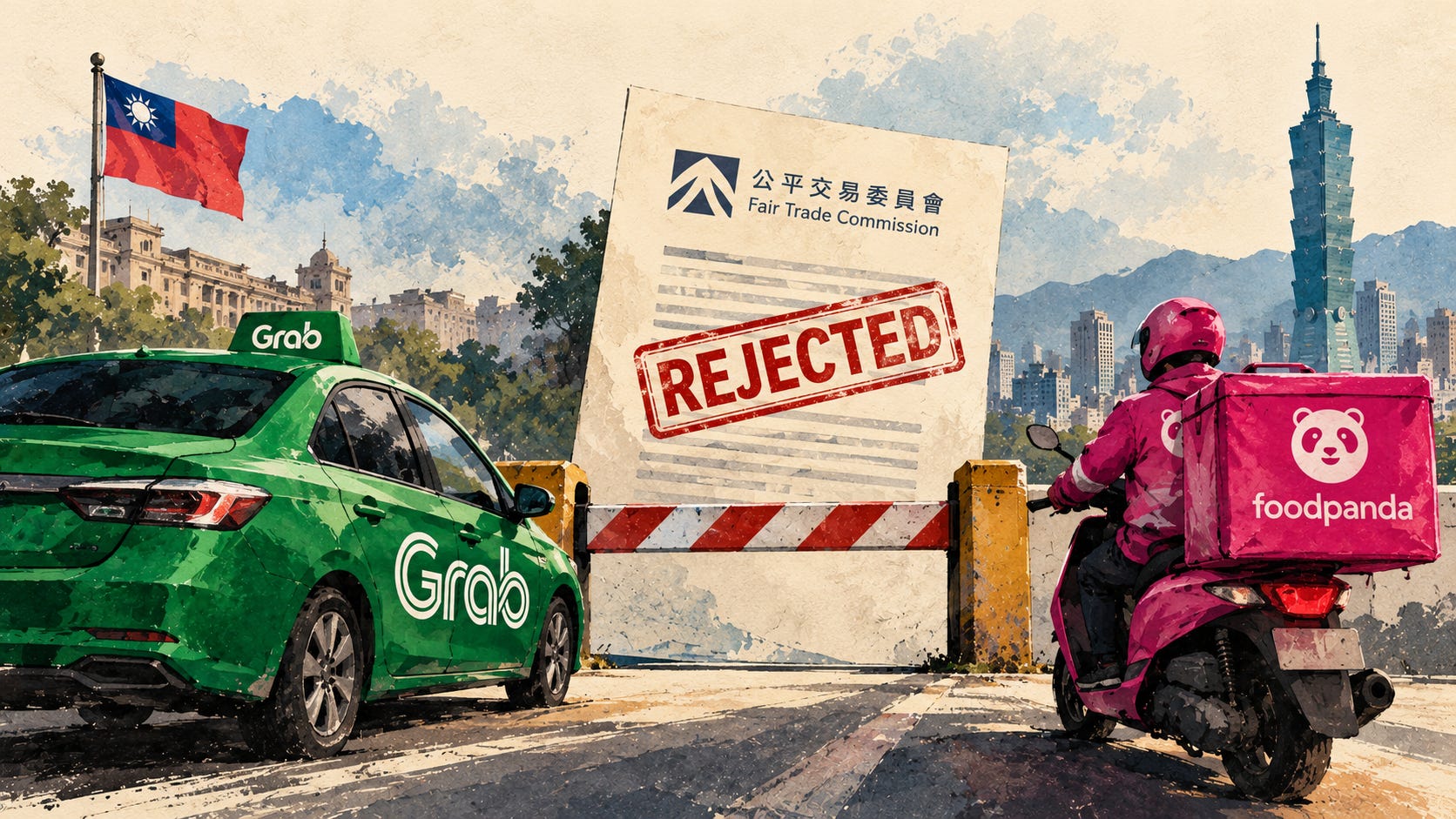
Grab’s plan to expand into Taiwan appears to be over after the country’s Fair Trade Commission (FTC) blocked its planned $600 million acquisition of delivery business Foodpanda.
The deal was announced in March and it looked like it would finally see Europe-based Delivery Hero dispose of its Taiwan-based business, which was originally set to be acquired by Uber for $950 million back in 2024. That Uber deal was struck down on anti-competition grounds, and it is a very similar story again here.
Uber buying Foodpanda Taiwan would have given the US firm a monopoly in the country, and while that wouldn’t be the case for Grab, since it would be entering the country for the first time, the FTC was uneasy with the relationship between the two companies.
Its ruling noted that Uber’s 13.1% ownership stake in Grab could reduce the incentive for Grab and Uber Eats to compete hard on prices, promotions and service. It highlighted the two companies’ previous commercial ties, which include the sale of Uber’s Southeast Asian business to Grab in 2018 and Uber’s CEO Dara Khosrowshahi’s past role on Grab’s board of directors, as a major concern and said Taiwan’s high barriers to entry made the risk worse.
Grab proposed options to remedy the situation, including diluting Uber’s stake and limiting sensitive-information sharing, but they were rejected by the commission.
It’s not clear whether the companies will appeal the ruling. Grab told Focus Taiwan it was disappointed by the outcome. Delivery Hero noted it has a break fee for the deal not concluding, but it didn’t specify whether that will come into force.
Grab’s case was undoubtedly not helped by a series of protests across Southeast Asia in response to the company’s fees. Protests started in Indonesia in late August after a Grab driver died after being caught up in a police clash during cost of living protests while delivering an order, and unrest spread to Vietnam where drivers called for a protest in September.
The proposed venture into Taiwan was part of a major investment spree from Grab this year which has included doubling down on financial services with the acquisition of buy-now-pay-later product Atome for an initial $1.5 billion, and the acquisition of US-based investment app Stash. Grab has also consolidated its Indonesia-based bank into its overall operations, too. (Disclaimer: Atome is an Ellerton client.)
This week’s update means we won’t find out what this foray outside of Southeast Asia can do for Grab’s business. Taiwan remains the jewel in Foodpanda’s Asia business, which Delivery Hero has been looking to dispose of for some time. It shut down its operations in Thailand, and has struggled to find buyers for the business in other parts of Southeast Asia.
The issue in Taiwan isn’t finding a buyer, as we can see, just structuring a deal that is deemed to be acceptable. There’s been talk of Foodpanda exiting Taiwan entirely, but that’s unlikely given that the business remains a valuable asset.
So much for Grab and Uber resuming their direct rivalry. That will have to wait for another time and another country.
DeepSeek raises another $15 billion from investors
DeepSeek has closed its second funding round of the year after pulling in $15 billion with battery giant CATL and Tencent among the leading investors, according to the Wall Street Journal. The deal follows the Chinese AI firm raising $7.4 billion back in June.
Unlike AI companies from the US and other regions, Chinese firms are rarely public with their funding and other numbers. The details get out via media which can make them difficult to track. In this case, WSJ reports that the company is working to go public through an IPO as soon as next year. That, it claims, could see it beat domestic rival Moonshot AI as well as Anthropic and OpenAI in becoming a listed company.
That would be one hell of a trajectory for a business that, prior to this summer, was entirely bootstrapped by its founder, hedge fund owner Liang Wenfeng.
DeepSeek’s investors are said to also include investment firms Monolith Management and Shixiang, PE firm Stony Creek Capital, Lenovo-owned Legend Capital, and Chinese carmaker Geely. Its valuation appears to have surpassed $79 billion, and the company’s annualised revenue run rate (ARR) is now at more than $1 billion.
Beyond the funding, DeepSeek is increasingly working with Huawei to optimise its service on Chinese AI chips. The two firms are said to be working together to optimise Huawei’s Ascend processors with the ultimate goal of creating a domestic computing ecosystem with significantly reduced reliance on Nvidia’s technology and other non-Chinese components.
All in all, DeepSeek looks like a very different company to the one that burst on the scene with a capable model that was built with less investment and compute power than its rivals.
Deals
The Private Infrastructure Development Group exited Vietnamese electric-motorbike startup Dat Bike after the company redeemed its $4 million convertible loan, following a $26 million Series B round [TechNode]
Markets
Singapore-based DayOne Data Centers is weighing a smaller US IPO of $2.5 billion to $3 billion, roughly half its original target, after volatility hit data-centre stocks [Bloomberg]
Prism, the parent of Indian budget-hotel chain Oyo, cut its planned IPO to 33.5 billion rupees ($354.65 million), nearly half the 66.5 billion rupees it proposed in June [Reuters]
Chinese humanoid-robot maker Noetix Robotics confidentially filed for a Hong Kong IPO that could raise several hundred million dollars and happen as early as next year [Bloomberg]
South Korean entertainment platform Korai Flix will go public in the US through a $3.5 billion SPAC merger, after attracting about 26 million users across 15 Asian markets with AI-generated short dramas and companion avatars [Reuters]
AI and Chips
Vietnam’s Ministry of Public Security asked Samsung to work on chips for security equipment, AI-powered file analysis and biometric-recognition software [Nikkei Asia]
Moonshot AI is expanding into Singapore, where it is hiring for a sales role to build revenue, partnerships and market presence [Reuters]
Samsung Electronics and SK Hynix are upgrading their China factories to make more advanced memory chips, looking to meet AI demand while holding off local rival YMTC [Reuters]
Microsoft said China-aligned group Storm-0940 used the ARTEX AI penetration-testing framework to target hundreds of organisations globally, gaining privileged cloud access in some cases within three hours [Microsoft]
Eternal, the parent of Zomato and Blinkit, launched dark.ai, a privacy-focused platform that runs public AI models on its own infrastructure and offers user-controlled chat memory [Bloomberg]
Japan selected Preferred Networks and Tenstorrent for a five-year project to develop an advanced computing platform combining chiplets, photonics-electronics integration and advanced packaging [TechNode]
US tech companies building data centres in India are facing rising opposition over water, power and land use, as the government considers a national data-centre policy [CNBC]
Malaysian chip designer SkyeChip joined SoftBank-backed Saimemory’s Z-Angle Memory project in Japan to develop next-generation memory for AI data centres [Nikkei Asia]
Japanese AI startup EpicAI plans to deploy software at several automakers from next spring to speed up vehicle-design reviews and help them compete with faster-moving Chinese EV rivals [Nikkei Asia]
Israeli security firm Lava said it found 32 Nvidia Blackwell Ultra B300 chips linked to China Telecom, despite US export controls barring their sale to China [The Information]
Samsung Electro-Mechanics will receive 3.7 trillion won ($2.8 billion) in investment from Tesla and Nvidia for facilities making advanced chip substrates for AI semiconductors [Reuters]
Policy
China accused the US of discrimination under the guise of national security after Washington barred DeepSeek products from the technology systems of many federal agencies [NYT]
Malaysia’s government-backed TuJu navigation app is drawing criticism over unreliable directions and a lack of real-time traffic updates after officials were barred from using Waze [Bloomberg]
Indian digital-trust provider eMudhra will exit the global SSL/TLS certificate business after weak cryptographic key generation exposed private keys for eight intermediate certificate authorities and prompted major browsers to block them [Economic Times]
TSMC is exploring alternatives to rare-earth components in factory equipment to reduce disruption risks from China’s export controls [Reuters]
Japanese companies, including banks and airlines, took digital services offline as they assessed vulnerabilities in the widely used PHP programming language and rushed to install patches [Bloomberg]
In other news:
Southeast Asia’s digital economy is expected to grow 17% to $368 billion this year, as AI helps support consumer spending despite inflation and weaker demand [e-Conomy SEA 2026]
Chinese battery makers and their suppliers announced $12 billion in overseas investments across 14 deals this year, taking their expansion since 2023 to almost $90 billion [FT]
State Bank of India is investigating a suspected cyberattack after finding nearly 4,000 records containing customers’ personal information on the dark web [Bloomberg]
Tesla partnered with Ant Group to integrate Alipay into its cars in China, starting with a smart-parking service as it adds local features in a crowded EV market [SCMP]
A union representing Micron workers in Taoyuan launched Taiwan’s first semiconductor-industry strike, demanding regular profit-sharing during the AI-driven chip boom [Nikkei Asia]