


Welcome back to Asia Tech Review, your curated digest to keep up to date with tech news across Asia.
Grab’s newest earnings are in and while the company continues to run a tight and steady ship despite the recent fuel crisis, it is lacking in sparkle to really excite investors. That might begin to arrive in November when we see the effects of its first major push into fintech, as we explore today. Elsewhere, Alibaba and DeepSeek duke it out to be the best value AI model.
We resume normal service next week as I will be back from Europe, so look out for more regular emails from us.
To keep up with our issues, follow us on LinkedIn or WhatsApp. Please do share Asia Tech Review with people you know who want to get smart about Asia tech.
Grab is ramping up its fintech play to convince investors it’s really a tech company
The market is getting excited about Grab’s lean into fintech after it released its Q2 2026 financials.
The company’s share price rose 3% after it raised its full-year 2026 guidance, increasing revenue expectations by 1.4% and adjusted EBITDA by 2.8%. Grab said the “strength” of its core business is one reason, but its move to deepen its financial services business seems key.
Grab is posting decent financial results, as we noted in its Q1 results in May, but it isn’t growing like a business that gives investors fomo. Overall revenue rose by 22%, a little below the 23% growth in Q2 2025, and it recorded a $19 million operating profit, but there’s not a lot to jump around about.
Sure, Grab has steered its business through concerns around rising oil prices without taking a revenue hit. It hit growth despite incentives to partners (rides, shops, etc) and customers rising to $706 million from $546 million a year ago. Put simply, people in the region are watching their spending, CFO Peter Oey said. (His latest earnings explainer video involved a hot wings challenge, by the way.)
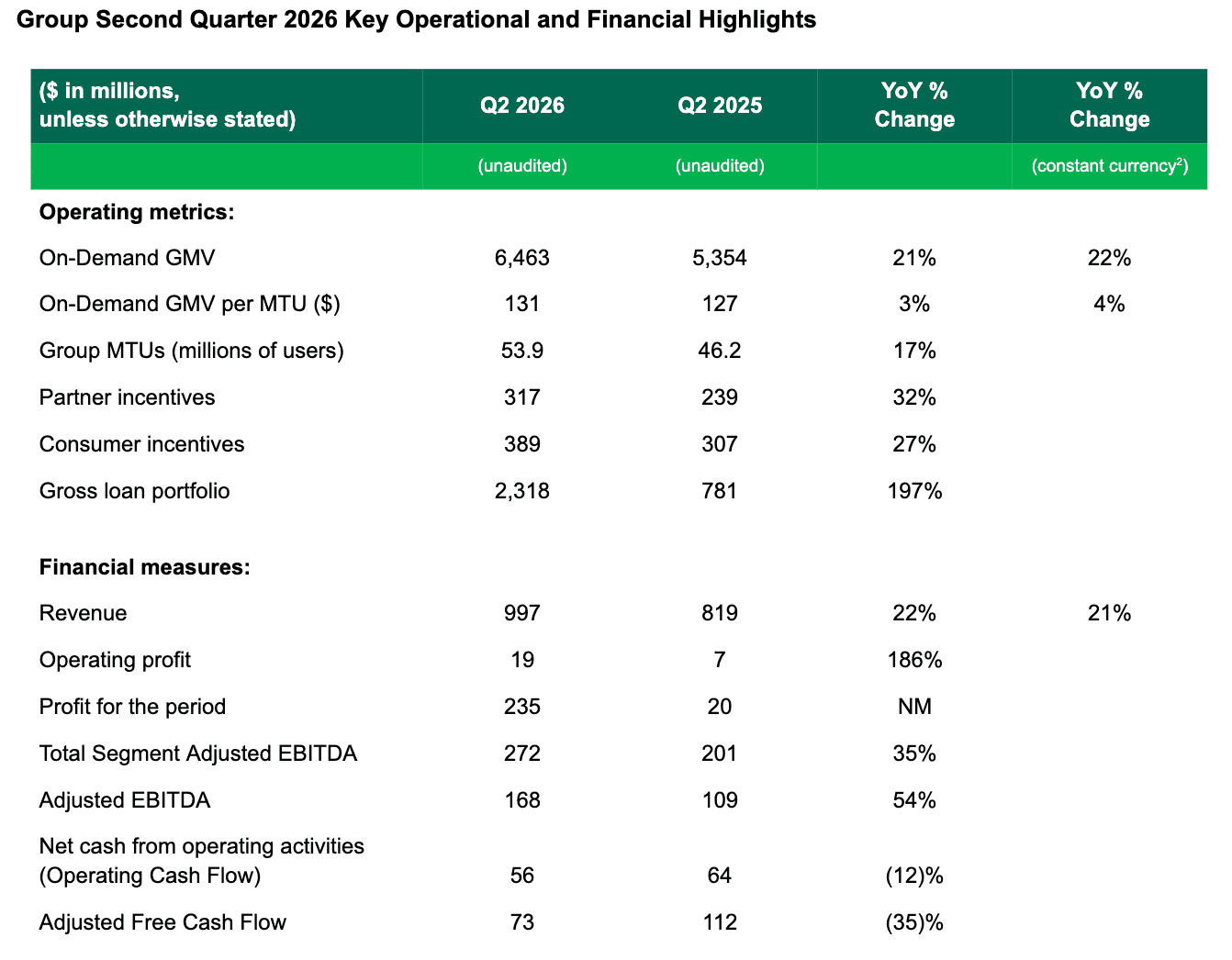
Grab needs to find a strong growth engine, and it is betting financial services can be it.
This isn’t a new bet. I wrote much the same in early 2021, and five years later there’s been no boom but there are flickers of promise.
Revenue from Grab’s financial services business grew by 59% year-on-year in Q2, having grown 43% in Q1. But it accounts for just $134 million of its total $997 million revenue right now.
The company has taken steps to accelerate growth. It acquired US-based investment app Stash in a cut price deal in February and then in May it consolidated Indonesia-based digital bank Supabank, once just an investment, into its business. These two entities will show up on the balance sheet in the next quarter.
Grab’s initial focus on payments with a side of banking didn’t really play out. Its digital bank plays are maturing now, but the bet is that AI-based investments or savings can propel it from just being a transportation business. That won’t happen overnight.
Qwen’s newest model bursts on the scene, but DeepSeek remains the value king
The world is a little too obsessed with finding China’s next DeepSeek or Kimi K3 moment, but the launch of Alibaba’s newest model is another moment for Chinese tech to bask in.
Qwen3.8-Max, the e-commerce giant’s newest model, is built on 2.4 trillion parameters and the company cites benchmark results that rival Fable from Anthropic and surpass Moonshot’s Kimi K3. The new Qwen’s significance goes beyond performance, since its pricing blows many rivals out of the water.


The Qwen team claims the model costs just $2/m input and $6/m, which would make it 1/3 of the price of Kimi and some 80% cheaper than Western models, which it claims it can perform alongside. The overall cost of using a model will depend on its efficiency and capabilities, as explained below, but the price drop is notable.
Alibaba’s management was said to be disappointed that Moonshot, a company that it invested in and helped secure Nvidia chips for training, could ship a model in Kimi K3 that surpassed Alibaba’s own efforts. Now it has its own player and at a competitive cost.
Is this Alibaba flexing its financial weight and sacrificing revenue for attention, usage and narrative? Maybe.
But, as mentioned, cost isn’t just about token price. One analyst firm calculated that Qwen3.8-Max is less efficient overall than DeepSeek, which tops the list as the cheapest AI model to use:
San Francisco-based Artificial Analysis estimated V4-Flash’s average cost at 3 cents per test, compared with 86 cents for Kimi K3 from Chinese rival Moonshot AI, $1.86 for OpenAI’s GPT-5.6 Sol and $3.15 for Claude Fable 5.
The comparison provides a more realistic measure of value than pricing alone because it accounts for the amount of data a model must process and generate to complete a task. A model with low headline price can still prove expensive if it requires significantly more steps to produce an answer.


DeepSeek will get a lot scarier when it puts the $7 billion-plus funding round that it closed in June to work.
Deals
AI cloud company CoreWeave is entering Asia with its first data centers in the region, planning three facilities in Indonesia totaling 360 megawatts of capacity. The US firm expects the centers online by 2028 and will spend billions on the project, though it gave no specific estimate. [CoreWeave]
Uzbekistan’s TAS-1 project, backed by Saudi Arabia’s DataVolt, will deliver 6 megawatts at Tashkent’s IT Park by year-end, the first step toward 500 MW as Uzbekistan targets $1.5 billion in AI revenue by 2030. Kazakhstan’s rival effort is far bigger: the Nvidia-backed Data Center Valley in Ekibastuz aims for a full gigawatt using 100,000 next-generation chips, part of a $10 billion deal led by US firm Firebird. [Nikkei Asia]
South Korean AI chipmaker DeepX has raised fresh funding at a valuation near 3.14 trillion won ($2.2 billion), roughly four times its previous round [Bloomberg]
NTT Data plans to spend at least $9.6 billion through 2033 to quadruple its computing capacity to 1 gigawatt, adding roughly 750 megawatts over the next seven years to meet surging AI demand in Japan [Bloomberg]
Robbyant, the embodied artificial intelligence division of Ant Group, has begun seeking external funding, becoming the fourth unit of the fintech giant to step up capital-raising efforts [SCMP]
Markets
Shein is said to be considering offering cash payouts and free extra Class B shares for late-stage backers who invested at valuations up to $64 billion. The move would effectively lower those investors’ cost basis to around $40 billion, closer to the valuation Shein is targeting for its planned Hong Kong listing. [Bloomberg]
Bithumb, South Korea’s second-largest crypto exchange, confirmed it is preparing for an IPO targeted for 2028 [The Block]
Vast, the Chinese 3D-modeling startup behind Tripo Studio that’s backed by Alibaba and Baidu, is reportedly exploring a Hong Kong IPO with Bank of America and CICC advising [Bloomberg]
Chinese robot maker Unitree Technology is expected to be valued at more than 50 billion yuan ($7.4 billion) after its planned Shanghai IPO [Reuters]
Africa-focused fintech PalmPay is preparing for a potential Hong Kong IPO and is also in talks to raise about $200 million in a funding round to scale its business. The company serves roughly 40 million users, mostly in Nigeria, making it one of the largest consumer-finance and payments platforms across Africa and parts of Asia, with backers including Transsion, MediaTek and Singapore’s GIC. [Bloomberg]
AI and Chips
Huawei’s top chip scientist Liao Heng warned that Western chipmakers are nearing physical limits in the race for more powerful processors, predicting “an avalanche” once that threshold is crossed [Bloomberg]
Anthropic will let Indian organizations process Claude requests entirely on domestic servers, rolling out in-country inference through Amazon Bedrock in the coming weeks [Moneycontrol]
China’s CXMT is preparing to produce advanced sixth-generation low-power LPDDR6 memory chips in small quantities by year-end, positioning it to compete with Micron, SK Hynix and Samsung [Bloomberg]
CXMT is also considering building a second memory-chip plant in Beijing and is in financing talks with a tech manufacturing hub backed by the local government [Reuters]
HP, Asus and Acer have begun using small amounts of DRAM chips from China’s CXMT in some notebooks as an AI-driven memory shortage squeezes supply [Nikkei Asia]
JD.com launched an AI-powered smart helmet for food couriers, joining rivals Alibaba and Meituan in rolling out similar tech to improve rider safety and delivery efficiency [SCMP]
China’s air force is using an AI-enabled “intelligent strike planning system” to draw up battle plans for operations involving more than 100 units, a state television documentary revealed [SCMP]
Policy
India has proposed extending tax exemptions for foreign firms supplying machinery to contract manufacturers until 2041, a major win for Apple [Reuters]
Apple’s annual sales in India topped $10 billion for the first time last fiscal year, growing at a double-digit rate from about $9 billion a year earlier, with iPhones driving the bulk of revenue [Bloomberg]
India will seek parliamentary approval for tax changes aimed at boosting foreign investment and local manufacturing, according to sources [Bloomberg]
TikTok is finalizing agreements to settle three upcoming trials related to allegations that its video product is addictive and harmful to minors [Bloomberg]
The Trump administration is drafting a ban on imports of new Chinese optical transceivers, key data center components for AI infrastructure [Reuters]
India is introducing legislation that could reshape its Unified Payments Interface, potentially allowing merchants to pay charges on some UPI transactions [TechCrunch]
In other news:
An unsecured police dashboard offered a rare glimpse into how Chinese authorities monitor foreigners in the country, revealing the scale at which officials collect and aggregate private data, from travel records to personal communications, to build detailed profiles. [NYT]
Hong Kong police have flagged a $3.3 million romance scam involving fake crypto app [The Block]
Chinese autonomous-driving company WeRide is entering Denmark through a partnership with electric-mobility operator GreenMobility, marking its first move into the Nordic region [The Next Web]
Several popular Samsung smart TV apps have been found to contain code that shares owners’ internet connections with strangers, putting millions of TVs at risk of hijacking [TechCrunch]
Southeast Asian films and dramas are winning bigger audiences on streaming platforms at home and abroad [Nikkei Asia]