


Welcome back,
A small plug for the ATR WhatsApp channel, follow along if you like to get your news there. We never spam, just 1-2 essential posts a day. Now to Grab.
The Singapore-based ride-hailing company announced its first annual profit of $65 million in 2025, showing that its core business can indeed be sustainable. Grab actually made a full-year profit of $200 million, thanks to $203 million in income from its $7 billion-plus cash reserves, which we will return to later.
Despite a first full year in the black, Grab’s stock is down 16% this year to date. Investors aren’t impressed for a few reasons:
It is expensive: trading at over 200X P/E, Uber is 70-80X for comparison
Weak operating margin: Grab made $65 million from $3.37 billion sales, that’s sub-2%
Cash intensive: operating cash flow fell from $852 million to $79 million in a year due to lending business demands
Slow growth: a 20-22% overall revenue growth estimate, not a huge jump on the 18% in 2025
But on the strategy side, Grab is pulling exciting moves thanks to that cash reserve.
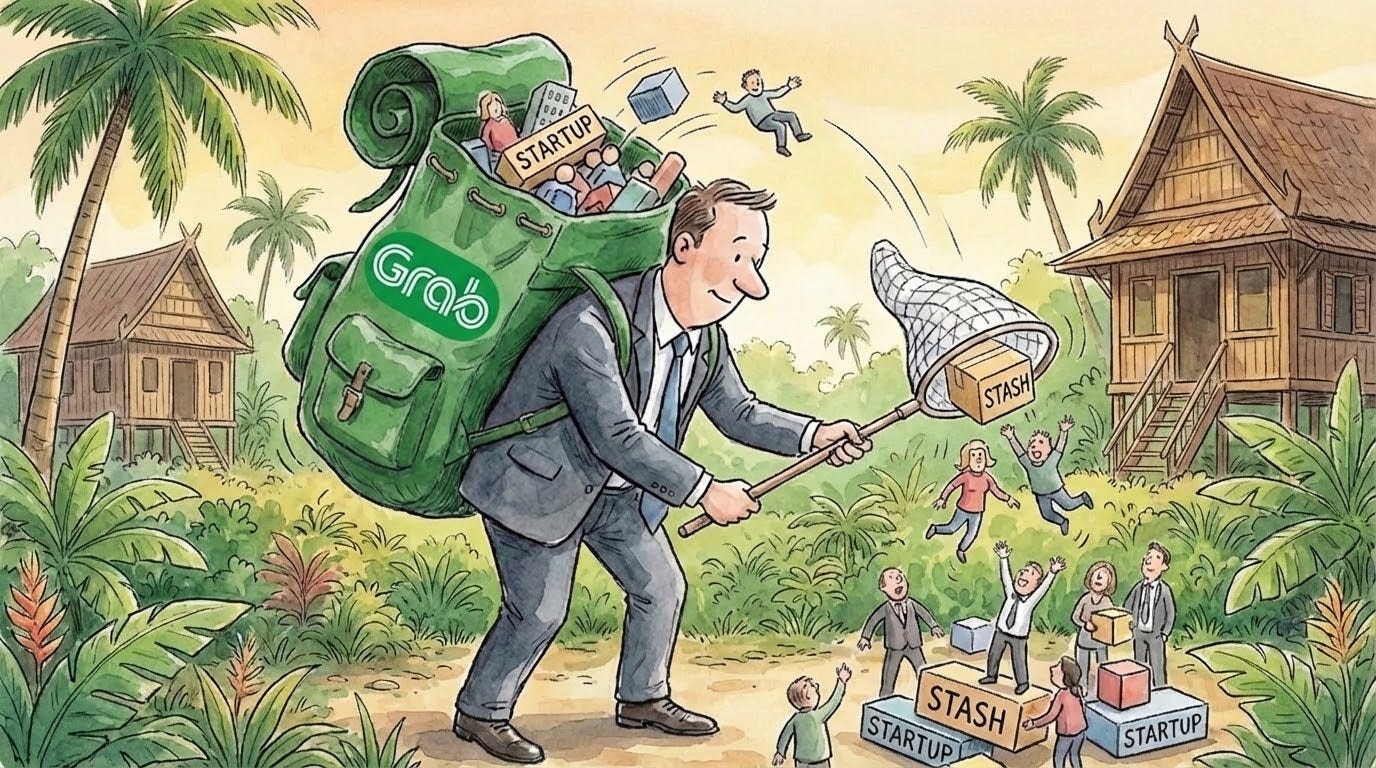
Alongside its financials, it announced a deal to buy a majority share of Stash, a US fintech with more than one million users and $5 billion in assets, at a valuation of $425 million.
That represents a big discount on the $1.4 billion valuation when it raised a $146 million Series H less than a year ago.
We wrote last year that Grab is spending its war chest to develop its automotive tech stack through investments into companies like public companies WeRide and Hesai, and acquisitions like US-based Vay. Now that’s extended to its financial services business and with a company with zero consumer presence in Southeast Asia.
Grab said it plans to bring Stash’s products to Southeast Asia, specifically its ‘AI Money Coach,’ and grow Stash’s US business. I like the idea of it fishing for technology outside Southeast Asia, particularly with bargain deals that can generate revenue standalone. Maybe that focus on value is why a deal for GoTo, which has been much rumoured in recent months, hasn’t crossed the line yet.
The fintech business was always the revenue weapon Grab needed to master to be more than just a transport business. This annual report makes that need even clearer.
Have a great week, and happy Lunar New Year to those who celebrate it,
Jon
Follow the Asia Tech Review LinkedIn page for updates on posts published here and interesting things that come our way. If you’re a news junkie, the ATR Telegram news feed has you covered with news as-it-happens or join the community chat here.
China tech goes full AI ahead of New Year
There’s no rivalry quite like China tech. With New Year looming, the country’s top firms are rushing to launch and promote their new AI products. Alibaba is perhaps the standout as it presented agentic commerce to shoppers en masse for the first time.
The e-commerce giant was forced to temporarily halt the coupon promotion on its Qwen AI chatbot, after it received 10 million orders within the first nine hours. The deal allowed users to get discounts to shop in Alibaba-owned retail platforms via the AI app. Despite the initial hitches, the company said over 120 million orders were processed in the first week.
Alibaba sits in a unique position to marry AI and commerce, but others made similar efforts. ByteDance gave away more than 100,000 products and held red packet lucky draws to bring users to its Doubao app. But the company got a lot more attention for Seedance 2.0, a new version of its AI video generator which has already been denounced by The Motion Picture Association for enabling “massive” content infringement. Disney sent a cease and desist letter, too.
ByteDance also shipped a new version of its Seedream image generator, but Seedance understandably hogged the limelight.

On the more regular front, if such a thing is possible, it is launch season:
DeepSeek boosted its flagship service ahead of its new release
Zhipu will launch GLM-5, an upgraded AI model built for complex coding
MiniMax launched M2.5, a productivity-focused model
Alibaba unveiled RynnBrain, an open-source AI model for robotics
DeepSeek’s newest product hasn’t shipped yet, but already there’s clamour for it. That’s been stoked by OpenAI telling US lawmakers that the Chinese firm is using sophisticated “distillation” techniques to extract outputs from American AI models.
There’s no response. It looks like DeepSeek is happy to be gossiped about. You’d imagine its product will do all the talking for it.
Related: Zhipu is preparing a secondary listing in Shanghai after raising $558 million in a Hong Kong IPO
PayPay, Japan’s top payment app, files for US IPO
Japan’s largest payment business claims 72 million users and now it is headed to Nasdaq in what will be a fascinating listing as the first of its kind from Japan.
Cash was always king in Japan, but 8-year-old PayPay has helped shift things digital by leaning on owners SoftBank and Yahoo for distribution, and riding the government goal to digitise 65% by 2030. India’s Paytm was a founding partner, but it sold its share for nearly $300 million in 2024.
Tapping into the massive userbases of Line Japan and Yahoo Japan has given PayPay the platform to lead digital payments in Japan. That’s reflected in the ownership as PayPay is essentially a SoftBank entity with some ownership from Naver, the parent behind popular messaging app Line.
This listing will give those two a chance to cash in on the success of monetising digital payments from their consumer-facing businesses. But, as is the case with strong payments companies like PhonePe in India, going beyond just transactions is tough.
PayPay is coming off the back of its first annual profit of $261 million profit for the year ended March 31, up from a $5.5 million loss the previous year. It needs users to commit to using its card, banking and investment services, and reduce its dependency on its parents.
China
The US withdrew an updated list of Chinese firms allegedly aiding Beijing’s military shortly after it was posted with the addition of Alibaba, Baidu, BYD and other top Chinese tech firms link
Ant Group is aiming to make its digital healthcare arm as successful as Alipay’s digital payments by reaching most of China’s population through a 3 year strategy focused on AI Doctor Agents and an AI-based health app link
Huawei will launch its Mate 80 Pro smartphone with a self-designed AI chip link
China appears to be using a covert cyber training platform to rehearse attacks on neighbouring countries’ critical infrastructure link
A Chinese scammer responsible for laundering $73M was sentenced to 20 years in absentia after fleeing the US link
Pony.ai began mass production of a Toyota-developed robotaxi, targeting 1,000 units this year link
Investment firm Eight Roads reportedly shelved plans to sell stakes in dozens of Chinese tech companies as geopolitics ease link
A Dutch court ordered a mismanagement probe at Nexperia, a setback for Chinese parent Wingtech by allowing the European management team that took charge after a Dutch state intervention last year to remain in place—Wingtech plans to use “all legal means” to regain control link
A global memory supply shock is squeezing China’s smartphone and broadband manufacturers link
Palo Alto Networks softened a report linking a cyberespionage campaign to China after Beijing banned its software, according to a report link
ByteDance is in advanced talks to sell mobile game studio Moonton to Saudi Arabia’s Savvy Games Group for $6–7B link
Meituan warned it will post its biggest annual loss since 2021, forecasting a $3.4B deficit on account of fierce competition in the food delivery space link
SMIC reported a 60.7% jump in Q4 profit to $172.85M, that beat estimates but it warned that heavy spending on AI chips could leave some data centres idle link
NetEase missed estimates as it reported a 29% drop in Q4 profit to $902.9M link
WeRide plans to at least double its fleet this year as it aims to turn profitable by 2030 link
Beijing tightened its crackdown on real-world asset tokenization, extending restrictions to offshore yuan-pegged stablecoins link
India
OpenAI CEO Sam Altman says ChatGPT has 100M active users in India, he comments came as India’s AI Week prepares to start, we’ll have more details in next week’s issue link
India overhauled its startup rules to back deep tech companies, extending benefits to 20 years and raising revenue thresholds for startup-specific tax, grant, and regulatory benefits to around $33M from $11M link
The country also approved a $1.1B state-backed fund of funds to channel capital into startups via private investors, sharpening its focus on AI, advanced manufacturing and other deep-tech sectors link
Delivery startup Swish is reportedly in talks to raise $30–35M from Bain Capital Ventures and Accel link
Flipkart is said to be weighing entry into online food delivery with a Bengaluru pilot planned for May–June link
Sarvam AI reported strong performance on benchmarks for document understanding and Indian languages link
India ordered social media platforms to step up action against deepfakes, slashing takedown timelines link
A look inside India’s only “dark factory” in Tamil Nadu, which runs autonomously through the day and night with robots assembling semiconductor chips without any human supervision link
A UC Berkeley study of 596 Indian tech startups found homegrown founders now outperform diaspora returnees link
Insurance aggregator InsuranceDekho is reportedly weighing a Mumbai IPO that could raise up to $250M link
Used-car platform Spinny raised $160–170M led by Fidelity and Accel link
Malaysia and India signed an agreement to enable cross-border QR payments link
Space startup AgniKul Cosmos and NeevCloud plan to launch an AI data centre in low-earth orbit, with a proof-of-concept mission due this year and commercial rollout in 2027 link
Southeast Asia
Abu Dhabi-based AI firm G42 is leading a $1B project to build data centres in Vietnam link
Singapore said a China-linked cyber espionage group breached all four of the country’s major telecom operators—officials said attackers gained unauthorized access to parts of telecom networks and, in one case, reached limited portions of critical systems, but there were no service disruptions and no evidence customer data was accessed link
Chinese companies outspent US firms on investment in Singapore last year in a surge often described as “Singapore-washing” link
Singapore’s GIC led a $30B Series G funding round in Anthropic link
Google announced new investments to deepen R&D capabilities and build a workforce for the AI economy in Singapore link
Singapore/Thailand-based electric motorcycle maker Sleek EV raised $8.5M led by the venture fund of Taiwan-based motorcycle maker Kymco link
Singapore-based Topview, which develops a collaborative AI content workspace, closed a $14M Series A round link
Singapore’s Polybee raised $4.3M in seed funding to scale its drone-based pollination technology link
GoTo partnered with MRT Jakarta to launch a transit-digital platform integration link
Criminal networks in Southeast Asia are reportedly using cheap AI tools to scale up scams despite government crackdowns link
Zenyum, a Singapore-based dental startup, merged with Indian rival MakeO Toothsi to create a joint business with 1,100 partner doctors link
South Korea
Travel startup Myrealtrip is targeting a valuation above $1B for a Seoul IPO as early as late 2027 link
Coupang failed to preserve evidence during a South Korean data breach probe, fuelling trade tensions with Washington link
The financial watchdog launched an investigation into Bithumb after it mistakenly sent $43B in bitcoin to users link
Meanwhile, Seoul Gangnam Police lost track of 22 BTC ($1.5M) seized in an investigation link
South Korea will tighten crypto oversight targeting market manipulation link
ByteDance is in talks with Samsung to manufacture an in-house AI chip targeting 100,000 units this year link
OpenAI, Samsung SDS and SK Telecom will begin construction of two South Korean data centres in March link
A profile of SK Hynix, which has become a cornerstone of the AI boom, supplying high-bandwidth memory chips that power Nvidia’s accelerators link
Samsung began the first commercial shipments of HBM4, taking an early lead in advanced AI memory link
Taiwan
The Trump administration plans to exempt US hyperscalers from upcoming chip tariffs, tying carve-outs to TSMC investments link
A series of agreements between Taiwan and the Trump administration point to a sweeping expansion of TSMC’s US footprint, placing the chipmaker at the center of a potential $250 billion reshaping of the semiconductor supply chain. link
Taiwan pushed back against US calls to shift 40% of chip capacity to the US, calling it impossible link
Japan
SoftBank’s Vision Fund reported a $2.4B ‘gain’ in the December quarter, driven by its OpenAI stake link
A looming shortage of T-glass, essential to AI chips and made largely by a single Japanese supplier, is emerging as a bottleneck for Apple and Nvidia link
Andreessen Horowitz invested in Shizuku AI, a San Francisco startup operating in Japan developing AI-driven virtual characters link