



Grab made its most ambitious M&A deal yet after it announced plans to buy Foodpanda Taiwan from Delivery Hero for $600 million.
This is Grab’s most significant outlay to date and it marks its first move outside of Southeast Asia, where it currently serves eight countries. When Grab got itself profitable last August, we suggested it could use its $6 billion warchest for acquisitions, but we didn’t foresee this level of spending.
The Foodpanda agreement, coupled with a February announcement to buy US fintech Stash for $425 million, means Grab has committed $1 billion in deals in the last two months alone. That’s on top of a major investment spree on autonomous driving tech in Q4 2025.
Now the finances are in order, with a first full year of profit recorded, Grab is clearly looking to expand its core business but with one key criteria: value.
In both cases, it has got deals at a sizable discount.
The Stash sale price was well below the startup’s $1.4 billion valuation one year ago, and likewise Grab is paying less than the $950 million that Uber had agreed when it landed a deal to buy Foodpanda Taiwan. That deal was struck down by regulators exactly a year ago over concerns that Uber, which is still active in Taiwan, would become a monopoly. Grab isn’t likely to have that concern to deal with. (There’s no word on whether it will expand from food to transportation, but it will resume its battle with Uber on food, at least.)
Delivery Hero’s CEO said the Grab deal was the culmination of nine months of negotiations. We’ve long known that Delivery Hero wants out of Asia to focus on other markets, and its Foodpanda Taiwan business is the jewel in its regional crown. We can expect Foodpanda to continue to narrow its Asia presence but closures or, ideally, asset sales.
Grab has got a decent deal in the end. If there was ever any secret that iat is in acquisitive mode, that’s certainly out.
It’s pretty clear it will continue to scour for value-focused deals while it can, and maybe we see it dip its toes into pure AI or more automotive tech. Then there’s that GoTo/Gojek deal…
Have a great week.
And be sure to check us out on LinkedIn, Telegram or WhatsApp for news as it breaks,
Jon
India’s Sarvam goes after enterprise AI with new $200M funding incoming
It’s been a busy week for Sarvam, India’s home-grown AI company, after it announced plans to develop services for enterprises and potentially government sectors. All the while, it is reportedly raising a huge round that would give it unicorn status.
Chanakya is Sarvam’s upcoming service that’s built with on-premise deployments and air-gapped environments in mind to provide security for customers that need additional safeguards when it comes to using AI.
That could include large companies with safety demands, governments and the military. In this case, using cloud-based AI services poses a risk that IP, processes and other internal data could leak out. Using dedicated ‘enterprise’ AI services doesn’t mitigate that risk so the process is handled on-premise.
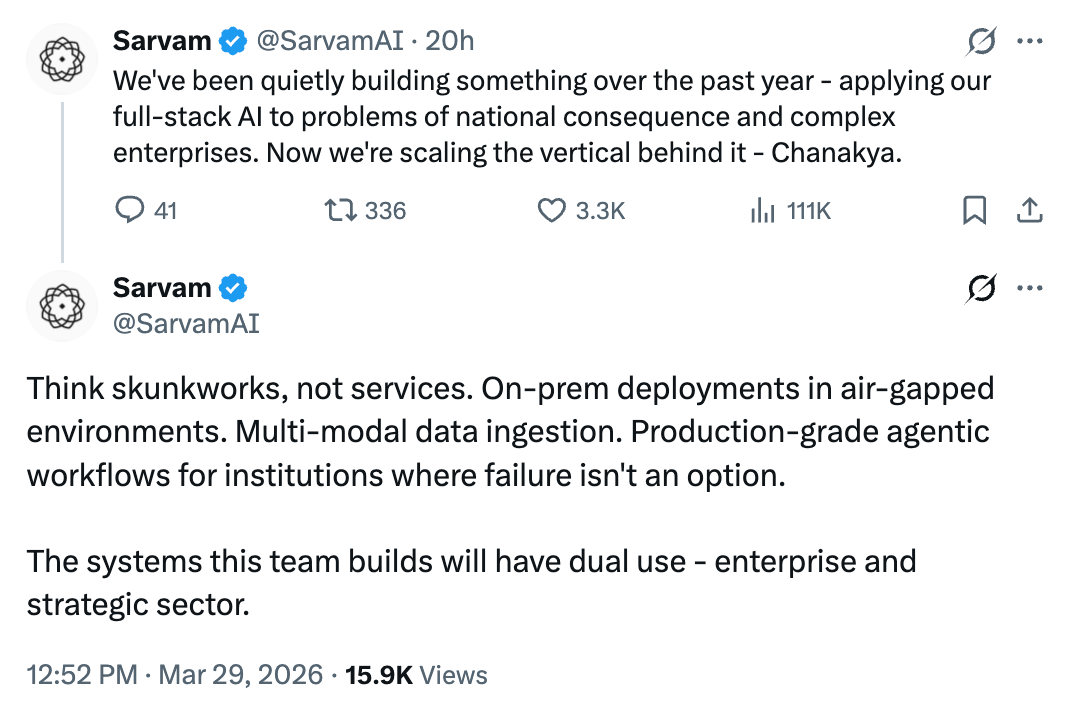
With Chanakya, Sarvam plans to offer that high-level service whilst keeping customer data on Indian soil. AWS, Google Cloud and Microsoft Azure offer similar services worldwide, but they must comply with US laws including the Cloud Act, which can force them to hand over customer data from any location in the world.
Developing government, military or simply enterprise-grade AI is no easy task, but it is one that could unlock significant opportunities for Sarvam. We’ve said before that “nationalism alone” wouldn’t work for India-made products like WhatsApp rival Arattai, but Sarvam could be a different case.
An injection of funds to fuel this move looks to be incoming. Sarvam is reportedly in talks to raise $200-$250 million from the likes of Nvidia, Accel and HCL Tech in a deal that would value the business at $1.5 billion.
Sarvam launched its inaugural consumer chat AI product in February, and now it partnered with Razorpay to introduce voice-led commerce. That hasn’t taken off in the US, but India has the potential to be a very different market.
China bars Manus co-founders from leaving as Meta deal review continues
China didn’t look like it could do much when Manus, a startup that relocated to Singapore, was acquired by Meta for $2.5 billion in January. But Beijing is not to be underestimated: it emerged last week that Manus co-founders Xiao Hong and Ji Yichao have been barred from leaving China whilst the deal is reviewed.
It isn’t clear why the duo were on Chinese soil, it appears ill-advised given the furore around the transaction. But Beijing now has unlikely leverage.
Meta has already started integrating its products with Manus’ tech and agents, so any unwind would be quite unprecedented. Even if it does nothing, a message appears to have been received.
“The path taken by Manus: people will not go down that route anymore,” Wayne Shiong, head of US-based AI fund Argo Venture Partners told CNBC.
That makes sense. Companies in China will need to be more deliberate about their future pathway. Or take steps like carving out their intentional business, such as data centre operator DayOne. But that approach is trickier for companies like Manus which operate and sell globally from inception. That’s bad news for US funds like Benchmark that had worked this angle.
Meanwhile: A top AI conference quickly reversed a policy banning submissions from researchers at US-sanctioned entities after a boycott threat from China’s largest tech body. NeurIPS had introduced the rule citing US law, but said it was issued in error and apologised following uproar after Huawei and others were barred.
China
We wrote that Alibaba is getting serious about monetising AI and last week it launched an AI platform to automate tasks for small e-commerce businesses, including market analysis, design, sourcing and inventory monitoring link
Alibaba also unveiled its XuanTie C950, a 5nm CPU designed to run AI agents that can handle multi-step tasks autonomously link
Huawei’s new 950PR AI chip is gaining traction in China, with ByteDance and Alibaba preparing orders after strong early tests showed better performance and improved compatibility with Nvidia’s CUDA link
DJI sued rival Insta360 for alleged patent infringement ahead of its new drone launch link
The US FCC has banned imports of new foreign-made consumer routers, tightening its crackdown on Chinese electronics over security concerns, though existing devices remain unaffected link
Kuaishou said its AI video-generation model Kling generated $150M in revenue in last year link
Chinese open-source AI models like Qwen and DeepSeek dominated Hugging Face downloads, though Nvidia still controls the underlying infrastructure, according to a new report link
Pony AI and Uber are expanding their robotaxis partnership into European roads with Zagreb, Croatia, the first stop link
Memory chip maker CXM, which is planning a major domestic IPO, more than doubled revenue to $8B in 2025, boosted by a global shortage link
AI chip firm MetaX more than doubled 2025 revenue to $231.5M as the country’s AI boom drives demand for domestic chips, with narrowing losses and a new flagship C600 chip in the pipeline link
Robotera raised about $143M USD in a new funding round at a valuation of over $1.5B USD as it scales humanoid and logistics robot deployment link
SMIC, China’s largest chipmaker, sent chipmaking tools to Iran’s military, US officials claim link
ByteDance is rolling out Dreamina Seedance 2.0, its new audio-video model, on CapCut that lets creators generate and sync content from prompts, images and reference videos link
AI glasses are reportedly catching on in China, powering everything from hands-free shopping to high-tech cheating: early users can rent a pair for about $6 a day to navigate streets, translate conversations and even sit exams link
China is closing the gap in advanced chips, unveiling a high-performance processor based on the open-source RISC-V architecture that it says matches global standards link
Notable earnings:
Xiaomi sales grew at its slowest in years in sign of poor phone demand link
PDD, the owner of Temu, has quickened its growth after its US business steadied with Q4 revenue up 12% YoY to around $18B but net profit down 11% YoY to ~$3.56B link
Meituan said it expects losses to narrow after China curbed the competitive delivery fight link
AI firm SenseTime said it turned EBITDA positive during the second half of last year, the first time since its listing in 2021 link
Pony AI delivered its first ever profitable quarter—net income reached $75.5M helping the full-year loss narrow by 72% to $76.8M link
The UK sanctioned Xinbi, a Chinese language crypto marketplace accused of enabling large scale scams and human exploitation link
Austrian authorities have yet to approve JD.com’s bid for Ceconomy, putting the €2.2B deal for Europe’s largest electronics retailer at risk link
India
Reliance Jio Platforms reportedly held talks with 13 marquee foreign investors to sell down 8% of individual stakes in an upcoming Mumbai listing link
Rentomojo, the online furniture rental platform backed by Accel, filed for IPO link
Food delivery startup Swish raised a $38M Series B round valuing the 18-month-old company at $139M and taking total funding to $54M as its 10-minute delivery model gains traction link
AWS is expanding its data centre footprint in India, lining up capacity across Mumbai and Hyderabad link
Apple Pay is facing pricing hurdles ahead of its India launch, as near-zero UPI fees and low card charges undercut its global 15–20 basis point model link
The co-founders of crypto exchange CoinDCX were bailed after being arrested in an impersonation fraud case link
Ultrahuman, the Bengaluru-based smart ring maker, is moving to revive its US business and up its rivalry with Oura after it won approval for its Ring Pro—a previous trade ruling had curbed its imports and cost up to $50M in lost sales link
Accel and Prosus picked six startups from more than 2,000 applicants for their first joint India cohort, backing “off-the-map” ideas in areas like healthcare, climate, space and longevity link
Amazon MX Player launched a microdrama service as vertical video content continues to gain momentum in India link
OpenAI hired JioStar CEO Kiran Mani as its managing director for the Asia Pacific region link
Indian billionaire Gautam Adani is in talks with US giants including Meta, Google and Walmart to partner his fast-expanding data centre business link
Deccan AI, which develops high-accuracy AI systems for enterprises and frontier model labs, raised $25M link
Scimplify, which provides specialty chemical and advanced material manufacturing infrastructure for large companies, is in discussions to raise $30-40M from a consortium of Japanese investors led by Hitachi Ventures link
Fitness startup Cultfit raised $47M from Temasek, its first major funding in two years link
Health insurance platform Plum raised $20M led by Peak XV Partners link
Fusion energy startup Pranos Fusion raised $6.8M in a round co-led by pi Ventures and Ankur Capital link
The Indian government has held multiple consultations as it plans to curb children’s social media use link
Revolut plans to base about 40% of its global workforce in India by end-2026, scaling its global capability centre to 5,500 staff link
Google’s top India counsel reportedly resigned after 16 months in the role link
Southeast Asia
A senior US official accused China’s government on Wednesday of implicitly backing Chinese criminal syndicates running cyber scam compounds across Southeast Asia and of exploiting a crisis that has resulted in billions being stolen from Americans each year link
Thai startup Amity, which claims to buy, build and develop AI services, raised a $100M Series D led by Singapore’s EDBI—founded by Korawad Chearavanont, a 31-year-old from the family behind Thai corporate Charoen Pokphand (CP) Group, Amity said it is planning to go public in 2027 and it claims most of its revenue comes from Europe link
Indonesia’s finance minister hinted that the government may take action in response to the prevalence of low-cost imported goods from China on local e-commerce platforms link
Singapore-based payment infrastructure firm Tazapay raised a $36M Series B extension led by Circle Ventures with new investors including Coinbase Ventures and CMT Digital link
Thailand introduced new guidelines for e-commerce platforms that set out standards on pricing and business conduct to curb unfair trade practices and preventing market dominance link
Indonesia began enforcing a sweeping new rule banning children under 16 from accessing major digital platforms link
Japan
Sony is close to selling a majority stake in its home entertainment business to China’s TCL in a deal valued at $1B link
News app operator SmartNews is reportedly considering an IPO in Tokyo as soon as October at a valuation below the $2B of its last major funding round in 2021 link
Sakana AI launched its first consumer chatbot, Sakana Chat, which is tailored to Japanese language and culture—previously its focus was on enterprise services link
SoftBank secured a $40B bridge loan to fund investments in OpenAI and broader corporate needs, deepening its push into generative AI link
Singapore’s Startale Group raised a $63M Series A round from SBI Group and Sony Innovation Fund to expand its blockchain services to Japan link
Sierra, a San Francisco–based startup building AI-powered customer experience agents, acquired Tokyo-based enterprise AI startup Opera Tech link
South Korea
AI startup Upstage is in talks with AMD to purchase 10,000 of its latest AI accelerators and scale domestic compute capacity link
South Korea’s SK Hynix will spend $7.9B on ASML’s EUV chipmaking tools through 2027 link
At the same time, SK Hynix plans to raise $10B through a US listing that will fund AI infrastructure including a semiconductor cluster in Yongin and expanded memory capacity link
South Korea will invest $166M in AI chip startup Rebellions as it pushes local semiconductor opportunities link
Hong Kong
MiniMax has become one of Hong Kong’s top stocks thanks to its positioning as your workplace ‘bestie’ link
No doubt inspired by MiniMax and Zhipu, Chinese AI tiger Moonshot is in the early stages of considering a Hong Kong IPO to boost its services which include popular LLM Kimi link
Meanwhile DeepRoute.ai is said to be the next autonomous driving company from China to eye a Hong Kong IPO, following listings from WeRide and Pony AI last year link
Rest of Asia
Taiwan will keep its electricity rates unchanged for now to mitigate inflationary pressures from the war in the Middle East link
Three men including a US soldier were jailed for letting North Korean IT workers use their identities to get jobs at US companies link
Binance, the world’s largest crypto exchange, is under fire after investigators found accounts moving $1.7B to entities linked to Iran link