


Welcome back to Asia Tech Review, your curated digest to keep up to date with tech news across Asia.
Southeast Asia’s governments and citizens have reacted cautiously to the growth in data centres in this region with concerns around access to power, water and environmental factors. But Malaysia continues to charge ahead and attract big bucks from major names as we explore today.
To keep up with our issues, follow us on LinkedIn or WhatsApp. Please do share Asia Tech Review with people you know who want to get smart about Asia tech.
For news as it happens, follow ATR Bulletin, our real-time news site that keeps you in the know.
Malaysia extends its data centre lead
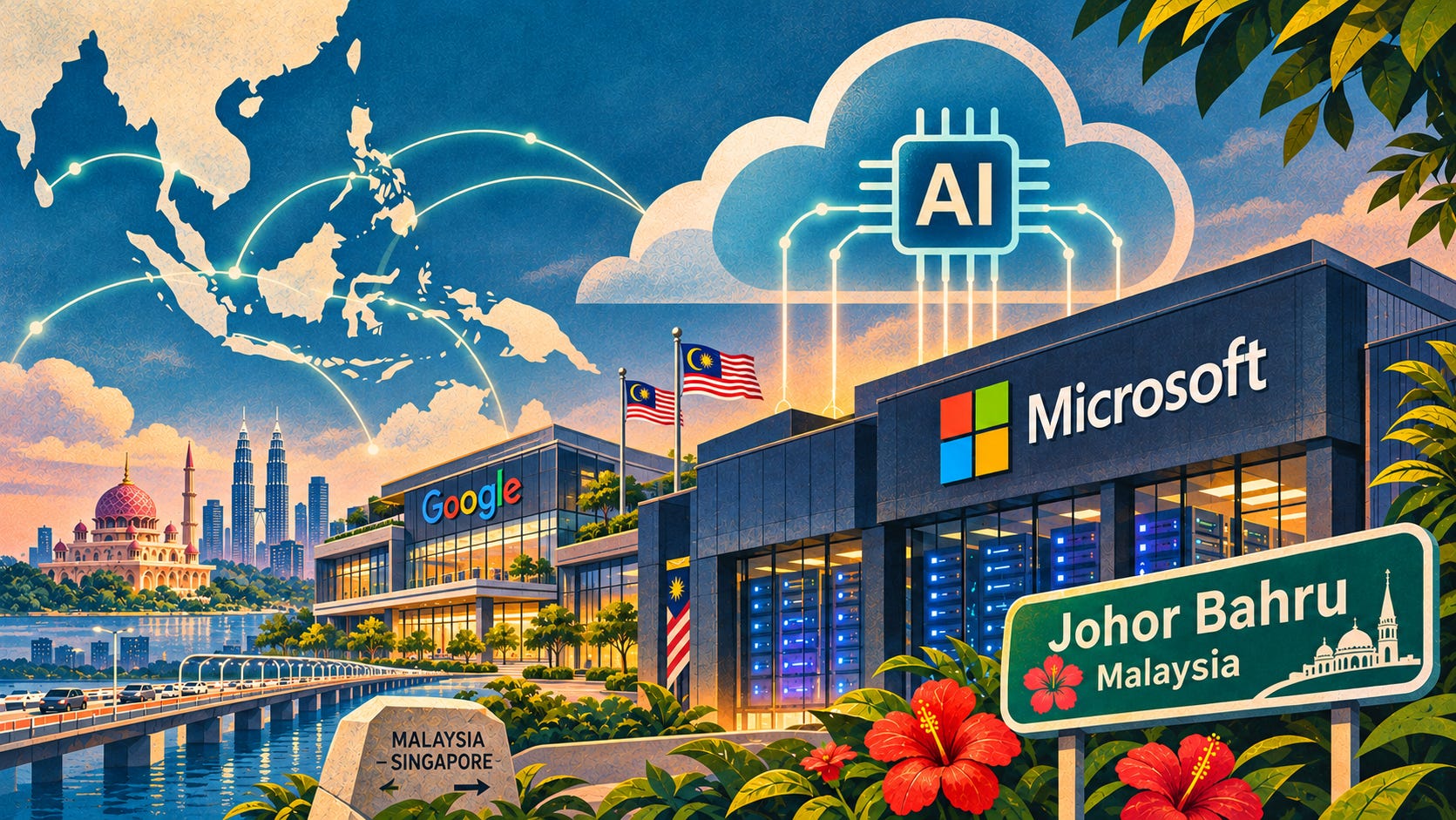
There’s been a lot of heat on data centres in Southeast Asia with protests and regulatory tightening but two US tech giants are upping their commitment to the region, specifically in Malaysia.
Google said it plans to invest $15 billion into the country across the next two years to expand its data centre and cloud infrastructure capabilities, while at the same time Microsoft has committed $2.2 billion over four years to develop a cloud service in Malaysia’s Johor Bahru.
Plans for its first data centre in Malaysia were announced by Google two years ago, and now it is following up with additional expansion in Selangor and a new facility in Negeri Sembilan.
The company said its fresh commitment will upskill as many as 800,000 Malaysians by 2031, further secure local water supplies and add more than 1 gigawatt (GW) of clean energy capacity to Malaysia’s National Grid. It made the announcement alongside Prime Minister Anwar Ibrahim.
Microsoft, meanwhile, just activated its second cloud region in Malaysia and it is planning a third as part of its $2.2 billion four-year investment plan for the country. That’ll give its service more reliability and security for serving Malaysian businesses and others across the region.
Malaysia has stepped into the increasingly uncertain void around data centres in Southeast Asia. That began when Singapore paused new projects from 2019-2022 due to concerns around resources, and it has continued thanks to the advantages Johor, such as proximity to Singapore, availability of land and lower costs.
Political favour is also becoming a factor. There have been protests near developments from local residents concerned at the social and environmental impact, though nothing on the scale of neighbours like Indonesia. Still, Anwar has claimed that Malaysia has restricted some proposed new data centre builds, specifically those not aligned to AI.
Google and Microsoft both fit his criteria and, beyond playing up the social benefits of their investment around training and jobs, Microsoft’s pledges have included water access and bringing clean energy to the national grid. That’s no surprise given how controversial new projects have become across the region.
Thailand is limiting new facilities and Indonesia’s position is uncertain, which leaves opportunities for others. Vietnam is making progress but Malaysia remains the clear winner, for now at least.
In related news:
Singapore’s Digital Group secured $1.3 billion in green financing from six banks to expand its JH1 data centre campus in Malaysia [The Edge Malaysia]
Haoyang Data Center 1 (Thailand) has secured a loan of up to $590 million from a leading Thai bank to finance the development of a hyperscale data centre facility in Thailand. The seven-year, five-month loan was disclosed in a Hong Kong Stock Exchange filing. [Bloomberg]
Microdrama startup EloElo lands $80 million
We wrote about India’s Pocket FM in September after the Indian startup went public with how it used AI to supercharge content on its audio story platform. That’s seen it move into the microdrama segment, having initially been a podcast and audio storytelling service. Now, a microdrama platform itself has landed a boatload of cash after EloElo closed an $80 million Series C.
Hornbill Capital with traditional media giant NBCUniversal led the round which values the business at the $500 million mark.
Pocket FM claims strong growth outside of India as well as domestically, but EloElo is laser focused on its home market where its Story TV app claims more than 33 million active users each month with a catalogue of over 5,000 titles.
The company makes money through a freemium pricing model and advertising, but analysts estimate the audience that has ever paid for content is just 40 million, with as few as 15 million paying regularly each month. EloElo is creating more content using AI tools, but for now it has not released it widely unlike Pocket FM.
Deals
Vietnamese tech company VNG, backed by Singapore’s GIC, is exploring a US listing that could raise $300 million at a valuation of up to $3 billion [Bloomberg]
China has reportedly told SoftBank it will block the planned $5.4 billion acquisition of ABB’s robotics division, a setback for its physical AI ambitions. China is the division’s largest market, with about 12,700 employees and more than 90% of the robots it sells locally manufactured there [FT]
China’s robotics sector raised 11 billion yuan ($1.6 billion) in October, down 67% from its June peak of 32.8 billion yuan, as investment in humanoid developers and robotics AI companies cools. The total was less than half the 24 billion yuan raised in August, according to ITjuzi. [Bloomberg]
Premji Invest is in talks to back Bengaluru-based Sanlayan Technologies in a $30 million to $40 million round at a valuation of about $200 million. Separately, it is in advanced talks to lead a $30 million to $40 million round for aerospace components maker Hical Technologies, with Singularity AMC joining the Sanlayan round and TVS Capital joining Hical [Economic Times]
Markets
Singapore will streamline IPO approvals from 4 January 2027, with SGX RegCo taking over prospectus reviews from the Monetary Authority of Singapore and issuers using a single portal for prospectuses and listing applications [TechNode]
Chinese chip-testing equipment maker Semight Instruments has appointed Citic Securities, Goldman Sachs and JPMorgan to prepare for a Hong Kong listing that could raise more than $1 billion next year [Bloomberg]
Chinese memory chipmaker YMTC has suspended preparations for its planned 33 billion yuan ($4.9 billion) Shanghai IPO, citing unspecified factors in an internal memo. The delay could reportedly last several months as regulators tighten scrutiny of share offerings [Reuters]
SoftBank-backed Nigerian payments company OPay halted its $300 million US IPO hours after pricing following an inquiry by a Chinese regulator. OPay has no operations or revenue in China, although founder Zhou Yahui has business ties there [Bloomberg]
Baidu’s AI chip unit Kunlunxin may push its planned $2 billion Hong Kong IPO to 2027 as it waits for approval from China’s securities regulator. The company filed confidentially in January and had expected approval this summer [Bloomberg]
AI and Chips
About 600,000 Nvidia H200 AI chips are being held in Hong Kong while they await approval for shipment to mainland China. Beijing has allowed some imports, but has yet to approve large-scale shipments [Reuters]
SK Hynix is still waiting for US approval to import chipmaking equipment for its Dalian plant, a snag that complicates plans for two NAND factories in New York. Its Solidigm unit plans to invest $45 billion in the Marcy plants, with spending potentially reaching $100 billion [Reuters]
Chinese AI and cloud companies including Alibaba, Tencent and ByteDance have ordered about 6 million Nvidia RTX Pro 5500 chips but expect to receive only tens of thousands, roughly 1%, in the next four months as Nvidia struggles to ramp up production [Bloomberg]
Oracle has scrapped a five-year, $7 billion agreement to lease up to 100,000 AI chips to Tencent across Southeast Asian data centres after pressure from the Trump administration. The deal would have given Tencent access to advanced chips restricted from use in China [FT]
Baidu developed Apollo World, an AI simulator that creates virtual driving scenarios to train its robotaxis for rare and dangerous road hazards that are difficult to reproduce safely [SCMP]
Tencent released Hy4, an open-weight AI model with image analysis and visual reasoning features aimed at enterprises and AI agents. Tencent says it remains behind leading closed-source models in advanced maths, coding and visual reasoning [SCMP]
India’s CERT-In gained access to Anthropic’s Mythos 5 AI model to strengthen cyber defences but is cautious about testing it on government systems because cloud-based access raises data leak risks. [Economic Times]
Micron has largely paused construction of a memory chip plant in Taoyuan, Taiwan, amid a prolonged labour dispute and concerns that uncertainty over an agreement with a local union could derail the project [Bloomberg]
Crypto
Binance says North Korean hackers compromised multiple employee devices in a months-long campaign that led to the theft of $6.3 billion. CEO Richard Teng claims the attack was not the result of a single mistake or breach [The Record]
Policy
A South Korean consumer group plans to complain that Tesla misled tens of thousands of customers by marketing driver-assistance software that cannot legally be used in most of its vehicles in the country [Reuters]
Two Thai opposition leaders received Apple alerts warning of attempted spyware attacks on their phones ahead of a December no-confidence debate and are demanding the government disclose whether state agencies were involved [Bloomberg]
India’s IT ministry has proposed government-led checks before deployment of AI models trained under its draft framework, covering fitness for use, fairness, bias mitigation and data security [Moneycontrol]
A Vietnamese court sentenced 11 people linked to pirate football streaming site Bún Chả TV to between eight and 12 months in prison, the first jail terms in the country’s latest piracy crackdown. Three commentators received suspended sentences [TorrentFreak]
China’s export controls on critical metals have disrupted supplies of tungsten carbide micro drill bits used to make printed circuit boards and chip substrates, sending prices up severalfold and hitting refiners in Japan, Taiwan, the US and Europe [Nikkei Asia]
India’s IT ministry is considering social media rule changes that could remove platforms’ legal immunity for user-generated content, potentially exposing services that curate and recommend posts to greater liability [The Indian Express]
India’s CERT-In has identified a hacking group it calls Crafty Falcon as responsible for AI-driven attacks on non-bank lenders, fintech companies and crypto exchanges. The agency named tools used in the campaign, at least two of which are linked to China [Reuters]
Three Republican House committee leaders have asked Nvidia CEO Jensen Huang to brief them on his interactions with Megaspeed executive Alice Huang, who has reportedly been identified as a Chinese intelligence asset. The lawmakers also want details of Nvidia’s safeguards against foreign espionage, citing concerns over China’s access to sensitive US technology and information. [CNBC]
In other news:
Grab Vietnam will spend VND2.95 trillion ($112 million) on lower fees, driver refunds, bonuses and promotions from 10 November, after drivers complained about falling incomes and called for a two-day boycott in September [TechNode]
Google, cybersecurity companies and Japanese police have taken down X.CPE, a botnet that infected more than 1.3 million set-top boxes in over 200 countries. Google linked it to Chinese device maker Videostrong Technology, with telehealth equipment, karaoke machines and digital signage also affected [The Record]
India’s National Payments Corporation has set up a wholly owned subsidiary, NPCI Tech Solutions, focused on AI, blockchain and digital financial infrastructure [Reuters]
Japan Airlines, Cathay Pacific, Korean Air, Asiana Airlines, Singapore Airlines and Malaysia Airlines have reported data breaches linked to a cyberattack on Spanish travel technology provider Amadeus [The Record]
Huawei has unveiled its Qinyun HM650 desktop series for enterprise and government users, powered by its proprietary HarmonyOS and Kirin X90 processor. The company says the computers use entirely Chinese-made components and are the first desktops certified as 100% domestically produced, though the scope of the certification is unclear. [SCMP]