


Welcome back to Asia Tech Review, your curated digest to keep up to date with tech news across Asia.
We are in earnings season, and that means more good news for Sea as the Singapore-based firm registered record numbers for Shopee (again) and promising growth for its fintech arm. Elsewhere, Manus confirmed it will unwind its $2 billion sale to Meta, and there’s lots of other news.
To keep up with our issues, follow us on LinkedIn or WhatsApp. Please do share Asia Tech Review with people you know who want to get smart about Asia tech.
Another big quarter of growth for Shopee and Sea Monee

Sea is Southeast Asia’s only true internet giant based on the company’s newest earnings.
We wrote about the company’s impressive growth in May when it published Q1 results and Q2 is equally as impressive. It brought even stronger growth across the board with the exception of adjusted EBITDA.
GAAP revenue: $7.8 billion, up 48.1% year-on-year.
Gross profit: $3.5 billion, up 47.3%
Net income: $458.1 million, up 10.6%
Adjusted EBITDA: $917.2 million, up 10.6%
Its Shopee e-commerce business hit record highs for GMV, order volume and revenue. Cost of revenue, i.e. what Sea spends to make money and fund growth, increased 48.7% year-on-year but that’s down from 51.7% in the previous quarter. Costs for Shopee went up by 51.9% year-on-year due to the increased cost of logistics, Sea said. It said it is also investing in expanding its logistics capabilities.
The company’s fintech arm (Monee) looks like being the next major growth lever. It pulled in nearly double the revenue of Sea’s Garena games business ($1.4 billion vs $747 million) but with 58.9% annual growth, compared to 48.9% and 33.5% for Shopee and Garena, respectively.
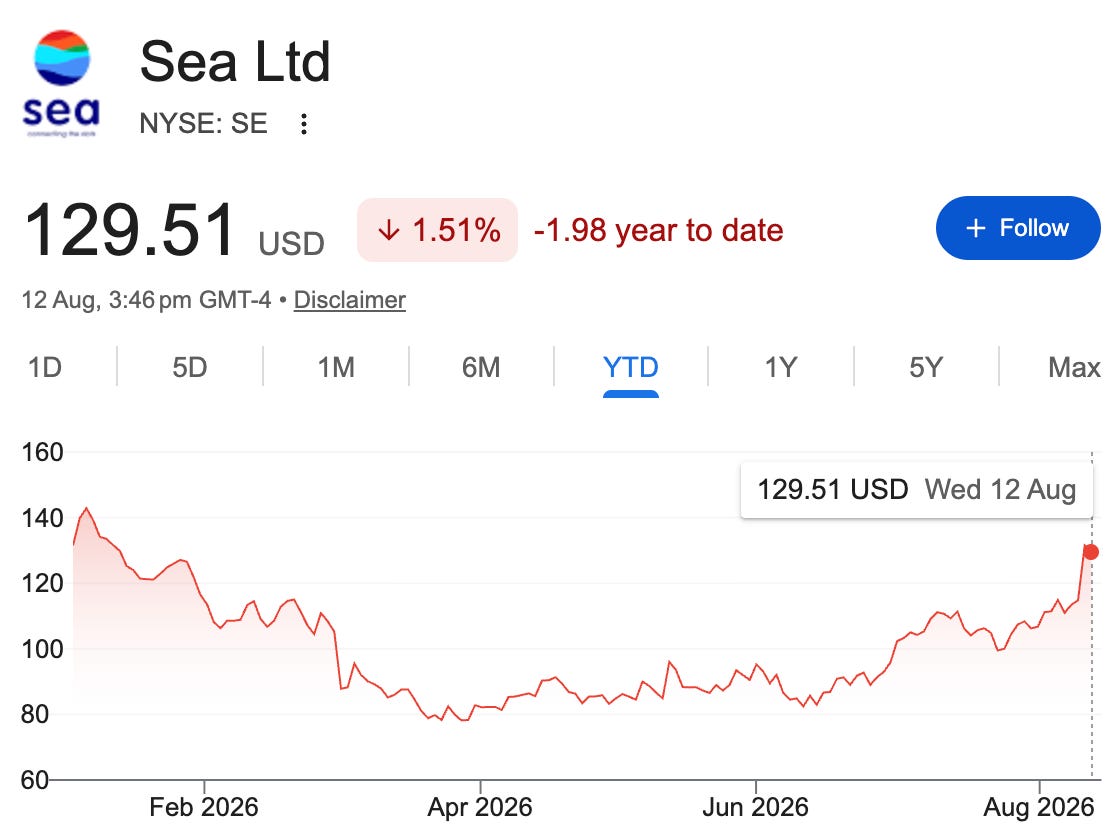
It’s been a good month for Sea, but the stock is still down this year to date
Shopee continues to account for over 60% of all revenue, and it is clearly the big focus, but Monee has the scope to grow strongly.
“Only a fraction of the users across our ecosystem are using Monee’s financial products today, and credit penetration remains low across our markets,” Sea chairman and CEO Forrest Li said in a statement.
This fintech play is similar to that being pursued by Grab and Gojek. But their financial results, released earlier this month, don’t have anything like the same traction. Grab tried payments when it first went public in 2021, but it has since turned to M&A to build out a savings and financial services playbook. Sea’s focus on lending sits better since Shopee is Southeast Asia’s largest online sales platform.
Sea has used Garena cash flow to fund Shopee’s continued growth and Monee can do the same. That’s deliciously ironic since Monee will grow off the back of Shopee’s growth.
Manus confirms it will soon be independent of Meta as $2B unwinds
It’s official, Manus is going independent.
It wasn’t a well-kept secret, but the Chinese company confirmed it “will soon return to operating as an independent company” via a notice informing users that data created following its Meta acquisition will be deleted.
Meta bought the Manus business at the tail end of last year for just over $2 billion but, as is now famous, it was forced to unwind the deal after the Chinese government ruled it illegal in April.
Now that the wheels are firmly in motion, data collected during Manus’ time under Meta ownership will be removed, although users have an 11-day window to back it up. Interestingly, Manus said user data is stored in Singapore and the US, with no mention of China.
There’s no word on how Manus will be structured as an independent business. Multiple news outlets reported last month that Tencent was leading the deal to prise it from Meta, but the reports suggested it would not become a majority shareholder. Previously, the founders were said to be in the market to raise money that they’d put towards the deal.
There’s also been speculation that Manus might be headed to an IPO fairly soon. That seems likely given the appetite that retail investors have for all things AI, particularly on the Hong Kong Stock Exchange. Manus going public in the next year or two might be the most certain thing we have on the company’s future right now.
Deals
Accel closed an oversubscribed $550M India fund less than two years after its previous vehicle, part of a $3.5B global fundraising push as the firm leans into AI, consumer internet, fintech and advanced manufacturing in the country [TechCrunch]
The former architect of Alibaba’s Qwen AI model, Junyang Lin, just launched his new startup called Pragmatik Labs to build AI agents for digital and physical environments. The company is backed by Tencent, HSG and Gaorong Ventures. [Bloomberg]
Singapore-based Jungle Ventures is pushing nearly all new deals into AI and advanced manufacturing, with India now close to 70% of deployment and $200M-$300M earmarked for the country every two years [Economic Times]
Webtoon Entertainment will pay about $100M for 60% of Korean gaming studio RI Games Holdings, giving the Naver-backed comics platform more room to turn its webtoon franchises into games [Bloomberg]
Amkor Technology is exploring a sale of part of its China business at a possible $1B-$1.5B valuation, with Asian investment firms and industry buyers expected to take a look [Bloomberg]
Samsung SDI is taking full control of its $3.5B US battery venture after buying General Motors’ 49.99% stake [WSJ]
Indian electric mobility startup Yulu raised $93M, including $63M of equity led by GEF Capital Partners and $30M of debt, to expand its fleet and move deeper into e-commerce logistics, bike taxis and express parcel delivery [Economic Times]
Markets
What AI gloom? Singapore lifted its 2026 growth forecast to 4.5%-5.5% after stronger AI investment and a softer economic hit from the Middle East war helped second-quarter GDP rise 5.9% [Reuters]
Shein plans to launch its Hong Kong IPO as soon as next Wednesday at a $30B-$40B valuation, a steep reset from the $98.2B it fetched in 2022 [Reuters]
Rakuten reported its first quarterly profit in six years, swinging to 7.7B JPY ($49M) of net income as e-commerce and fintech growth pulled the Japanese group out of the red [Bloomberg]
Singapore data centre operator DayOne has confidentially filed for a US IPO that could come as soon as next quarter, with the company weighing a roughly $5B raise that would rank among the largest data centre listings [Bloomberg]

Earnings
Tencent’s second-quarter revenue rose 11% to 204.8B CNY ($30.4B), but net profit of 56B CNY ($8.3B) missed analysts’ 61.8B CNY ($9.2B) estimate as the Chinese tech giant lifted AI spending [Reuters]
Foxconn’s second-quarter net profit rose 35% to 60B TWD ($1.86B), beating forecasts as AI server demand kept lifting the Taiwanese manufacturer’s earnings [Reuters]
Tencent Music’s second-quarter revenue rose 5.8% to 8.93B CNY ($1.32B), helped by 11% growth in music services and $60M from newly acquired Ximalaya as membership revenue climbed 8.1% to $706M [Billboard]
AI and Chips
North Korea-linked Kimsuky is said to have built local AI systems to automate cyberattacks, analyse stolen data and generate more convincing phishing, raising the ceiling for state-backed hacking campaigns [Reuters]
Sony and TSMC plan to start mass-producing next-generation image sensor chips in Kumamoto from 2029 through a 60-40 joint venture expected to cost about 1T JPY ($6.3B) [Nikkei Asia]
Chinese humanoid robot makers supplied more than 97% of global shipments in the first half of 2026, with Agibot overtaking Unitree after shipping 8,400 units and taking 44% of the market [Bloomberg]
Taiwan’s Powertech Technology is investing $400M in a Singapore AI chip packaging venture with Broadcom, with AMD lined up as the first customer before mass production starts in mid-2027 [TechNode]
Singapore’s GIC and Macquarie partnered with Anthropic to build US data centres for Claude through a new entity called Theseus Infrastructure [Bloomberg]

Also in Singapore, NUS and OpenAI will give students, faculty and staff access to ChatGPT Edu and Codex, expanding a campus partnership that began with the university’s School of Computing in March [NUS]
India’s $250B IT services industry is under growing pressure from AI automation, threatening routine software and business-process work across a sector that employs about 6M people [FT]
Alibaba is testing paid demand for Qwen-powered office tools, with annual plans from 200 CNY ($29.60) to 1,499 CNY ($222) and extra video-generation credits costing up to 968 CNY ($143) [SCMP]
AI coding startup Cursor plans to open its first India office by year-end after its local user base tripled to more than 3M developers, making India its third-largest market [Moneycontrol]
Policy
Britain’s special forces used Royal Navy drones with Chinese-made camera components that secretly transmitted data to a device in China, prompting the Ministry of Defence to cut connectivity on the fleet [The Telegraph]
South Korea will launch a 5T KRW ($3.52B) semiconductor fund and provide another 5T KRW in trade finance as Seoul tries to speed up chip clusters and supplier support [Reuters]
South Korea also plans to put more than 1T KRW ($707M) of fresh capital into a new sovereign wealth fund for AI and other strategic industries in 2027, joining the global push to channel public money into high-tech sectors [Bloomberg]
India is preparing a 1.27T INR ($15B) second-phase semiconductor incentive programme for fabs, packaging, testing, supply-chain firms and local chip designers [Business Standard]
The FBI is investigating how a federal agency was swept into a years-long North Korean remote IT worker scheme that placed operatives inside major companies and organisations [Federal News Network]
In other news:
Shein is scaling back its attempt to move operations out of China after a Vietnam warehouse push failed to match the cost and speed of its Chinese supply chain [Reuters]
India’s UPI operator wants the country’s diaspora to carry the payments network overseas, linking it with systems in 15-20 markets over the next decade and testing agentic AI payments through tools like ChatGPT and Gemini [Bloomberg]
Microsoft says a financially motivated China-linked group is exploiting a critical bug in widely used security software, with its new StormEncryptor ransomware campaign starting on Aug. 2 [The Record]
Apple Pay is set to launch in India by October with Visa and Mastercard credit-card support but no UPI transactions, giving Apple a narrow first step into the country’s premium cards market [Business Standard]
VinSpace, from Vietnam’s Vingroup, signed a SpaceX launch deal for its first satellites in 2027, part of the conglomerate’s push into satellite manufacturing, operations and data services [Bloomberg]
China-linked hackers are using AI agents to conduct reconnaissance and break into targets in Taiwan, researchers say, showing how cyber operations can run with much less human input [FT]