


Happy Friday and welcome back to Asia Tech Review, your curated digest to keep up to date with tech news across Asia.
Temasek came out swinging with some huge numbers for its financial year, with 16% US dollar returns and a portfolio that’s now worth over $400 billion. We planned to look at its startup deals this month, since it is doing them at a far quicker pace, so we put our analysis into today’s newsletter. There’s also a lesson about holding crypto tokens that belong to startups.
To keep up with our issues, follow us on LinkedIn or WhatsApp. Please do share Asia Tech Review with people you know who want to get smart about Asia tech.
From Anthropic and OpenAI to Vercel, Harvey and AMI Labs
Singaporean sovereign fund Temasek took a painful and embarrassing hit after it invested $275 million in FTX, the crypto exchange that went insolvent. Three years on, it is navigating the frothy world of technology pretty well, thanks to AI and other deals.
Temasek announced impressive 10.5% shareholder returns (16.4% in US dollar terms) with its newest financial results this week, as its total portfolio value hit S$518 billion ($401 billion). That’s despite global tensions and the Middle East-led fuel crisis.
Going forward, Temasek plans to do more deals in the US market, as Bloomberg reports:
Temasek’s assets in the Americas, which are second only to its home nation of Singapore, hit 26% of the portfolio in the most recent fiscal year – a huge jump from the roughly 11% it represented in 2016. The portion in China rose slightly to 17%, although the exposure remains well below the 24% it represented a decade ago.
On crypto, by the way, Temasek President Nagi Hamiyeh said it remains “off the table,” but he also seemed to say never say never.
I want to look specifically at how the two funds are capturing deals around the AI boom.
The Singaporean government is one of the few investors to back both Anthropic and OpenAI, through its Temasek and GIC funds, the latter of which manages Singapore’s foreign reserves. It is also an investor in Nvidia. Those stakes tell of its ambition to back the safer category leaders when it comes to AI, which is projected to move from 6% of its allocation to 15% by 2031.
In the first half of this year alone, GIC and Temasek completed 14 deals for AI or AI-related companies, including Anthropic, OpenAI, AMI Labs (the AI Lab from Yann LeCun), legal-focused Harvey, fintech Ramp, developer platform Supabase and data centre firm DayOne. Vercel, an AI website builder, and workflow platform Temporal are also among its past investments.
The last sixth month of deals is up sharply from just seven AI investments in 2025, most of which were made through GIC. (Note: Vertex Ventures deals are not included, that might be a separate piece itself.)
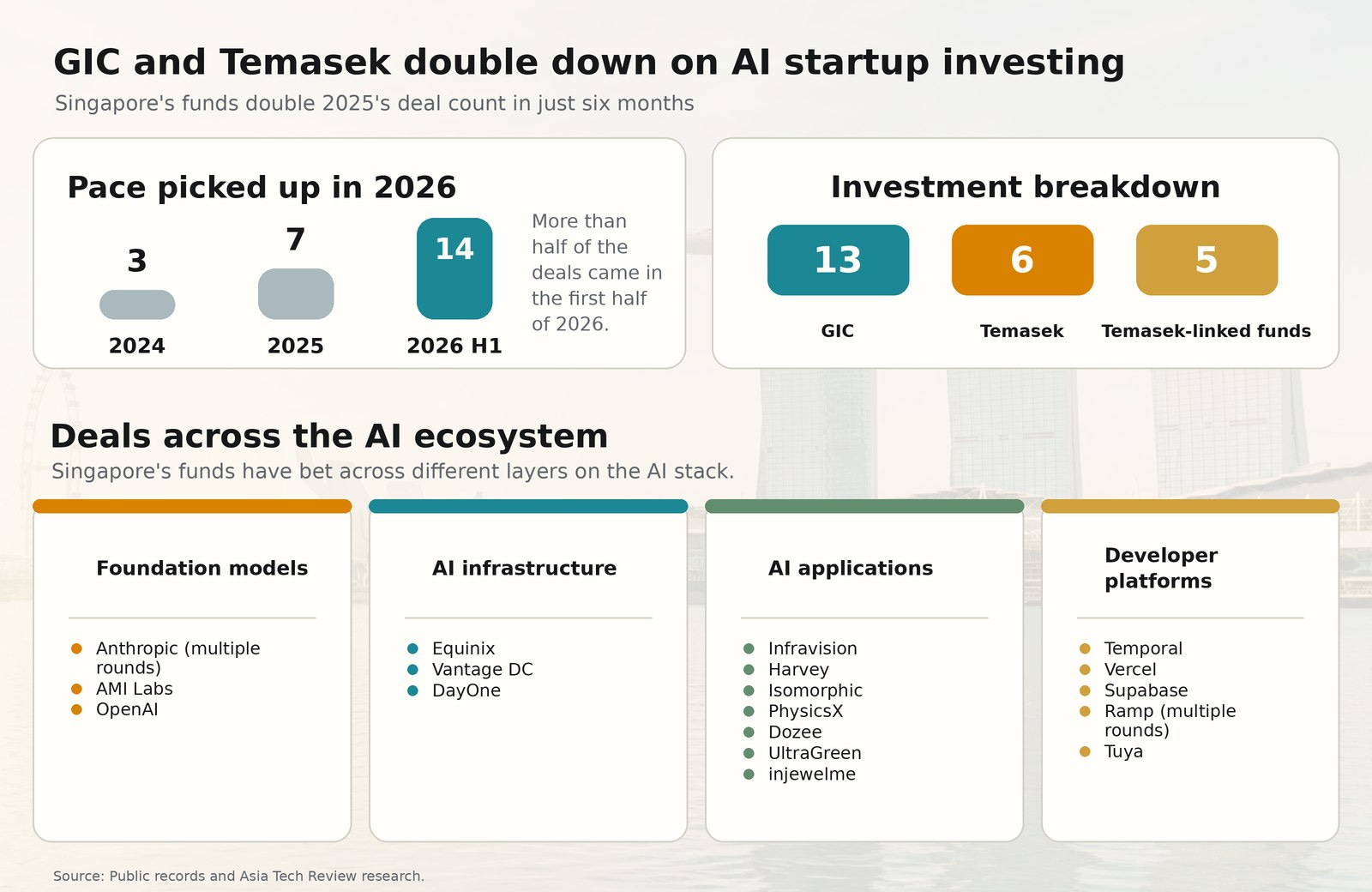
The AI deals look particularly strategic considering the past investment in data centres like Equinix in 2014 (GIC inked a joint venture), Vantage in 2015 and DayOne, as well as power firms. Moving up to cover developer tools, medical AI and top models gives a decent slice of the AI ecosystem.
Expect to see a lot more action in the second half of the year, although the concentration will continue to be overseas despite Southeast Asia making progress with AI and robotics companies. The biggest play remains public markets, but it’s always more interesting to see how colossal sovereign wealth funds make their play among startups and private markets. That’s where the real outsized winning deals can be found, but there’s also plenty of risk as Temasek is well aware thanks to FTX.
You can check out Temasek’s full report at this link. Fascinating to get a look into such a huge fund, which is now one of the world’s top 10.
Nium acquihires crypto card startup Cypher leaving token holders angry
Nium, the cross-border payments firm headquartered in Singapore, made its first crypto acquisition after it scooped up Cypher, a crypto debit card startup backed by Y Combinator, Coinbase Ventures and others, in an undisclosed deal.
The deal is an acquihire that will result in the Cypher Visa debit card and blockchain protocol closing down by September, although some services including new card issuance and top-ups are already disabled.
Founded in 2022, Cypher was an early entrant in the now very busy and competitive crypto card space. In a press release issued last October, it claimed to have more than 100,000 users (disclosure: I was one) but its early momentum appeared to slow. Cypher doesn’t rank among the top 20 crypto cards based on spend, according to on-chain data from analytics company PaymentScan.
Nium will use Cypher’s team, including founder Kuberan Marimuthu who is ex-Amazon and Coinbase, to build new products and services for the crypto industry. Marimuthu will become VP of Digital Assets at Nium. The company specialises in helping banks and financial institutions move money globally at lower cost and with more speed. Nium CEO Prajit Nanu said the addition of this new division will be a pivotal moment for Nium to offer banks fiat to digital asset services thanks to a raft of new legislation worldwide and surging interest in stablecoins.
However, with all things crypto, the acquisition has angered Cypher users who feel blindsided by the company’s upcoming closure.
Cypher users earned their spending rewards in the company’s token, a setup that’s not uncommon in the crypto card space. While it didn’t require users to lock their tokens (make them untouchable for a significant period of time) to get a card, it did incentivise locking tokens for up to two years in order to gain preferential cashback options from their favourite merchants.
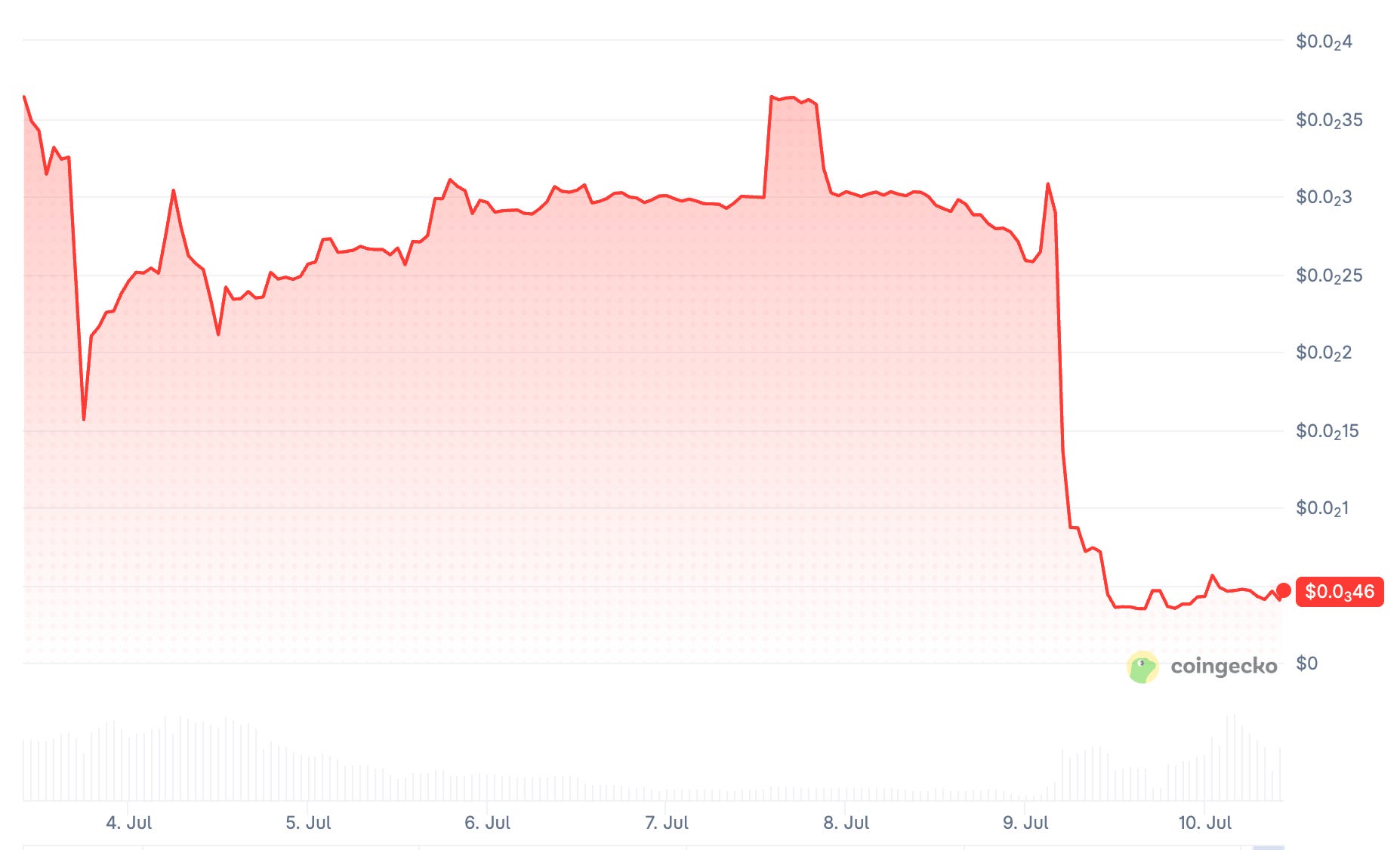
After announcing the deal and the company’s planned closure, Cypher’s token price unsurprisingly took a massive nosedive. CoinGecko data (below) shows it has lost over 87% of its value in the last week. That’s not isolated, however, as that price is down 99% since the token was introduced back in October with trading volume dropping to single-digit thousand US dollars per day as of last week.
Perhaps in preparation for a backlash, Cypher announced the deal on X in a series of posts that did not allow replies.


The language also drew criticism, with some users complaining that they have been left holding the bag while Cypher made money from a token sale and acquisition.
This deal isn’t likely to be a major financial windfall for Cypher, which previously raised $4.3 million in 2023, but it does demonstrate how fast the crypto landscape can move and the risk of owning tokens.
Deals
Blackstone, CVC Capital Partners and MUFG are bidding for a stake in Vietnamese fintech MoMo in a partial sale that could value the company at more than $2 billion [Reuters]
Ant Group took a 28% stake in China’s Boohee Health as the company’s AI health app AQ surpassed 100 million users [TNGlobal]
Indian billionaire Nandan Nilekani will step down as a general partner at Fundamentum Partnership as the Indian venture capital firm launches its third fund, which is targeting about $200 million [TechCrunch]
Indian wholesale e-commerce platform WizCommerce raised Rs 79.5 crore ($8.3 million) from existing investors including Blume Ventures, Alpha Wave, Z47, 100X VC and Peak XV Partners [Entrackr]
Markets
Chinese AI model maker Zhipu priced a $4 billion Hong Kong share sale at HK$1,588 per share, a 13% discount to its previous close, after its stock rose roughly 1,700% since listing [Bloomberg]
Apple supplier Luxshare Precision closed 1.6% lower in its Hong Kong debut after raising HK$24.3 billion ($3.1 billion) in the city’s biggest listing this year [Bloomberg]
SK Hynix is set to raise around $28 billion from a Nasdaq ADR sale this week, but Culpium notes its AI-memory exposure is highly concentrated: HBM was about 8% of DRAM bit shipments last year but around 40% of DRAM revenue [Culpium]
Chinese memory chipmaker CXMT will open investor subscriptions next week for a Shanghai IPO targeting at least 29.5 billion yuan ($4.3 billion), with the deal potentially raising more than $5 billion [Bloomberg]
Autonomous driving company Momenta had a muted Hong Kong debut after raising $751 million in its IPO at a valuation of around $9 billion; shares were up 2.8% from the offer price in early trading [Wall Street Journal]
Shanghai chipmaker Iluvatar CoreX is raising about $850 million in a Hong Kong share placement after a rally in its stock since its January IPO [Bloomberg]
China’s Nexchip Semiconductor is seeking to raise up to HK$6.98 billion ($890.3 million) in a Hong Kong share sale, adding to the city’s pipeline of mainland chip listings [Reuters]
Chinese AI model maker Zhipu is seeking to raise about $4 billion from a share sale after its stock rose almost 1,500% since a January listing in Hong Kong [Bloomberg]
Bain Capital exited its full stake in Japanese flash-memory chipmaker Kioxia after an AI-driven rally pushed the company’s shares up more than 4,000% since its debut [Bloomberg]
South Korean AI chip startup Rebellions plans to list in Korea in the first half of next year, with a potential US listing to follow [Reuters]
Shanghai Iluvatar CoreX Semiconductor raised about $902 million in a Hong Kong share sale, selling 14.9 million shares at HK$476 each after a rally since its January IPO [Bloomberg]
Zostel asked India’s securities regulator to review OYO’s IPO filing over litigation disclosures [Entrackr]
Following OYO’s filing for IPO in India, Southeast Asia-based RedDoorz says it plans to go public in Singapore next year. Early days but it plans to raise $50-$100 million for acquisitions [Business Times]
The parent of India’s CarDekho reportedly plans to file draft IPO papers this quarter for an offering of up to Rs 3,000 crore ($360 million) [Economic Times]
AI and Chips
Google Cloud will roll out its latest AI models locally in India as part of a data-sovereignty push and it is exploring local AI server manufacturing [Economic Times]
MiniMax is said to be developing a 2.7 trillion-parameter large language model, which would be the largest open-weight model released by a Chinese company [Reuters]
China’s National Vulnerability Database said it found security backdoor vulnerabilities in Anthropic’s Claude Code, escalating tensions in the US-China AI rivalry [Wall Street Journal]
US lawmakers are weighing curbs on American companies’ use of Chinese AI models as a House committee investigates risks tied to China’s AI capabilities [CNBC]
Hesai Technology is expanding in the US through sensors used in Nvidia-backed autonomous vehicles despite being blacklisted by the US Department of Defense as a Chinese military entity [CNBC]
Tencent’s Xiaowei AI agent is being tested inside WeChat as the company tries to turn its super-app into an AI-powered assistant platform [Bloomberg]
China will reportedly allow a handful of top AI firms to buy limited quantities of Nvidia’s H200 chips after previously holding back local purchase approvals to protect domestic chipmakers [The Information]
LG will invest $1 billion in a chip-packaging plant in Hai Phong, Vietnam, with operations due to start in 2027 and mass production targeted for 2028 [Nikkei Asia]
India’s JioStar, the Reliance Industries streaming unit with 500 million monthly users, is using OpenAI technology to build a conversational AI platform for content discovery and shopping [Bloomberg]
Thailand approved nine investment projects worth a combined $1.99 billion across AI, advanced electronics, aviation, clean energy and food as manufacturers reposition supply chains in Southeast Asia [TechNode Global]
In other news:
India scrapped 7.5% and 5% import duties on selected mobile-phone and electronics components, a move expected to benefit manufacturers including Apple and Xiaomi [Reuters]
Malaysia’s Zetrix AI Berhad group will provide the underlying protocol for the Philippines’ public blockchain infrastructure [TNGlobal]
Despite other nations opening up to digital assets, India’s central bank and tax authorities are pressing for stricter cryptocurrency curbs [Reuters]
Uber CEO Dara Khosrowshahi has stepped down from Grab’s board likely due to the incoming conflict of interest from Grab’s acquisition of FoodPanda Taiwan, which will put it into competition with Uber once again [Grab]
Taiwan charged two businessmen with helping Chinese state-linked hackers run an espionage campaign that used leased LINE accounts to impersonate international journalists and plant malware [The Record]
Google appealed an Indian ruling over its advertising platform, arguing that the decision could harm consumers [Economic Times]
Truecaller CEO Rishit Jhunjhunwala accused India’s telecom regulator of blocking the app from displaying spam data for calls from the country’s 1400 and 1600 number series [TechCrunch]
US hospitals are increasingly hiring Filipino nurses for remote monitoring roles to cut costs and fill staffing gaps, a shift that may worsen the Philippines’ nursing shortage [Rest of World]
Editor’s note: After today’s newsletter was published, we updated the deal count and graphic for Temasek/GIC deals. And the loose headline for the Nium-Cypher acquisition. Our apologies for any confusion.