


Happy Monday and welcome back to Asia Tech Review, your curated digest to keep up to date with tech news across Asia.
Southeast Asia has typically been a laggard when it comes to robotics. It’s tough to compete with the US, the land of innovation, and China, the world’s manufacturer, but now the region is finding a niche through companies that take the lab and design work and turn them into practical outputs. That’s our main topic for today’s newsletter, but that’s only because we don’t write about football or the World Cup. (You can ask me about those directly, I have just as much to say…)
To keep up with our issues, follow us on LinkedIn or WhatsApp. Please do share Asia Tech Review with people you know who want to get smart about Asia tech.
Outside of Asia Tech Review, I run Fully Drafted, a communications and consulting company focused on traditional comms, thought leadership and investor relations. Get in touch if you think we can help you.
Southeast Asia’s robotics startups are finally leaving the demo floor
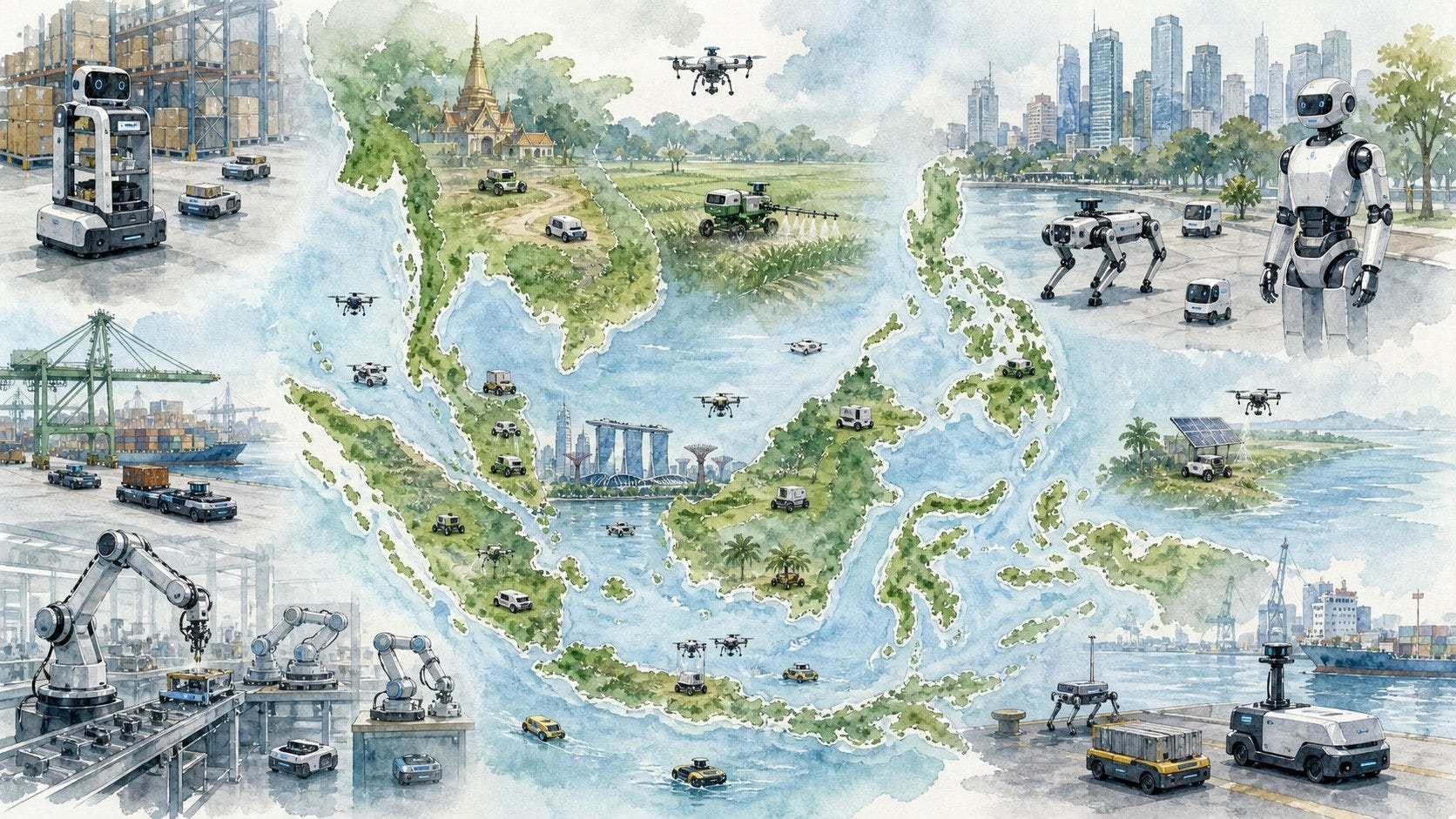
We’re used to seeing China dominate the robotics narrative globally, not to mention in Asia. Southeast Asia doesn’t have dancing robots on national TV or IPOs from robotics companies, but it is gaining momentum with Singapore firmly in the centre.
Last week, dConstruct raised $125 million in what is one of the largest investments for a robotics startup in Southeast Asia to date. It’s also a huge Series A for a company in the region. The five-year-old company develops 3D worlds to build better navigation for robots, drones and vehicles.
More interestingly, the company came from the first cohort of the RoboNexus accelerator, a venture building programme from Singapore’s National Robotics Programme. dConstruct isn’t the programme’s only early validation.
Spinoff Robotics, a five-year-old company providing drone-based solutions for cleaning and inspecting industrial infrastructure, was acquired by Nanoveu, an Australia-listed company focused on AI and automation. The deal price was not disclosed but it’s a major landmark for the programme and Singapore itself as a hub.
We know Singapore is positioning itself as a destination for deployment, both in terms of AI and robotics. Back in May, the government announced a slew of partnerships and initiatives including the development of a national AI strategy, an AI lab from OpenAI, a robotics lab from Nvidia and a testbed for businesses to develop robotics solutions in areas like delivery and cleaning. Grab, DHL and Unitree (the Chinese firm behind those dancing robots) were all among the launch partners.
The RoboNexus accelerator builds on this focus on deployment, i.e. not developing core technology but instead adoption and practical application of technologies. Elsewhere, we’ve seen Neptune Robotics raise $52 million for its ship-cleaning robots (it is investing heavily into Singapore), BeeX raise $7.7 million for underwater inspection drones, Augmentus raise $11 million to make coding robots easier and, most recently, Thailand’s Amity close $7 million for concierge robots.
Rather than chasing sci-fi visions, Southeast Asia is catching the attention of investors by graduating robotics from the lab into practical deployment, with Singapore doing a lot of heavy lifting with its initiatives and programmes. The big question looming will, again, be exits and global capabilities.
Alibaba stops using Claude after being called out for copying
Weeks after Anthropic accused Alibaba of carrying out “the largest campaign to illicitly extract Claude’s capabilities,” the Chinese e-commerce giant is moving to bar its employees from using the AI service.
Reuters reports that employees will no longer have access to Claude from 10 July. Instead, they’ll use Qoder, Alibaba’s homespun coding assistant, and, you’d presume, its own Qwen-based services. Alibaba declined to comment when we asked. However, a source close to the matter did confirm to Asia Tech Review that the details and dates are correct.
Last month’s accusation prompted Alibaba’s share price to slide by as much as 5%, leaving the price at a 16-month low. While the company never responded publicly to the accusations, it has taken prompt action. A further reason for the switch might be the fact that Chinese AI labs have frequently been called out for copying by US AI firms. Most recently in March, Anthropic called out a host of Chinese AI firms for ‘distilling’ (training their models) on Claude. The claim is pretty damaging given how Chinese models have emerged, as we noted at the time:
Chinese AI firms have generally built their reputation around doing more with less. Unlike Anthropic, OpenAI and others with multi-trillion dollar budgets, they’re financed more modestly and have limited access to technology from Nvidia and others which is key to training large-scale models.
The idea that they are reliant on their US peers undermines that narrative which China has crafted.
In the months since that accusation, AI has become a national government issue.
The US restricted the introduction of Mythos and Fable, Anthropic’s newest Claude models, and it is taking the same approach with OpenAI’s newest version of ChatGPT for fear of what it could enable adversaries, including governments like China, to do.
Indeed, Anthropic was caught including secret software in the recently released version of Claude Code which tracked if a user was located in China or had links to Chinese URLs or labs. It has since removed the setting, but it shows clearly where things are moving to. As a highly visible Chinese company, Alibaba likely had little choice but to make this move away from Claude.
Deals
Indian data centre operator Yotta Data Services is in talks with global and domestic funds to raise about $1 billion, with its promoters seeking to sell a 25-30% stake at a $3 billion valuation [Economic Times]
Temasek-backed Azalea Investment Management launched Azalea All Access, its first private equity evergreen fund, with $350 million in initial commitments from anchor investors [TechNode Global]
Markets
Chinese robot maker Unitree Robotics won regulatory approval for a Shanghai listing through which it plans to raise CNY4.2 billion ($619.4 million) [Reuters]
China’s quant funds have more than doubled assets under management to about $384 billion in less than a year as they adopt AI trading tools [Bloomberg]
AI and Chips
Kioxia began shipping samples of its 332-layer 3D flash memory chips to AI data centre operators, with the parts set to power data-centre SSDs made at its Kitakami plant in Japan’s Iwate prefecture [Bloomberg]
Hong Kong handled more than half of mainland China’s $239 billion in chip imports through May, up from about one-third a decade ago, as AI-related trade through the city accelerated [Bloomberg]
Micron broke ground on a JPY1.5 trillion ($9.3 billion) Hiroshima plant expansion that will produce high-bandwidth memory chips for AI processors, with shipments expected around summer 2028 [Bloomberg]
ByteDance’s Seedance video generator is gaining Hollywood users with low pricing, realistic output and timeline-based prompting features [Los Angeles Times]
India’s CG Power & Industrial Solutions began chip production at its new Sanand, Gujarat facility, with capacity expected to rise from 200 million to 5 billion units a year [Bloomberg]
In other news:
GoDaddy warned that India’s crackdown on websites impersonating major brands could make the internet less safe for legitimate businesses after a New Delhi court ordered new disclosure and domain-ban requirements [Reuters]
India’s IT minister Ashwini Vaishnaw directed MeitY to summon Meta after a BBC investigation found Instagram had run ads promoting child abuse material [Economic Times/BBC]
India told Meta to remove child abuse content from Instagram and explain the steps it is taking to prevent such material from appearing on the platform [Bloomberg]
India is investigating a Tata Electronics data breach that exposed documents linked to Apple’s unreleased iPhone 18 Pro after a ransomware group posted component and supplier lists and photos on the dark web [Reuters]
China proposed amendments to its e-commerce law that would expand its scope beyond platforms and merchants, adding broader digital economy oversight and tighter coordination across government levels [Bloomberg]
India’s information and broadcasting ministry gave Telegram 15 days to strengthen piracy detection and takedown systems for films and OTT content [Economic Times]
According to Alternatives.pe - Nanoveu (NVU) acquired Spinoff Robotics for a consideration of 3 million fully paid NVU shares to be issued at a deemed issue price equal to the VWAP of shares on the ASX over the 10 trading days immediately preceding the settlement date subject to 12 months escrow. Additionally, Nanoveu could also issue 4 million NVU performance rights, which will convert into NVU Shares subject to achievement of performance milestones.
If true, this means that the exit is ~AUD$150K, with additional rights to be converted into shares.
Not exactly the landmark exit being touted.