


Welcome back to Asia Tech Review, your curated digest to keep up to date with tech news across Asia.
Yesterday we looked at Amazon, today it is Shopee. We have the details on Sea, the e-commerce service’s parent company, its latest earnings, which sent its share price soaring by more than 10%.
Sea posts monster results as gaming and fintech fund Shopee e-commerce growth
Sea remains Southeast Asia’s top internet company by some margin after it posted impressive growth figures for its Q1 earnings period.
I will avoid throwing out a load of figures, but you can’t ignore the main ones:
GAAP revenue: $7.1 billion, up 46.6% year-on-year
Gross profit: $3.1 billion, up 40.7%
Net income: $438.2 million, up 6.7%
Adjusted EBITDA: $1.0 billion, up 9.3%
Nearly 50% revenue growth is impressive, but that came at a cost, as we’ll get to. To understand how that’s possible though, it’s important to remember that while Sea is best known for Shopee, it also operates gaming unit Garena and its Monee fintech business.
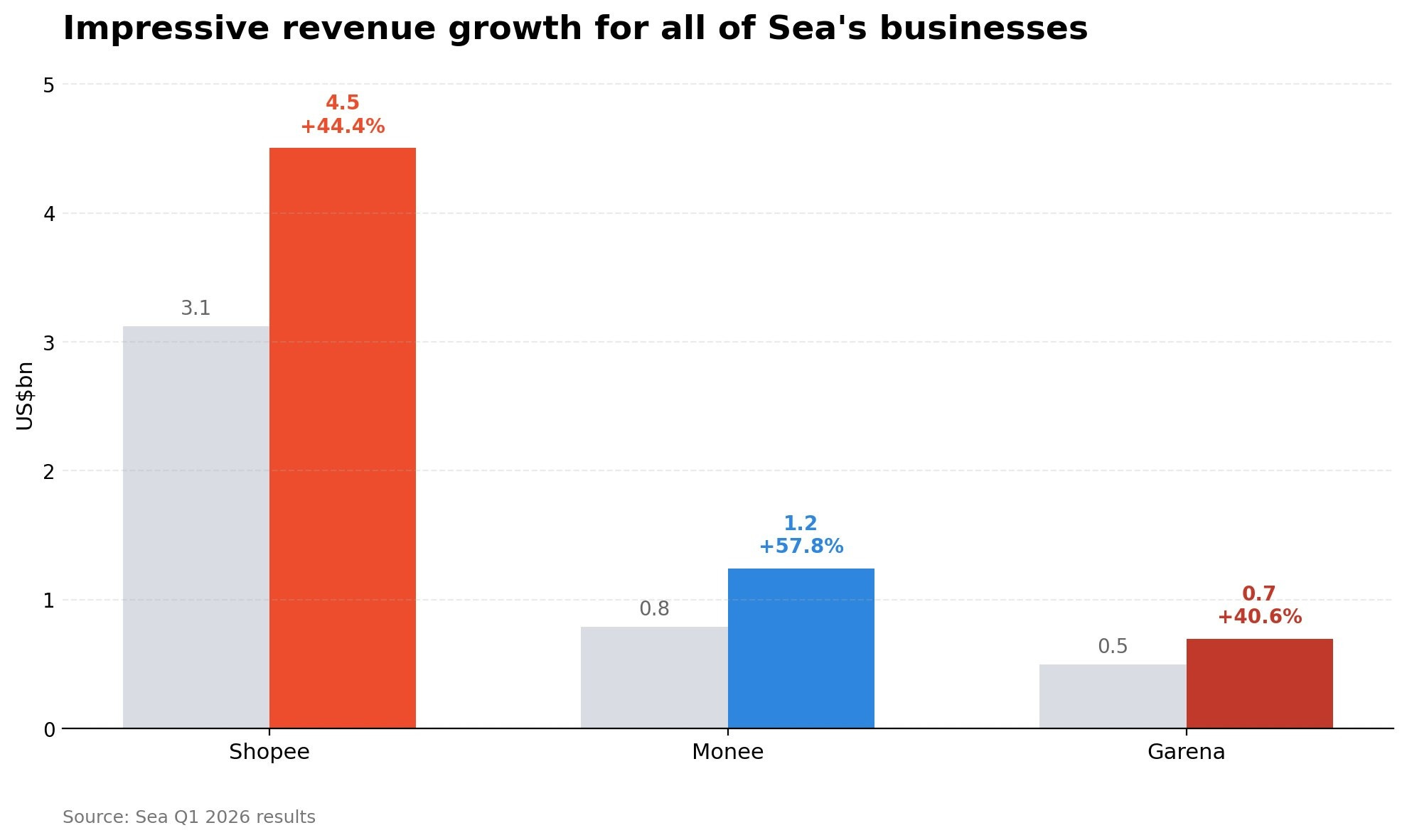
Shopee accounts for more than 60% of all revenue, and it carries the brand, but growth across the board enabled those stellar e-commerce numbers.
Doubling down on Shopee
Shopee posted strong growth, but it came at a price with cost of revenue rising 55% annually. Sea said that reflected both higher logistics costs as order volumes grew and investment in logistics capabilities.
Competition across Southeast Asia remains cutthroat. Unlocking Shopee’s next phase of growth is initially looking expensive, as gross margin fell from 46.2% to 44.3%. That would ordinarily raise concern, but Sea was able to absorb that pressure because Garena and Monee continued to grow strongly. The company managed to remain profitable overall.
Alibaba continues to fund Lazada, while TikTok Shop is still gaining ground across the region. TikTok is investing significantly in infrastructure, a show of its ambition. Those factors go some way to explaining why Sea is spending more heavily to defend and deepen Shopee’s position.
Garena’s best quarter since 2021
Gaming is how Sea started life, and it operates two big games in the form of Free Fire and Arena of Valor. Garena had its best quarter for almost five years with sales, user growth and more metrics up double-digit percentages.
That is important because these popular games, both of which are around a decade old, give it the free cash to invest more heavily into e-commerce without spooking the market with huge losses. There are even signs that the gaming business has further headroom to grow, with the rate of paying users continuing to increase year-on-year.
Growth in Brazil
Shopee launched in Brazil before Covid as part of a broader expansion plan that didn’t fully play out during the pandemic. But Sea remained committed to the Latin America market, and Brazil was Shopee’s fastest growing market in the quarter. Despite investment in logistics, fulfilment and incentives, the market remained profitable, according to Sea.
Brazil is a key part of the strategy because it offsets the competitive and maturing Southeast Asian market with a different growth story. And it isn’t just about online commerce as Sea’s flywheel starts to kick in.
Brazil became the fourth market where Monee’s loanbook has reached $1 billion, thanks to 250% annual growth. There’s likely more to come after Sea secured an SCFI license to enable more lending and credit services.
Online beauty retailer Konvy lands $22 million for Southeast Asia expansion
There’s always a lot of talk about Thailand as a startup market, chiefly how it lags the rest of Southeast Asia. That makes it particularly notable that Konvy, a Thailand-focused beauty brand and e-commerce startup, raised $22 million.
The round was led by a $15 million cheque from Cool Japan Fund (CFJ), a government-backed fund that essentially expands Japanese soft power and business interest by investing in tech startups, fashion media and more. Singapore’s Insignia Ventures was among the existing backers which also took part.
Konvy was founded in 2011 and it sells healthcare and beauty products through a mix of online and offline channels. Those include 16 physical stores in Thailand, partnerships with big name chains like Watson’s and distribution through e-commerce and social commerce platforms, particularly TikTok.
The company sells in Malaysia and the Philippines, where it has one offline store. Expansion in those two markets will be one strategy funded by this investment as well as increasing the flow of Japanese goods onto its physical and digital shelves. With CFJ’s backing, the goal is to increase the share of Japanese names among its 1,000 brands, which supply some 20,000 products to Konvy.
There’s no word on valuation, but the founders have spoken before of their desire to build a billion-dollar valued business. Konvy definitely sits in an interesting position, covering traditional e-commerce and fast-rising channels like TikTok Shop. And in a category that continues to grow in spite of economic headwinds.
In other interesting news you won’t want to miss:
Unitree, the AI company that provided dancing robots for a TV show in China’s Spring Festival, just introduced real-life transformers [SCMP]
Lightspeed is reportedly scaling back its new India fund from an original target to raise $500 million, down to $300-350 million [The Economic Times]
More than 50,000 Samsung workers could go on strike after talks between the company and its labour union, which were mediated by the government, broke down [Reuters]
Google is doubling down on mosquitos… in Singapore… the US firm is opening its largest adult mosquito production facility and an overseas R&D centre to tackle mosquito-borne diseases using AI and tech [Technode]
India’s PineLabs is expanding its merchant payment services to the Philippines [Entrackr]