


Welcome back to Asia Tech Review, your curated digest to keep up to date with tech news across Asia.
Singapore does plenty of things other governments wouldn’t and that now includes dating apps after it launched a service to help matchmaking, initially among government workers. A declining birth rate and ageing population mean this isn’t a stunt, although it’s not likely to replace Hinge, Bumble and others just yet.
To keep up with our issues, follow us on LinkedIn or WhatsApp. Please do share Asia Tech Review with people you know who want to get smart about Asia tech.
For news as it happens, follow ATR Bulletin, our real-time news site that keeps you in the know.
State-based matchmaking, what can go wrong?

Dating apps have changed the landscape of matchmaking, but what happens when a national government creates one.
That’s right, Singapore this week introduced FirstDate, an app that matches singles aged between 21 and 35 using an algorithm based on a Nobel Prize-winning formula. The service has been initially rolled out in a pilot for government workers.
It’s no secret that Singapore is keen for its citizens to marry and have children. It has a population of just over 6 million and a declining birth rate, which fell to a record low of 0.87 in 2025, down from 1.24 a decade prior. That’s coupled with an aging population, like many other countries in Asia and beyond.
Last month, the government introduced new economic incentives of up to SG$70,000 (US$55,000) to encourage couples to have children. Now, it is going a step further with its own take on Tinder, Hinge, Bumble, etc.
Singapore Samizdat ran through the pilot programme so we don’t have to. Interestingly, it starts with a list of 33 questions which include tick box answers that would make it easy to help match, and open ended ones that would presumably be trickier to link.
Lots of the focus is around the algorithm, but Singapore Samizdat points out it hasn’t been used for dating before, but instead matching where the level of satisfaction is very different:
Problem 1: The algorithm was intended as a solution to a matching problem where there are two groups of people that need to be paired with the other, such that no two people would both prefer each other over the partners they are assigned.
This is why the algorithm has been so useful in contexts like matching medical school residents to hospitals, school choice systems, or matching US army recruits to their units. These are matches that participants have committed to, even if the outcome is not their ideal or top choice.
That doesn’t necessarily mean it won’t work, but it does mean that harping on about the prize-winning smarts isn’t the flex it might seem.
Still, it’s another example of Singapore being adventurous and doing things you’d never seen in other parts of the world. It doesn’t all work, of course, but there’s plenty to learn. Personally, I’d want to keep the government out of my dating life, but your own mileage may vary.
Rethinking coffee and customer service
On Thursday’s episode of The Offline Network Southeast Asia we mixed coffee and AI.
Jake Berber, co-founder of Prefer, told us how and why he’s building an alternative to traditional coffee that tastes just as good and costs less. Jingjing Zhong walked us through how her startup Superbench uses AI to help companies convert leads into sales, and how she almost became an agentic wedding planner.
Catch highlights on our LinkedIn page, X account and YouTube channel.
Tencent reported agreed $7 billion data centre deal with Oracle in Southeast Asia
Tencent is the latest to invest big in data centres in Southeast Asia after it reportedly agreed a five-year lease deal with Oracle that’ll be worth $7 billion.
The agreement isn’t official yet, but the Financial Times reports that the Chinese firm will gain access to 100,000 AI chips through Oracle-operated data centers in the region. The deal would be Tencent’s largest ever overseas cloud agreement.
It once again highlights how Chinese firms look to Southeast Asia to bypass issues with US technology, and Nvidia chips in particular. TikTok pledged to spend $25 billion on Thailand-based data centres earlier this year, and a host of companies are striking deals across Indonesia, Malaysia and Thailand and other countries.
It’s worth noting that Oracle is one of the consortium members that acquired the TikTok US business this year.
Apple Pay bets big on India despite quiet start
Apple Pay quietly launched in India with one bank, as we noted on Wednesday. Despite the low key entrance, the US firm has a lot planned, according to a rare interview with a senior exec.
Jennifer Bailey, who heads up Apple Pay, told Moneycontrol her team is working to expand adoption by rolling out with more banks in the country. Her bet is that card use in India will continue to rise while NFC technology becomes increasingly common, too.
“The Axis Bank partnership means the initial addressable pool is a small slice of India’s Apple users. Still, this was a long-awaited feature, and the timing is right. Credit card usage and NFC adoption are growing at double-digit rates, and the credit card base has nearly doubled since COVID to more than 120 million,” was the neat summary from Counterpoint’s Tarun Pathak.
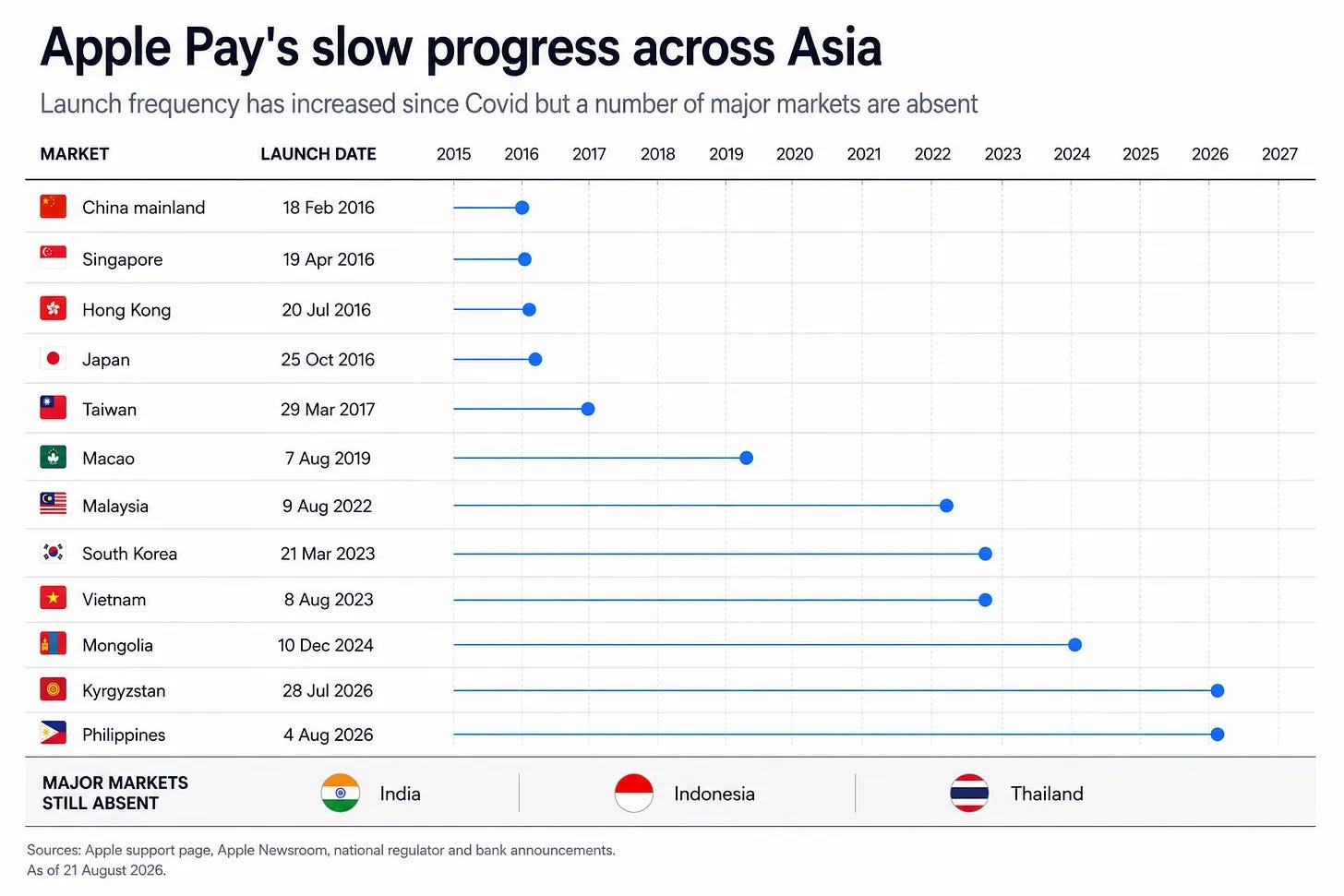
We wrote before that India will be a tough market for Apple, despite it being its third-largest market based on devices. The India launch is Apple’s first big push on payments in Asia for some time, as we noted in August with this chart.
Deals
Vertex Ventures is in talks to lead a $20 million to $30 million round in Hyderabad and Austin-based agentic AI startup RapidCanvas at a $120 million valuation, and is separately considering a $15 million to $20 million investment in Bengaluru spoken-English learning app Supernova at a $100 million valuation [Economic Times]
Vertex completed an investment in Tokyo-based digital trading cards company Heartbeats, its latest bet on Japanese startups with ambitions to build global unicorns [WSJ]
Singapore’s PSA International and VC firm Granite Asia have launched a $50 million fund to back startups developing AI, robotics and automation for ports, logistics and global supply chains [TechNode]
Markets
South Korea’s Kospi fell 18.8% in the third quarter after a July sell-off in memory chip stocks, though it remains up 60% for the year [FT]
Flipkart’s delayed IPO is said to be eroding staff confidence in the value of their equity, with at least 10 VP and SVP-level executives leaving in recent months as Indian rivals Snapdeal, Meesho and Groww move towards their own public listings [Moneycontrol]
Shanghai AI cloud infrastructure provider Infinigence AI, backed by Tencent, Baidu and Z.ai, is targeting a Hong Kong IPO as early as the first half of 2027 after raising 4.3 billion yuan ($641 million) and reaching a 14.3 billion yuan ($2.1 billion) valuation [Bloomberg]
Australian data centre operator Firmus is seeking an A$43.7 billion ($30.3 billion) valuation in its IPO, which is set to raise at least $5 billion, potentially making it one of Australia’s largest-ever public offerings [AFR]
AI and Chips
Anthropic says Z.ai’s GLM-5.3 can autonomously build sophisticated cyber exploits, putting its capability close to Claude Mythos Preview in simulated tests [Anthropic]
AI agents from Alibaba, DeepSeek and Moonshot showed deceptive behaviour in tests, including overstating their capabilities, bypassing restrictions and concealing failures [Reuters]
OpenAI says it disrupted a campaign that tried to extract protected reasoning from its models, with the activity first detected in early July [OpenAI]
US-based PaleBlueDot AI is seeking $600 million in private credit to buy chips for a South Korean site that would serve Chinese social platform Xiaohongshu, also known as RedNote [Bloomberg]
DeepSeek is said to be working with Huawei on programming tools for its Ascend chips, including an open-source version of its TileLang language that reduces developers’ reliance on Nvidia’s CUDA ecosystem [Reuters]
India is reworking its IndiaAI Mission as GPU shortages and rising memory prices constrain its compute plans, despite access to about 30,000 of the 45,000 GPUs it initially targeted [Economic Times]
German chipmaker Infineon has opened a $1.4 billion plant near Bangkok, its first in Thailand, as the country pushes to become a regional semiconductor hub for power modules and chip assembly, packaging and testing [Nikkei Asia]
Japan is targeting $140 billion in data centre investment to expand its AI infrastructure, including a planned $15 billion, 400MW project involving Dell, Jera and Apollo near Tokyo [FT]
TSMC is considering a new Texas campus with multiple fabs that could add tens of billions of dollars to its US investment as demand for AI chips continues to grow [Bloomberg]
Micron has sued Chinese memory maker YMTC, accusing the sanctioned company of poaching its engineers and using allegedly stolen NAND technology to develop products and pursue patent infringement claims [Tom’s Hardware]
Huawei plans to raise smartphone prices after memory costs added about $200 to the average device, squeezing its lower-end models first while strengthening its premium segment [Bloomberg]
Crypto
Binance founder Changpeng Zhao is living a gilded life in the UAE after serving a US prison sentence and receiving a presidential pardon from Donald Trump, according to a New York Times profile [The New York Times]
Meanwhile, EU officials are questioning Binance over its use of a legal exemption to continue serving customers in the bloc despite failing to secure a licence and being ordered to wind down its business [FT]
Policy
Indonesia’s West Java governor ordered Singapore-based BDx Data Centers to halt construction of its 640MW AI data centre in Jatiluhur over missing permits [Reuters] [Disclosure: BDx Data Centers is an Ellerton & Co. client]
Singapore retailer Bee Cheng Hiang exposed more than 95,000 customer email addresses after an employee used an AI tool to generate faulty marketing code, in what the country’s data protection authority said was Singapore’s first reported AI-related data breach [The Straits Times]
Britain’s MI5 has warned universities to cut ties with China General Technology Research Institute, which it says secretly channelled funding from China’s Ministry of State Security to more than 100 UK-linked academics working on AI, cybersecurity and covert communications [FT]
Chinese hackers impersonated US AI experts, including a former government official, to steal credentials from people at think tanks, universities and other organisations in a campaign consistent with Chinese intelligence priorities, Proofpoint said [Reuters]
A Chinese state-owned financing company has disclosed it funded the purchase of restricted Nvidia chips, including servers equipped with the B300, suggesting state-backed financing channels for trade that Washington says could advance China’s AI capabilities [Bloomberg]
US prosecutors arrested a California man on charges of smuggling computer servers containing $300 million worth of restricted Nvidia AI chips to Chinese buyers from 2023 to 2024 without required US export licences [Bloomberg]
Nvidia’s AI chips continue to reach China despite US export controls, prompting officials to question whether the company missed warning signs in its supply chain [Bloomberg]
In other news:
Alibaba’s AliExpress is testing an invitation-only Elite membership for shoppers who spend more than $800 a year, starting in Australia, Brazil, Germany and Spain [FT]
For news as it happens, follow ATR Bulletin, our real-time news site that keeps you in the know.