


Welcome back to Asia Tech Review, your curated digest to keep up to date with tech news across Asia.
We are going payments back-to-back to close out this week as we look at why Apple Pay has moved so slowly across Asia, and still not entered major markets like India, Indonesia or Thailand. QR codes and national payment systems have made Apple a late mover in countries where its brand of cashless payments might not be needed at all.
To keep up with our issues, follow us on LinkedIn or WhatsApp. Please do share Asia Tech Review with people you know who want to get smart about Asia tech. And check out Asia Tech Review Bulletin, a real-time news feed for Asia’s technology industry for those who are as obsessive about the news as we are.
Have a great weekend!
Apple doesn’t have it all its own way when it comes to payments in Asia
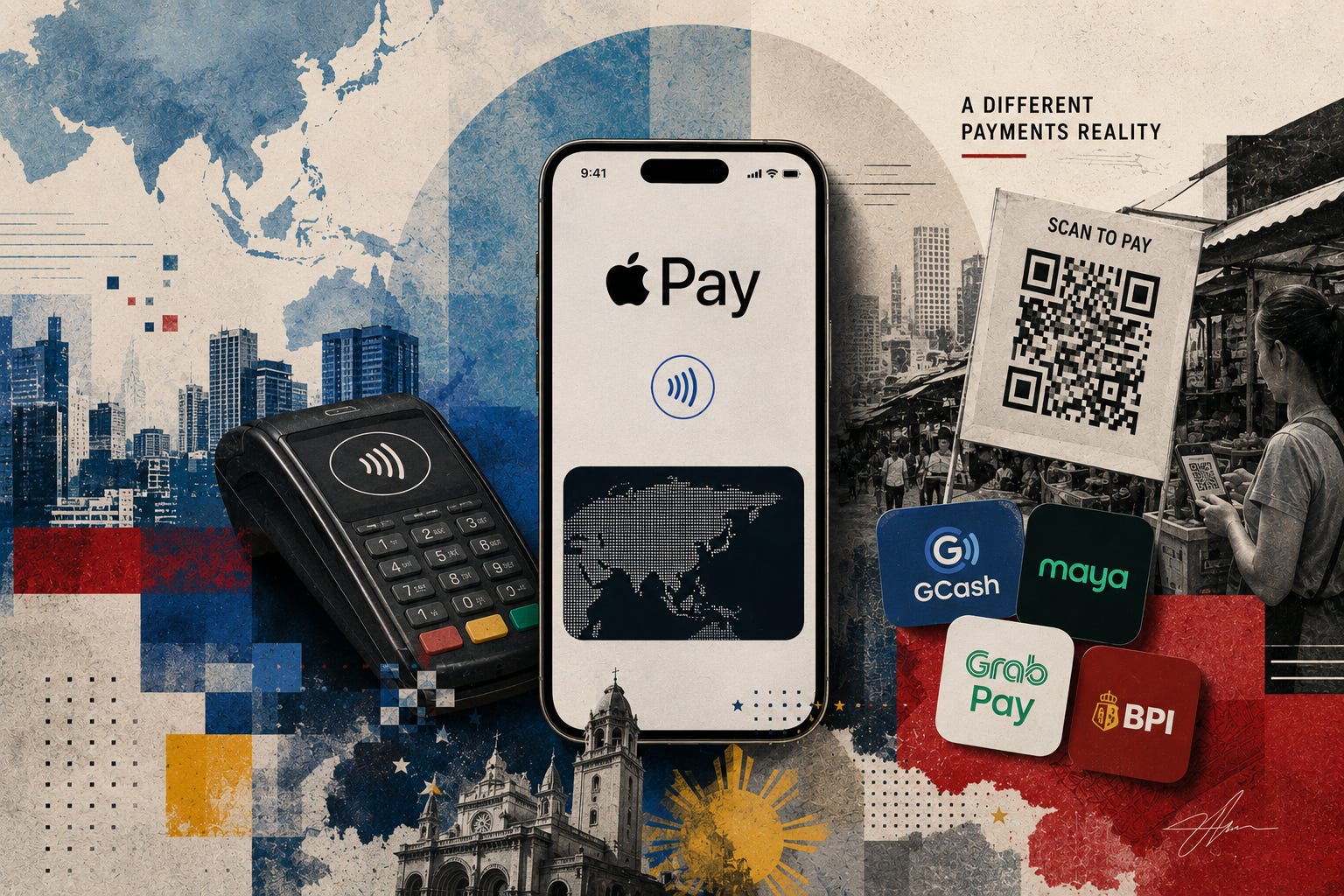
After what seems like years of waiting, Apple Pay is quickening the pace of its expansion across Asia after it launched in the Philippines this month.
Western markets are accustomed to tap-and-pay services from the likes of Apple and Google, to the point where it has gone beyond point of sale and into rewards, transport and even ID. But in Southeast Asia, India and other markets, the reality is different. QR payments picked up the cashless payment baton, even before Covid in some countries, and Apple has faced battles to introduce its payment service for numerous reasons.
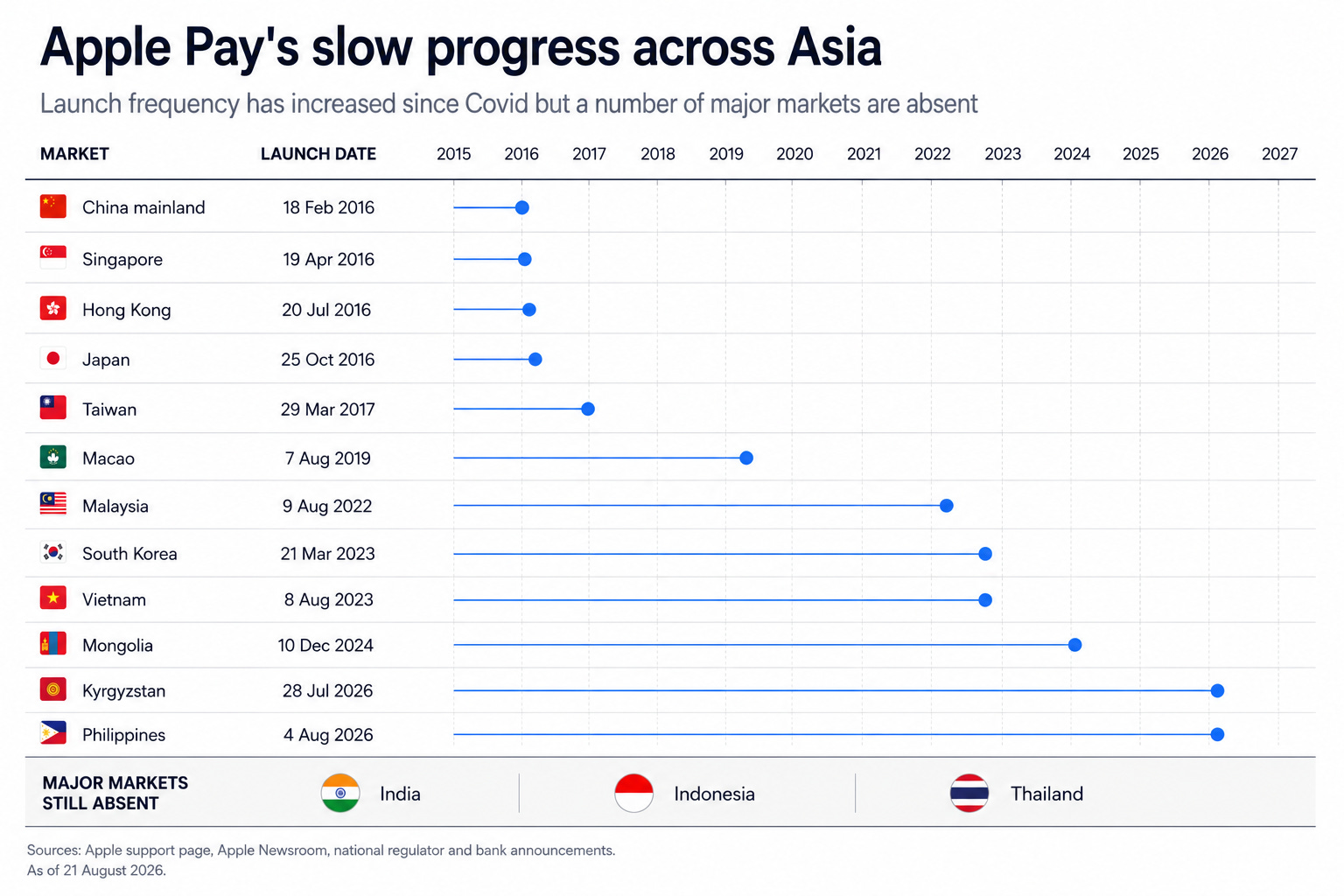
Apple Pay is supported in 12 countries across Asia, including China, Japan, Korea, Singapore, Malaysia, Vietnam and now the Philippines. The latter is Apple Pay’s newest market after it went live on 4 August with four partner banks. That’s a relatively modest launch squad but indicative of the challenge in a market where QR codes and local services pushed digital payments to nearly two-thirds of all transactions. The Philippines is telling of the payment challenge.
It may be available in more than 90 countries worldwide, but conspicuously absent from the list is India, Thailand and Indonesia. That’s surprisingly given that these are three large markets where Apple is ramping up business.
India incoming
Apple appears to be edging closer in India. We wrote back in May that its efforts there had stalled simply because it is not needed by many banks. The success of UPI, India’s government backed digital payment service, has made cashless payments the norm. That makes the situation very different from say the US or UK where Apple Pay came along and established that behaviour for consumers.
From our May issue:
The proposition is different there [India] because Apple is no longer offering a premium and differentiated offering in a busy market of cards. It is trying to offer a service that banks don’t really need, or want since it involves them losing the already tight margins they take from cards. Smaller banks are more keen to join the Apple Pay party, as you’d expect given their need to be disruptive.
That really is the crux of it. Apple’s iPhones might have 10% market share in India, at best, but card and UPI access covers almost the entire population.
Even if Apple Pay comes to India in October, as is being reported in the media, it appears that it will not launch with UPI support since it needs permission and a sponsor bank. That would massively dent its potential usage and adoption.
Late to the game
The situation in Thailand bears some comparison, too, since QR code payment adoption reached mainstream consumers a number of years ago. Retailers in cities like Bangkok have moved from manual QR payment (I pay, then I show the cashier the proof) to integrating Thailand’s PromptPay system into point-of-sale and even ATMs, so I can withdraw my cash without a card.
Banks in Thailand are also a traditional bunch. That’s to say that they don’t welcome outsiders often, though their stance has loosened in recent years.
Turkeys don’t vote for Christmas, but when cashless payments seemed imminent, Thailand’s banks teamed up to launch a system in 2016 that would keep them at the centre of the universe and not impact their revenue.
Their creation, PromptPay, remains a closed system that’s open to domestic banks, but some recent exceptions carved around tourism. Thailand has built interoperability with neighbouring QR code systems and there’s a tourist app that’s run by the national tourism association and a bank. Popular apps like Alipay, WeChat and Shopee have differing levels of connectivity to allow merchant payments while Grab is due to add support this year.
That makes sense given Thailand’s economic reliance on tourists. But against that backdrop and 10 years of PromptPay, you imagine banks don’t want Apple Pay, Google Pay or another third-party to sit in between them and their customers. Currently, visitors can pay at most merchants with Apple Pay but Thai banks themselves don’t support it for their customers.
The story is similar in Indonesia, where the national QRIS cashless system has grown in adoption and super apps like Grab, Gojek and Shopee are dominant when it comes to quick and easy payments.
With iOS adoption at around 15% in Indonesia, Apple won’t move the needle on the mainstream market but it might be able to argue that it can help more affluent customers spend more. But, again, this is subject to banks ceding some control in the customer relationship and handing over some of their payment margin to Apple.
East vs West
Apple Pay’s adoption is another of the classic examples to show that what works in the West, doesn’t necessarily work in the East. Apple has played the long game with a number of markets, and it is sure to do this same as it ramps up in the Philippines, moves into India and works on entering other markets.
But the local conditions are entirely different, and moving later isn’t an advantage in countries where banks have built a position on cashless payments already. The flip side for Apple, of course, is how valuable can many of these countries be compared to the US or Europe?
Related: Indonesia expanded Kartu Kredit Indonesia, its domestic credit card network, to consumers in a push to curb the dominance of Visa and Mastercard.
Markets
Kakao Mobility has confidentially filed for a US IPO that could raise around $1 billion, four years after shelving a domestic listing [KED Global]
Samsung and SK Hynix are preparing record shareholder payouts as investors fret over AI hardware demand. Samsung is expected to announce a return plan worth more than $72 billion, while SK Hynix could deliver more than $130 billion after a $29 billion buyback [Bloomberg]
TikTok’s international revenue grew 46% to $9.1 billion in 2025 despite its US sale and looming European fines [Forbes]
AI and Chips
Chinese AI companies are reworking software as US export controls limit access to Nvidia’s most advanced chips. Domestic hardware can increasingly handle inference, but complex work such as coding still depends on Nvidia processors [SCMP]
Earnings
Alibaba’s June-quarter profit fell 75% as it ramped up AI infrastructure spending. Capital expenditure rose 75% to 67.7 billion yuan ($10 billion), while revenue grew 9% to 268.95 billion yuan [CNBC]
Crypto
Binance launched a platform that lets AI agents analyse markets and execute trades for users, putting autonomous AI directly in charge of real money [TechCrunch]
Policy
China has tightened scrutiny of aerospace and optical-material exports to Taiwan, disrupting supply chains for the island’s technology manufacturers as customs checks delay shipments [Nikkei Asia]
In other news:
T-Mobile thwarted a Chinese cyberattack in 2024 by physically cutting a network cable after tracing suspicious activity to equipment connected to its network. The intrusion was linked to the wider Salt Typhoon campaign against US telecoms companies [Bloomberg]
LandSpace has become the first Chinese private company to recover a rocket’s first stage after an orbital launch, state media reported, pushing China’s reusable-rocket effort forward [NYT]
Hangzhou has used robots as traffic police since May, part of China’s push to move robots beyond showroom demonstrations and into everyday jobs [Reuters]