


Welcome back to Asia Tech Review, your curated digest to keep up to date with tech news across Asia.
This Friday we are diving into e-commerce charts that show a number of Southeast Asian countries ranking among the world’s fastest growing for e-commerce. The region’s online buying behaviour remains less mature, but also impacted by a major battle between the likes of Shopee, Lazada and TikTok Shop to grow fastest.
To keep up with our issues, follow us on LinkedIn or WhatsApp. Please do share Asia Tech Review with people you know who want to get smart about Asia tech.
For news as it happens, follow ATR Bulletin, our real-time news site that keeps you in the know.
Fierce competition drives Southeast Asia’s e-commerce growth

It’s easy to forget how early e-commerce is in Southeast Asia, but a new report shows countries across the region are among the world’s fastest growing when it comes to mobile.
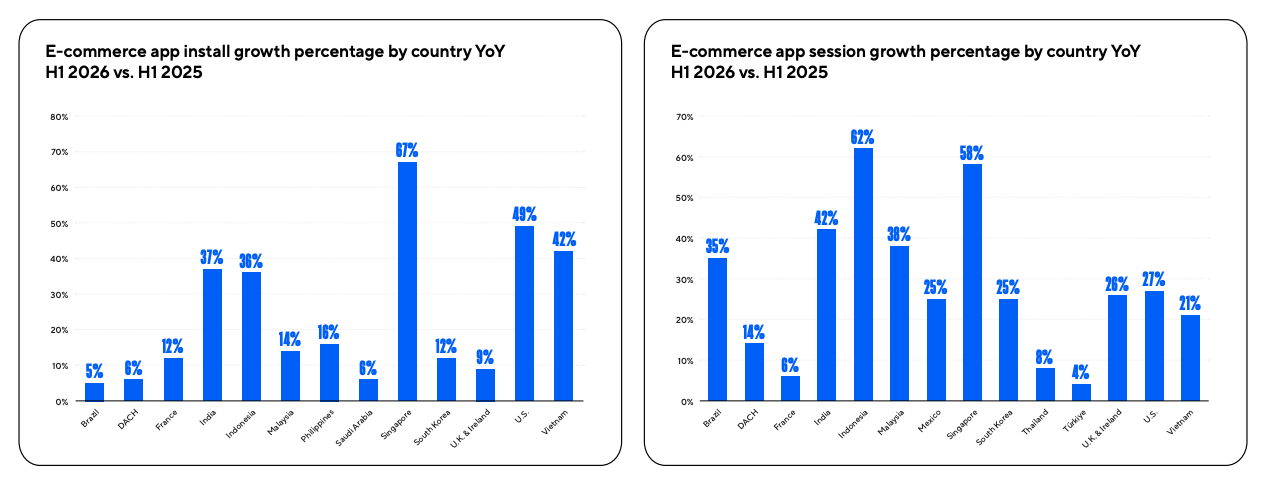
Singapore, Indonesia and Vietnam are among the world’s fastest growing markets for e-commerce app usage and downloads, according to a new report from mobile analytics company Adjust. The company found that regional growth was highest in North America with installs up 46% and session length up 26%, but it didn’t break out figures for Southeast Asia while slower growth in parts of Asia dragged the region down.
With Shopee, Lazada and TikTok Shop among the firms battling for consumer attention and wallets, Singapore ranked highest with installs up 67% and average session length increasing by 58%. Other Asian markets stood out:
Vietnam: installs up 42%, sessions up 21%
Indonesia: 36% and 62%
Malaysia: 14% and 38%
India: 37% and 42%
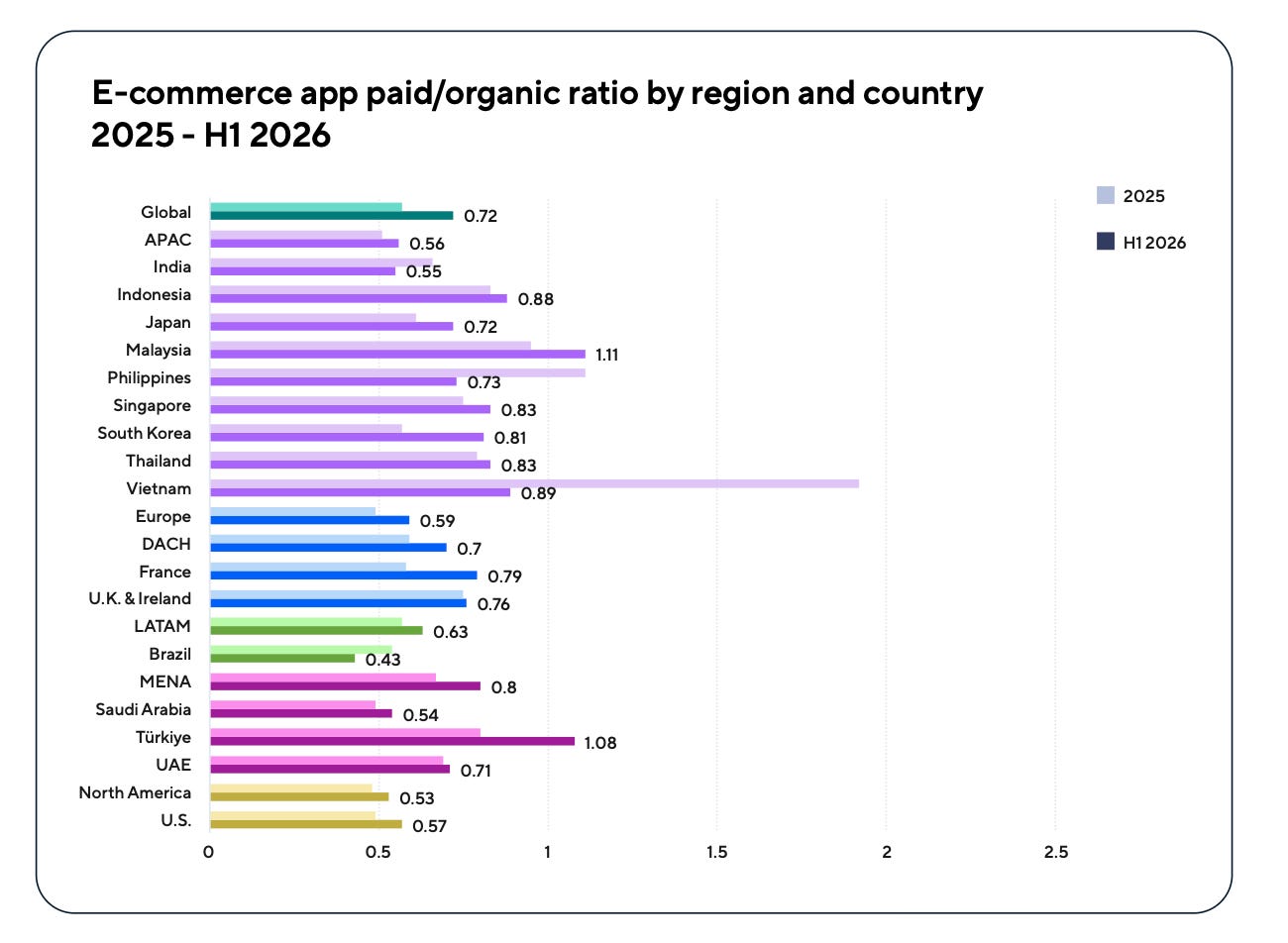
The report also found that markets in Southeast Asia, and Asia more broadly, are attracting more paid users via advertising and other channels such as YouTube. That reflects the fierce battle taking place in the region between those three e-commerce platforms and others.
Shopee, for example, continues to post impressive annual sales growth of nearly 50% each quarter, but the cost of sales is increasing as is its budget for logistics. Transporting goods in Southeast Asia is a complicated process, and it explains why Amazon decided to pull the plug on the region without ever expanding beyond Singapore.
But there is still plenty of progress to be made in Asia. Despite the impressive growth, actual time users spend in mobile shopping apps across Asia is lower than the global average, according to the report.
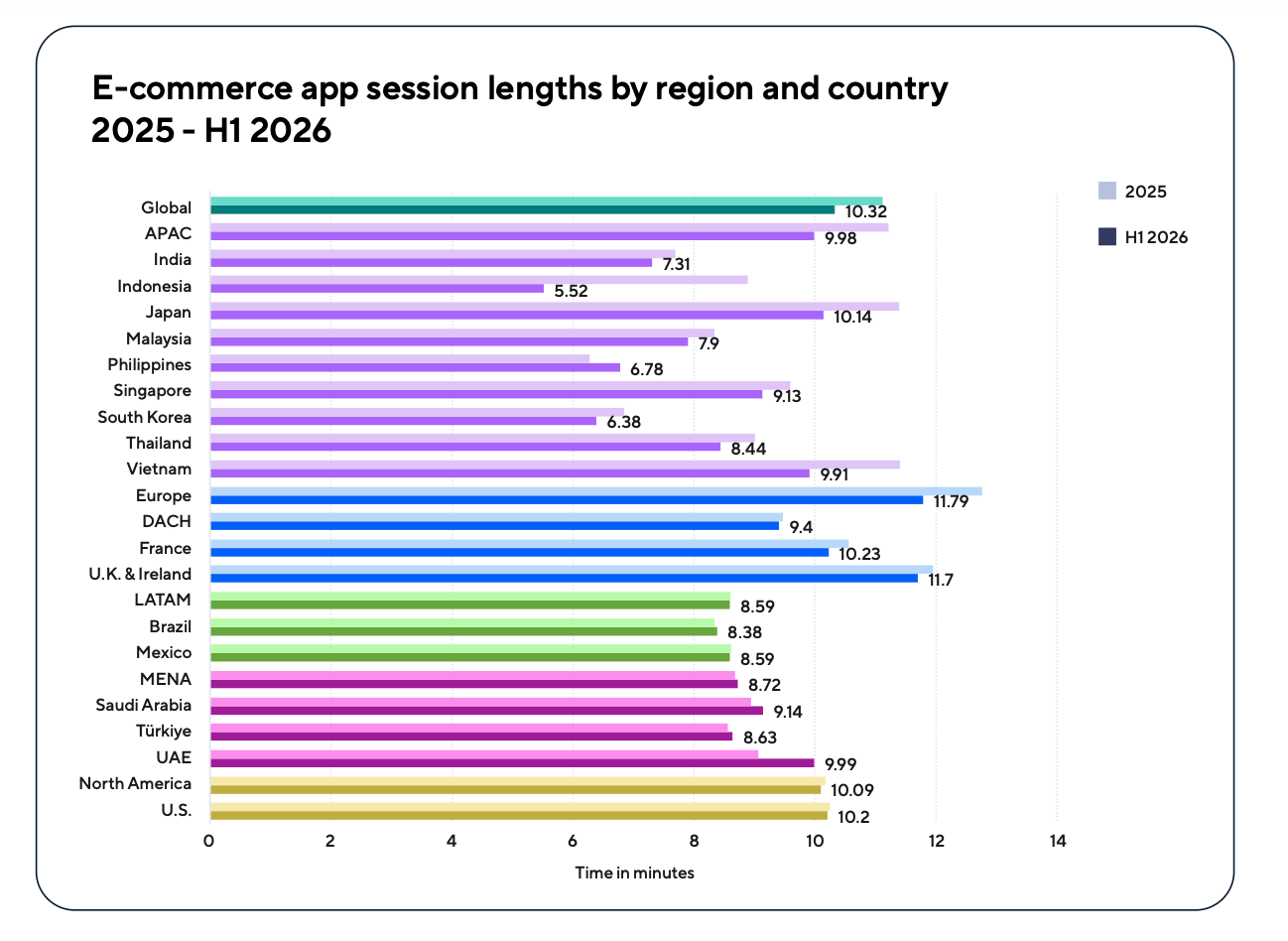
Amazon and others in Europe and North America still suck more time than their Asian peers. That could be down to the style of the shopping experience, in addition to the relative lack of maturity in Southeast Asia and beyond. But the gap continues to close.

US government investigates logistics firm over alleged chip smuggling
Southeast Asia has emerged as a cheat code for Chinese companies wanting access to US chips and hardware that’s banned on the mainland. We know some companies use facilities in the region to legally train their AI models on Nvidia-powered setups, that was the case with Kimi K3. But the US government is now cracking down on companies that are actively shipping these parts into China from Southeast Asia.
Apex Logistics, a Singapore-based transportation company, is being looked into over suspicions that it brought Super Micro servers built on Nvidia hardware onto Chinese soil. Bloomberg reports that Apex, which is owned by Switzerland-based Kuehne+Nagel, has no relationship with Super Micro, it simply handles shipments on behalf of customers. Nvidia CEO Jensen Huang has previously insisted there’s no covert shipping of the company’s products, particularly since they’re challenging to transport.
Still, if Apex is prosecuted, this would be the first time such charges have been raised over AI chip smuggling. That could open the floodgates for other investigations in the future.
Deals
SoftBank is in talks to acquire a majority stake in OpenAI-backed humanoid robotics startup 1X Technologies at a valuation of about $6 billion, giving the Norwegian company fresh backing after it missed a $1 billion fundraising target last year [The Information]
Singapore-based Flashlight Capital has offered 906.6 billion won ($655 million) for a 20.6% stake in S-1, South Korea’s largest security services provider, in the first activist takeover attempt involving a Samsung affiliate [FT]
Singapore enterprise AI company FileAI secured investment from SMBC Asia Rising Fund and Singtel Innov8 to expand fileForge, its platform for automating finance, compliance, procurement and customer-onboarding work [TechNode]
Chinese brain-computer interface startup Gestala raised 570 million yuan ($84 million) across two rounds in its first six months, as China’s race to commercialise less invasive neural-interface technology heats up [Gestala]
Markets
SenseTime posted its first profit since going public in 2021, with first-half revenue up 23.4% to 2.91 billion yuan ($407 million) and profit of 617.3 million yuan ($86 million), though its core business remained loss-making on an adjusted basis [TechNode]
Shein is looking to acquire or partner with fashion brands as growth in its own label slows, leaning on its China supply chain after a Hong Kong IPO that valued the company at just over $26 billion, down from $100 billion in 2022 [Bloomberg]
AI and Chips
Nvidia resumed H200 shipments to China under a new US licensing scheme, but the business remains tiny for now, with China sales accounting for less than 1% of its $89 billion data-centre revenue in the second quarter [SCMP]
Kioxia and SanDisk plan to invest more than $31 billion in Japan by 2032 to drive semiconductor technology and expand production capacity [Reuters]
Taiwan’s Powertech Technology plans to begin production at the world’s first panel-level packaging facility for AI chips as early as 2027, potentially moving ahead of TSMC on the next-generation packaging technology [Nikkei Asia]
Chinese chip suppliers may attend Semicon India 2026 as trade delegates for the first time, as India’s expanding electronics and smartphone manufacturing base draws more interest from across the border [Economic Times]
OpenAI launched ads for logged-in adult users on ChatGPT’s free and Go tiers in India, with Plus, Pro, Business, Enterprise and Education users remaining ad-free [Economic Times]
Alibaba launched its first data centres in South America, opening two facilities in Brazil to provide cloud infrastructure and agentic AI services [SCMP]
SK Hynix broke ground on a more than $4 billion advanced packaging and research facility in Indiana, expanding its US footprint as AI-driven memory demand keeps rising [Reuters]
Policy
Google is hiring a senior partnerships manager in Seoul as it prepares to launch full-functioning Google Maps in South Korea, including turn-by-turn directions [The Korea Herald]
South Korea’s media regulator said Meta’s youth-protection changes should apply worldwide [Reuters]
For news as it happens, follow ATR Bulletin, our real-time news site that keeps you in the know.