


Happy Friday and welcome back to Asia Tech Review, your curated digest to keep up to date with tech news across Asia. This issue is a bit longer than usual following our non-publishing day, so there’s plenty to dig into.
We’re looking primarily at Shopee, which now has some of the internet’s biggest names in its corner including Instagram, Facebook, YouTube and ChatGPT. That’s because Southeast Asia’s e-commerce leader is desperately trying to stave off the growing threat of TikTok Shop, which has rapidly risen to become the region’s second most popular destination for online shopping.
To keep up with our issues, follow us on LinkedIn or WhatsApp. Please do share Asia Tech Review with people you know who want to get smart about Asia tech.
Shopee is partnering with the internet’s biggest platforms to defend against TikTok Shop

Shopee is out to meet you wherever you are on the internet. The company just agreed a partnership with Meta to bring affiliate revenue to creators on Instagram and Facebook as part of its effort to rival TikTok’s growing e-commerce market share in Southeast Asia and beyond.
Endless scrolling of short videos may come to mind when you think of TikTok, but there’s a lot more. We’ve noted in recent years that the Chinese firm (technically headquartered in Singapore) has quietly risen up the ranks to become Southeast Asia’s second-top e-commerce business, behind only Shopee.
TikTok Shop is estimated to have reached $54.6 billion in GMV across Southeast Asia last year, up more than 50% year-on-year, according to figures from Momentum Works. That puts it behind Shopee’s $83.2 billion GMV, but TikTok Shop’s crazy growth rate suggests the gap will narrow further this year.
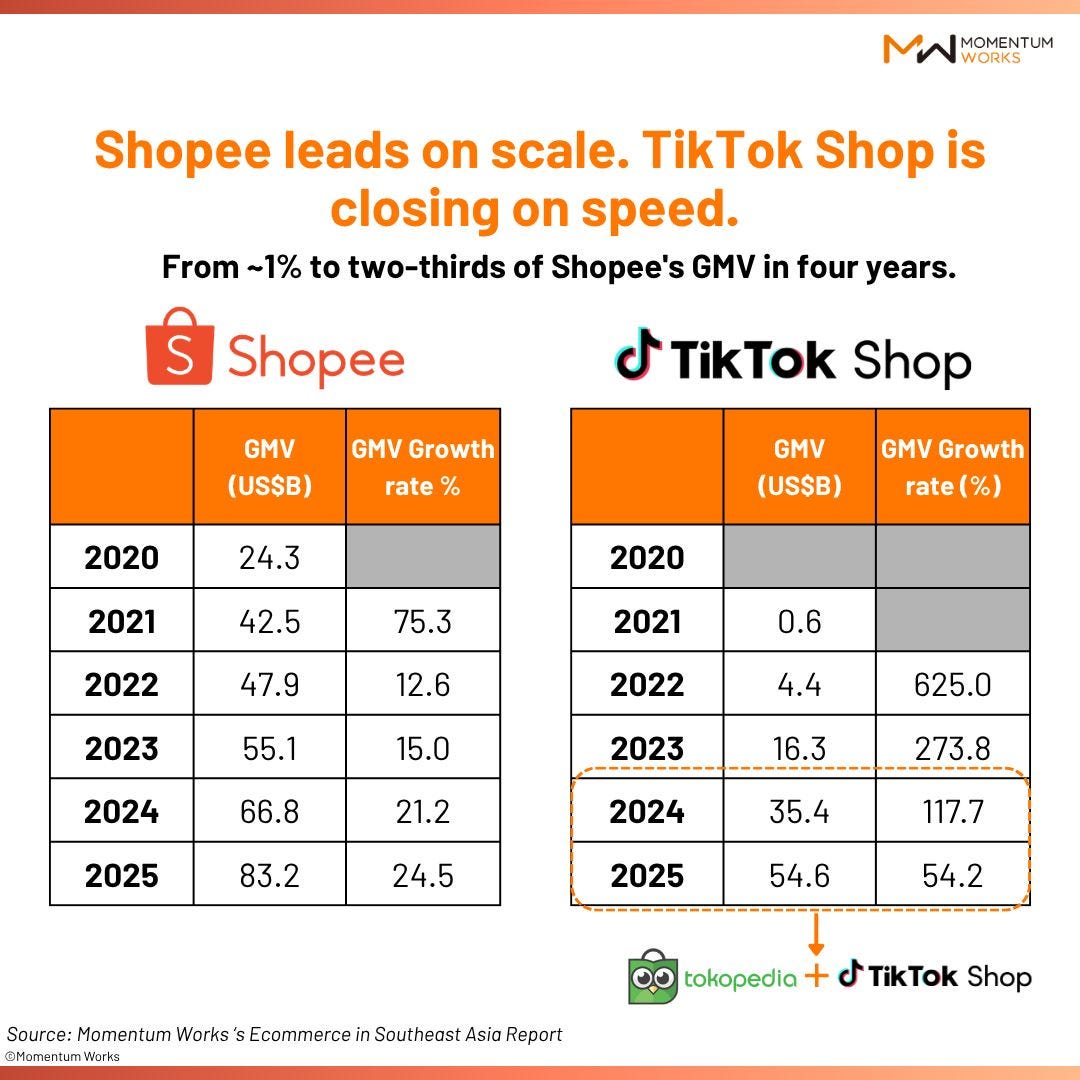
Social commerce felt a little gimmicky at the start, but it has become hugely lucrative and Southeast Asia is at the forefront. I’ve seen with my own eyes how consumers go on TikTok to find deals and products, as well as following their favourite creators. Shopee creates purchasing intent. By contrast, Shopee and Lazada are destinations when you know you want to buy.
That explains why Shopee is going out to build a moat to shore itself up as best it can.
The Meta deal will allow creators in Southeast Asia, Taiwan and Brazil to make money by linking to Shopee products. With a minimum follower count of just 1,000 on Instagram, a lot of people may begin shilling Shopee items, or large accounts might consider it a new revenue stream to explore.
Instagram is the best tonic for battling TikTok, but it is not Shopee’s sole gambit.
It linked up with OpenAI last month to add Shopee e-commerce capabilities to ChatGPT in those same target regions. Back in 2024, when the TikTok Shop threat was already visible, it partnered with YouTube to let video creators on the platform earn affiliate revenue the very same way as they can now do on Instagram.
Some years ago, Lazada and Shopee went all out to create engagement and bring users to their apps without purchasing intent. They rolled out games, gave livestreaming capabilities to sellers and more. Some of that has stuck, livestreaming may help deciding on a product, but it doesn’t funnel shoppers in as TikTok does.
ByteDance’s acquisition of Tokopedia helped drive its shopping business in Indonesia, which is second only to the US, not to mention making Tokopedia’s holding company GoTo profitable. But times are changing. TikTok Shop laid off a number of Tokopedia staff in Indonesia. Local reports suggested as many as 90% were impacted. TikTok confirmed that there were layoffs but not the numbers impacted.
Is TikTok and TikTok Shop about to get more ruthless in the region?
Regardless, executives at Sea, the parent of Shopee, will feel they have as good a defence as they can with Instagram, Facebook, YouTube and even ChatGPT in their corner. But does that patchwork of connections between creators and shopping stand up to TikTok’s integrated approach which puts it all on the same platform? Only time will tell.
But expect to see more stories of TikTok Shop’s surge when the annual e-commerce reports land at the end of the year.
Thailand’s Amity lands $7M more to build out its robotics business
Thailand’s Amity is quietly hoovering up investment money even during Southeast Asia’s funding winter. Fresh from raising $100 million in March for its core AI play, it announced that its robotics and physical AI business (Amity Robotics) closed a $7 million seed round that includes equity and debt.
The capital is coming from East Ventures, which famously backed early stage winners in Indonesia over the last decade or so, and 500 Startups with Singapore’s AlteriQ Global, which offers private credit, bringing the debt component.
Amity Robotics develops and sells a static concierge robot that’s designed to give information and answer questions in shopping malls, hotels and other locations with customers. Already, it is deployed in over 30 properties across Asia and the Middle East with Europe apparently to follow soon. The company looks to have tapped the network of founder Korawad Chearavanont, a member of the family behind Thailand’s mega conglomerate CP Group, to deploy the robot in resorts like IHG, Accor and Shangri La and some prestigious malls.
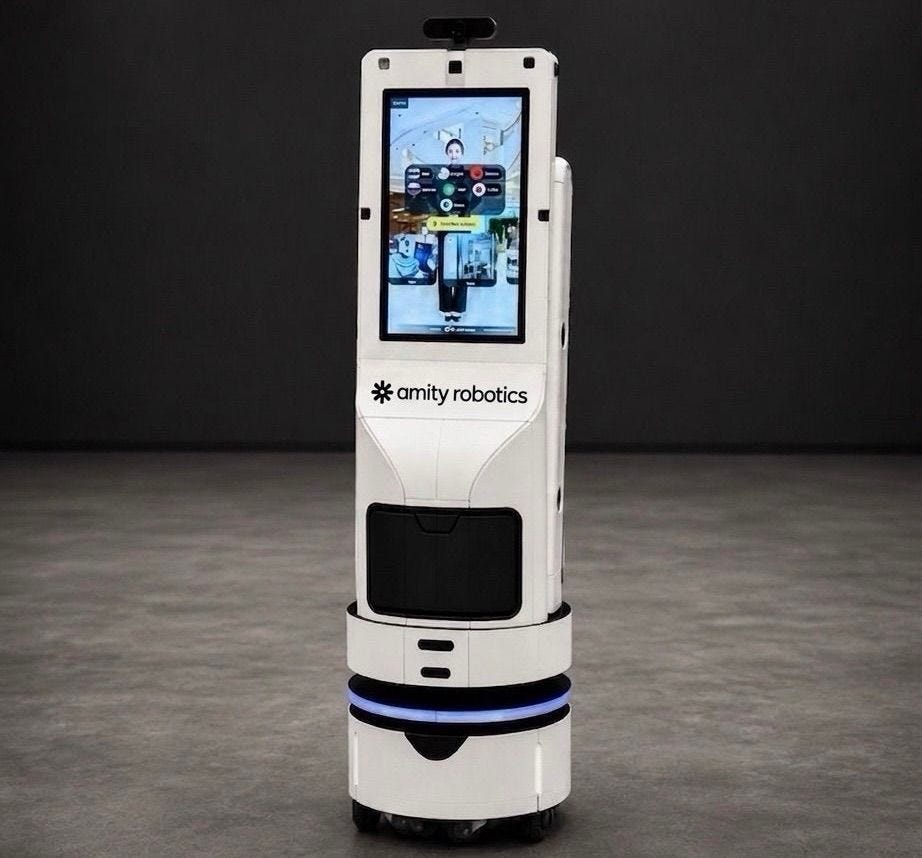
There are also plans to introduce a mobile version of the robot, which uses a combination of voice and a large touchscreen.
“We believe a world-class physical AI company can be built from Thailand and Southeast Asia,” Chearavanont said in a statement.
We don’t see a lot of robotics companies emerging from outside of Singapore in Southeast Asia, Southeast Asia itself isn’t really a hub. If Chearavanont can continue to apply his fundraising magic to the business, Amity has as good a chance as any startup at taking on this tough task, although it is tough to take on China, which is already producing dancing robots let alone static machines for malls.
Deals
China’s Kling AI raised an initial $2 billion in venture funding as the Kuaishou spinout expands its video AI operations, with further investors potentially lifting the round to about $3 billion [Bloomberg]
It feels like the 2010s again after Singapore’s Acti raised a $5.3 million seed round to build an AI-powered keyboard for personal context across apps [TechNode Global]
US-Korean AI video search startup Twelve Labs closed $100 million from Amazon, NEA and Naver Ventures to expand its AI video search technology [Bloomberg]
Indian VC firm Sparrow Capital closed its third fund at INR4.75 billion ($50 million), with plans to invest $1 million-$2 million each in 25-30 startups over the next three years [Economic Times]
SoftBank reportedly restarted talks with lenders for a $10 billion loan backed by its OpenAI stake, adding a repayment guarantee after earlier discussions stalled [Reuters]
Markets
India’s IPO wagon gains another passenger after the parent behind social platform ShareChat said it plans to raise up to $400 million in a domestic IPO next year. It claims to now be ‘operationally’ profitable this year with annual revenue of $105 million. It says it has over 150 million users across social networking and streaming services. Side note: nice of Bloomberg to label it a “rival” to Meta… [Bloomberg]
Indian VC firms had their weakest six months of fundraising for more than a decade after closing just $820 million across 32 funds as of mid-June [Economic Times]
By contrast, startup funding in India in the same period reached the second highest levels since 2022 with $7.4 billion in capital closed, although Meta’s unique $900 million investment in Cred lifted the numbers [Entrackr]
Xiaohongshu, the social app known as RedNote, is reportedly preparing for a Hong Kong listing that could become the biggest Chinese internet IPO in five years. It was previously valued at $17 billion but apparently private market valuations have “soared.” [Financial Times]
Creditors filed insolvency proceedings in Singapore against Udaan, the B2B e-commerce startup that was valued at over $3 billion, after it defaulted on $170 million of convertible notes due June 30 [Economic Times]
South Korea’s Kospi fell as much as 8.2% as Samsung Electronics and SK Hynix sold off on concerns over excess AI infrastructure capacity [Bloomberg]
AI and Chips
Japan is getting serious about sovereign AI after the government pledged to invest up to JPY1 trillion ($6.16 billion) in a nine-company consortium led by SoftBank, Honda, NEC and Sony to build a domestic AI foundation model [Nikkei Asia]

China’s semiconductor material makers are said to be ramping up advanced production as Beijing pushes for self-sufficiency and challenges incumbent rivals in a $73 billion market [Nikkei Asia]
Taiwanese prosecutors detained two Super Micro Computer employees and an Albatron Technology manager as part of a probe into alleged Nvidia chip shipments to China [Bloomberg]
Singapore police seized a S$55 million ($42 million) mansion and around S$1 million ($775,000) in bank funds tied to a probe into suspected cross-border smuggling of Nvidia chip-laden hardware [Nikkei Asia]
Anthropic rolled back a covert Claude Code feature that tracked whether users were based in China or linked to Chinese AI labs after a social media backlash [The Information]
ByteDance picked Brazil as the location for its largest data centre outside China, a $39 billion project that could scale to 1GW of computing capacity. This follows a commitment in May to invest $25 billion in Southeast Asia-based data centres. [Bloomberg]
Vietnam’s G-Group Technology Corporation will invest VND7.6 trillion ($300 million) in an AI and high-performance computing data centre campus in Hanoi [TechNode Global]
UBTech Robotics launched a consumer humanoid companion robot in China, with models priced from 119,800 CNY ($17,650) to 990,000 CNY ($146,000) [SCMP]
South Korean exports hit a monthly record of $102.25 billion in June, boosted by record semiconductor shipments from SK Hynix and Samsung Electronics [Nikkei Asia]
Beijing set a target of 50,000 industrial 5G private networks by 2030 as it pushes AI deeper into Chinese manufacturing [SCMP]
Indian serial entrepreneur Bhavin Turakhia is putting $30 million of his own money into Neo, an enterprise AI software startup built around redesigned workplace tools rather than chatbot add-ons [TechCrunch]
SK Hynix will invest KRW100 trillion ($64.4 billion) to build new chip plants in Cheongju, including a NAND flash facility due by 2029 [Reuters]
Microsoft and Singapore-based Lightstorm will lead a consortium building the 3,600km I-2SEA undersea cable linking India with Malaysia and Singapore [Reuters]
Apple is in talks to buy memory chips from China’s ChangXin Memory Technologies and Yangtze Memory Technologies for devices sold in China as global memory prices rise [Bloomberg]
SoftBank Group and its telecom unit will start renting AI computing power to US companies next fiscal year through a new neocloud venture, SB Neo [Bloomberg]
Z.ai, formerly Zhipu AI, launched ZCode, a free desktop coding app built for its GLM-5.2 model [VentureBeat]
Z.ai’s GLM-5.2 model is drawing attention from Silicon Valley executives and investors for coding and agent performance at lower cost than leading US rivals [Reuters]
In other news:
India has told Meta to pause the rollout of custom WhatsApp usernames because apparently it has concerns over fraud, phishing and impersonation implications of the move [Bloomberg]
Toyota wants to get into the flying car game after it announced a joint venture with US-based Joby Aviation to produce air taxis [Reuters]
Speaking of taxis, France’s BlaBlaCar will expand into 20 new countries, including Indonesia, Malaysia, the Philippines, Thailand and Vietnam. Its business in India just became its largest carpooling market with 19 million passengers [BlaBlaCar]
India’s Dream Sports shut down fintech platform Dream Money within a year of launch [Economic Times]
South Korea’s Financial Services Commission referred two suspects to prosecutors over alleged crypto price manipulation [The Block]
Ant International opened a Kuala Lumpur global development centre with 1,500 fintech roles, more than half of them in technology [TechNode Global]
Alibaba and its US payment processor will pay $600 million to settle US Justice Department allegations that merchants sold illegal drugs, chemicals and pill presses through its e-commerce platforms [Reuters]
A Shanghai court sentenced five people to up to six years in prison for moving more than $29.4 million across borders illegally using crypto [The Block]
Taiwan’s legislature passed a law establishing a regulatory framework for crypto trading platforms and stablecoin issuers [The Block]
New legislation to boost the role of startups and SMEs in Thailand is expected to clear parliament and take effect by the end of this year [Nikkei Asia]
Gaming firm Krafton agreed to pay bonuses to Unknown Worlds Entertainment staff after settling a legal dispute with the Subnautica 2 studio’s CEO and co-founders [Bloomberg]
Skyroot Aerospace is preparing to launch Vikram-1, India’s first privately designed orbital rocket, between July 12 and August 4 [Bloomberg]
Anthropic is in talks with Samsung to be a manufacturing partner for a custom AI chip [The Information]