


Welcome back to Asia Tech Review, your curated digest to keep up to date with tech news across Asia.
Anthropic’s launch and then withdrawal of its newest models have put AI sovereignty on the map worldwide. We look at how the landscape is across Asia’s biggest regions, the good, bad and ugly.
To keep up with our issues, follow us on LinkedIn or WhatsApp. Please do share Asia Tech Review with people you know who want to get smart about Asia tech.
AI sovereignty looks wildly different across China, India, Japan, Korea and Southeast Asia
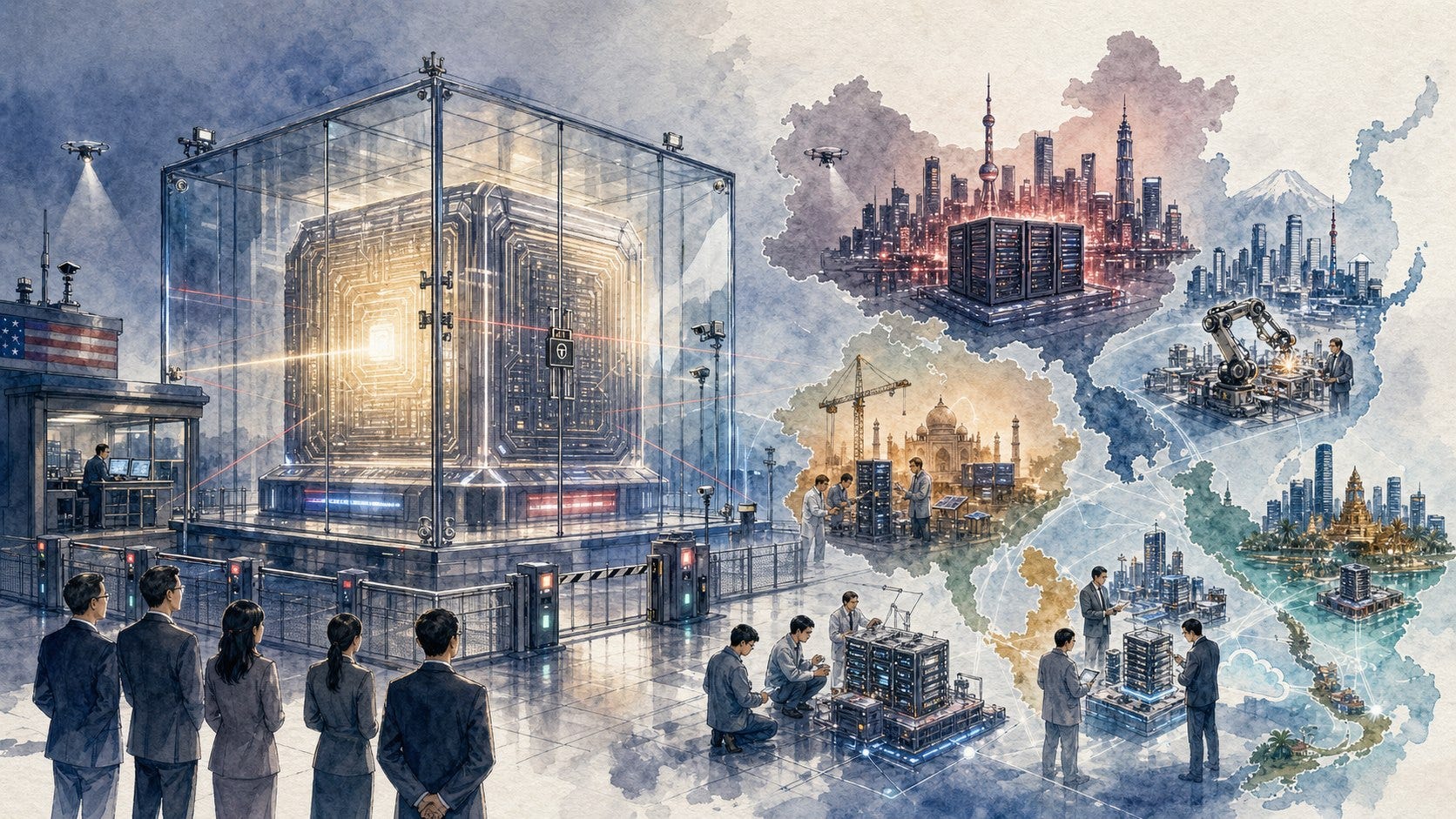
Companies, governments and citizens across Asia will start this week with acute knowledge of the term ‘sovereign AI’ after Anthropic withdrew its new Mythos and Fable models just days after their launch. In crucial subtext, the company says the US government ordered it to suspend access to the models for all foreign nations. Instead, it removed them for all users, US or otherwise while it works to “ensure compliance.”
Ignoring the complexities of Anthropic’s relationship with the US government, MG Siegler has a thorough account, developments over the last few days show that reliance on US technology is not advisable. We wrote about the importance of digital sovereignty last month in terms of storage and compute, and that extends to AI models, too.
That’s a new difficulty that governments across the world, and, in our case, Asia, must now navigate. Not all countries are equipped to handle the situation as we shall see.
China
China is a unique case. It is well into its own self-sufficiency strategy, which runs from its own storage and cloud computing options, to AI models, chipsets, memory and even venture capital, stock market and more.
That’s the blueprint. Beijing’s tempestuous relationship with Washington forced its hand, while its tech companies have been forced by both the US and China’s own aspirations. China, of course, already has a world-class tech industry and ecosystem, which few others can boast.
There’s much more to say, but for now we’ll leave this here as China is not in crisis around AI sovereignty. In fact, Anthropic and Washington’s moves stand to potentially benefit China as it leaves a void for reliable AI services that Chinese companies could move into.
India
China is streets ahead, but India is the new kid on the block when it comes to the sovereign tech stack. India has a cluster of companies developing AI models for the nation.
That’s led by Sarvam, which was reportedly raising up to $350 million at a $1.5 billion valuation in April and offers an indigenous AI chat app. Others in the race include early-mover Krutrim, but parent company Ola has pivoted it towards cloud after challenges, government-funded BharatGen and AI4Bharat, an open source data initiative that emerged from IIT Madras.
Sarvam’s founders have, unsurprisingly, called the Mythos/Fable incident a wakeup call that shows overseas service providers can’t be relied upon
“From our vantage point, it is super clear that India will build, leverage, and create massive business value and societal impact with sovereign AI,” CEO and co-founder Pratyush Kumar wrote on X.
On the government side, IndiaAI Mission was launched two years ago with the goal of helping Indian companies access AI services. Now, its mandate is adjusting to creating local AI infrastructure with the goal of increasing capacity and reducing that reliance on overseas providers. Already, the initiative has secured more than 38,000 GPUs.
South Korea and Japan
South Korea may be better placed than India based on the here and now. It has treated sovereign AI as an industrial strategy and engaged some of its top names.
The government selected five teams for a national AI model programme, including Naver Cloud, LG AI Research, SK Telecom and NC AI. Also involved was Upstage, an AI startup that’s rumoured to be heading for an IPO at a $3.3 billion valuation.
Korea has many of the infrastructure pieces already. From globally competitive chip and memory companies Samsung and SK Hynix, to cloud and internet players, telecom operators and a government with a set of ambitious national technology goals.
On the model side, Naver, LG and Upstage have developed models with the potential for distribution. SK Telecom is also building a strong model, and it recently tied up with Nvidia on infrastructure.
Japan’s approach is a little more disparate, but from similar starting blocks. Sakana AI catches the eye, having been founded by former Google researchers and backed by major investors including Khosla Ventures, Lux Capital and Google. While it is one of Japan’s startup hits, with a valuation of $2.65 billion, it isn’t specifically developing sovereign AI.
Like Korea, the local push has largely come from corporations like NTT, Rakuten, NEC and Fujitsu, which have been or are developing Japan-specific language models. The push is less about sovereign AI and more around bringing AI into corporations and consumer services, and integrating it into robotics, manufacturing, etc.
Southeast Asia
As a diverse and multi-country region, Southeast Asia’s status quo on sovereign AI and homegrown technology is more complicated and fragmented than the single markets we assessed. As we mentioned last month, the situation is worrying as the region tends to be a market for overseas players from the US, China and beyond.
AI Singapore, a government initiative, is developing the Sea-Lion model for the region. The open source model supports languages including Indonesian, Malay, Thai, Vietnamese, Filipino, Burmese, Lao and Khmer, but significantly lags top tier international models in terms of capabilities.
Elsewhere in the region, Indonesia’s GoTo developed local LLM Sahabat-AI, Malaysia has ILMU and there are other smaller developments taking place. Clearly, though, developing sovereign AI models that can hold their own will be a huge challenge. Given the length of time and effort development takes, many governments may not prioritise them.
In Thailand, for example, the aptly named TH-AI Pass is a 1.6 billion THB ($50 million) programme to fund access to premium AI tools for 5 million citizens for one year. The initiative attracted controversy for its short-term nature and scrutiny around the tender, but it sums up the mindset of governments that have fallen behind.
Deals
Alibaba bid $1.5 billion for Chinese grocery delivery firm Pupu to beef up its online commerce fight with Meituan [Bloomberg]
US firm BizLink is buying Singapore’s Interplex Datacom, which makes high-speed connectivity solutions for data centres, AI and communications networks, from Ennovi, its Blackstone-owned parent company, for $850 million [Bloomberg]
NTT Global Data Centers, a unit of Japan’s NTT, is seeking to raise at least $1 billion in fresh capital for US development projects [Bloomberg]
Equal AI raised $30 million to build an India-focused AI assistant that screens calls and summarises why someone is calling [TechCrunch]
Residential rooftop solar startup SolarSquare raised $50-55 million led by B Capital at a valuation of $450-500 million [Economic Times]
Rekise Marine raised $9.7M led by Accel and NKSquared to build autonomous ships and submarines for the Indian Navy [Economic Times]
Meesho acquired B2B grocery platform Kirana Club for Rs 202 crore ($24.3M) to expand beyond its consumer marketplace [Entrackr]
Markets
India’s Razorpay has reportedly confidentially filed for a domestic IPO that’s rumoured to value it at $5-6 billion, a drop from its previous high of $7.5 billion [Economic Times]
Humanoid robot maker EngineAI confidentially filed for a Hong Kong IPO, it previously raised $200 million in April [Bloomberg]
In a mirror of what’s happening in Korea, chipmaker Kioxia last week overtook Toyota to become Japan’s most valuable company as AI-driven demand pushed its market cap above 44T yen ($274B) [Japan Times]
Speaking of which, Korea’s SK Hynix is reportedly leaning toward Nasdaq for its planned US listing as it aims to capitalise on its surging business [Reuters]
MetaX looks like being the next Chinese chipmaker to list in Hong Kong [Bloomberg]
Regulatory heat
Meta is reportedly building separation between itself and Manus as an unwinding of its acquisition remains pending. Meta has halted data sharing, barred Manus staff from accessing its internal systems and Meta employees can no longer use Manus tools for internal projects. [Bloomberg]
South Korea’s Personal Information Protection Commission fined Coupang a national record 624.7 billion won ($409 million) for a data breach last December that exposed 33.7 million user accounts [Bloomberg]
South Korean police charged Bithumb CEO Lee Jae-won on suspicion of bribery suspicions, alleging the crypto exchange hired the son of a sitting lawmaker in exchange for favours [The Block]
China’s top labour union newspaper is sounding the alarm over AI’s threat to workers’ rights, urging regulators to tighten oversight of algorithms and give trade unions a greater role in shaping workplace protections. [Bloomberg]
In other news:
Tata Chairman Natarajan Chandrasekaran said AI agents could replace half the jobs at TCS, Asia’s largest software services firm [Bloomberg]
China’s Ministry of Industry and Information Technology and state assets regulator have jointly ordered local governments and state-owned enterprises to deploy humanoid robots across manufacturing, logistics, retail, and healthcare. The directive sets a target of more than 10,000 units in commercial use by end of 2026. link
Alibaba replaced DingTalk CEO and co-creator Chen Hang following reports of an internal debate over the workplace app’s role in the company’s broader AI strategy [Bloomberg]