


Welcome back to Asia Tech Review, your curated digest to keep up to date with tech news across Asia.
Who knew Monday would be a blockbuster news day for Asia tech? Today we’re looking at a billion-dollar acquihire and a Japanese AI startup that claims its newest model is as good as Anthropic’s Fable/Mythos.
To keep up with our issues, follow us on LinkedIn or WhatsApp. Please do share Asia Tech Review with people you know who want to get smart about Asia tech.
Meta’s $900M Cred deal isn’t really about Cred at all
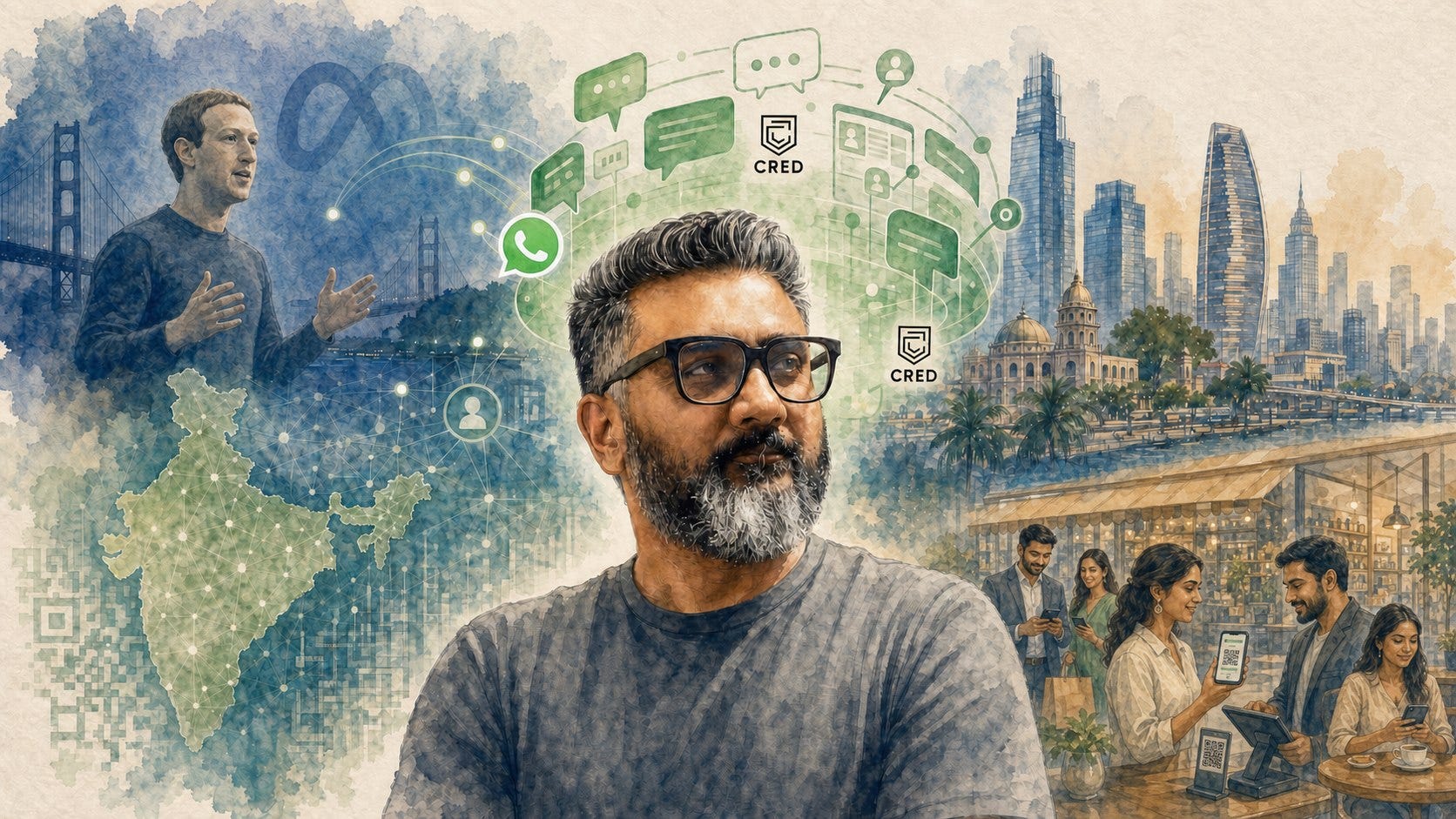
Mark Zuckerberg and Meta are forking out nearly $1 billion to essentially acquihire a new CEO to run WhatsApp.
That’s the one-line takeaway from a rather unique deal which will see Meta invest $900 million into India-based fintech startup Cred for a 20% stake. As part of the transaction, Kunal Shah, Cred’s founder and CEO, will move over to become the global head of WhatsApp.
Shah will remain the chairman of Cred, but his deputy, Miten Sampat, will step up into his role and lead the company to give Shah the capacity to run WhatsApp.
Some details of the news sneaked out a little early with Moneycontrol reporting that there had been talks between Meta and Cred over a possible investment or acquisition, as we noted in yesterday’s newsletter. I speculated that this would be a talent acquisition, in a similar fashion to how Meta hired Alexander Wang by investing $14 billion in his startup Scale AI in 2024, and it appears to be so, but with one twist.
Shah is not a Silicon Valley insider like most of Meta’s management, including former WhatsApp head Will Cathcart. But he may be India’s most prominent entrepreneur and angel investor, which is significant as we’ll explain.

Zuckerberg said Shah brings a “builder mentality and global mindset.” Meta COO Chris Cox added that he was “the clear choice” to replace Cathcart, who is moving to a role to build new products after seven years leading WhatsApp. There’s a lot about Shah’s past for Meta’s management to like.
At Cred, Shah has helped raise nearly $1 billion from investors at a valuation that peaked at $6.4 billion. But this isn’t his first rodeo. He sold his previous business, digital payment startup Freecharge, to early e-commerce leader Snapdeal in 2015 for around $400 million.
That was one of India’s earliest major startup exits. Rather than retiring, Shah doubled down. He became a prolific angel investor, I estimate he has a portfolio of over 50 deals which includes Gojek, Razorpay and Unacademy. He went back into fintech with Cred and built a business which targets the more affluent users in India, but offers a payment experience that’s far higher quality than other wallets and card companies.
Cred’s market share is not significant, but it does hold a full stack of licences and it has been profitable as a business, according to Shah himself.
WhatsApp is insanely popular in India. India is WhatsApp’s largest market for users. But, Meta has missed the payments race in India despite its efforts to make WhatsApp Pay a mainstream contender. Some of that has been regulatory challenges, which aren’t helped by being an overseas company that’s led by a non-Indian executive.
Installing Shah as WhatsApp CEO could clear some of those difficulties with his knowledge of regulators, licenses and building in fintech. WhatsApp has already seen early revenue promise with its business chat feature in India, and that’ll be a key focus, too.
They could have hired a local consultant, someone senior with experience of US corporates and startup culture. Flipkart hired Kalyan Krishnamurthy, a former Procter & Gamble and eBay executive with experience at investment funds, after it was acquired by Walmart in 2018. But Zuckerberg has a preference for entrepreneurial leaders and not simply executives as the hiring of Wang showed, and efforts keeping the founders of Instagram and WhatsApp at the company for as long as possible after their acquisitions.
Shah fits the bill not only because he has extensive experience, knowledge and presence in India’s startup ecosystem (Shah has over one million followers on both LinkedIn and X), but he’s also familiar with US startup culture and he has great links in Silicon Valley, too. No doubt, these are characteristics the Meta CEO will admire.

Ultimately, though, Shah’s job will be tough. Google Pay and PhonePe accounted for 79% of all transactions made on India’s UPI (universal payments interface) national payment system in May 2026, with Cred at just 0.68% and WhatsApp Pay lower still at 0.65%.
WhatsApp Pay is insanely late to the payments party in India. Even if it does find the right relationships, it has a lot of work to carve out market share. Of course, it also remains unclear how the change of culture will work. Will Shah be based in India and hire a team in the country? Will he need to bounce between the country and the US? Does Meta ultimately acquire Cred?
I’m looking forward to seeing how this plays out, and particularly what impact Shah will have on how WhatsApp develops. Meta’s investments in India haven’t really paid off, so it’s not a huge surprise to see it try something newer, more local and more personal. Even at nearly $1 billion for one person.
Japan’s Sakana enters the chat with an AI model it says matches Anthropic’s Fable
We’ve periodically written about Sakana, a Japan-based AI startup founded by former Google Research fellows, mostly when it raised money, but now it has burst on to the global stage with the launch of its newest model, Fugu.
“Our ‘Fugu Ultra’ model matches the performance of Fable and Mythos, delivering frontier capability without the risk of export controls,” the company said in an announcement on X. That said, it is not currently available in Europe while the company “works towards compliance” in the region.
Unlike other models, Sakana operates multiple LLMs using an ‘agent pool’ which essentially means it will use different models to handle requests based on the task. It claims to use both open and closed models, as well as its own, to remove “any single-vendor dependency,” which we saw when Anthropic unlaunched its Fable and Mythos models just over a week ago following US government intervention.
Fugu is also built for agentic AI and optimised for multi-agent systems. That’s the newest trend in AI usage right now. Rather than prompting a model, developers and corporations are increasingly building and deploying agents that can handle more complicated tasks without constant human interaction.
Sakana is valued at $2.65 billion and it has raised $379 million from backers that include US corporate VCs like Google, Nvidia and Salesforce, US VCs Khosla and Lux, and more than half a dozen Japanese corporates including MUFG, Sony and NTT.
Sakana claims Fugu Ultra beats the newest models from ChatGPT (5.5) and Google Gemini (3.1 Pro) as well as Anthropic’s Opus 4.8 on benchmarks. It even posted results that surpass Fable and Mythos on a handful of comparison tests, but real world usage may be another story.
The two Fugu models come with an OpenAI-compatible API, which means it can be easily plugged into OpenAI’s Codex app. The company is offering a free month for customers who buy its monthly subscription, which starts at $20 per month so it could be interesting for AI curious folks. Enterprise sales are hot in Japan, where a sovereign AI stack is emerging, so this will be a key avenue if Sakana is to grow revenue in this highly competitive landscape.
Deals
Samsung created the term ‘shadow AI’ when sensitive company information was famously exposed when its engineers entered information into personal ChatGPT accounts in 2023, so it’s notable that Samsung is giving ChatGPT Enterprise and Codex access to its Korea-based staff and numerous overseas divisions. OpenAI said this is one of its largest enterprise deployments to date, and it reinforces why the company and rival Anthropic have put a huge sales emphasis on East Asia to date. [OpenAI]
In more OpenAI Asia news: Sea, the company behind Shopee, announced a partnership to bring its e-commerce services into ChatGPT in its core markets of Southeast Asia and Brazil. It might not move the revenue needle but it shows Sea is mixing it with the bigger names in tech. [Sea]
Japanese bathroom fixtures maker Toto plans to invest 80 billion yen ($495 million) over the next five years to expand its semiconductor materials business [Nikkei Asia]
The founders of Taiwan’s Himax have become billionaires as surging demand for automotive display chips drove the company’s shares to more than double this year [Bloomberg]
Chinese investor NewTrails Capital will inject $55 million into African electric motorbike startup Spiro, pushing its valuation to nearly $1 billion and bringing the latest funding round to $270 million. Spiro has a network of around 100,000 electric bikes and 2,500 battery swapping stations across seven countries in Africa. [Bloomberg]
Markets
Chinese robotics company Coowa, which recently raised over $600 million in a round valuing it at over $3 billion, is said to be preparing to file for a Hong Kong IPO within the next few months [WSJ]
ByteDance is reportedly trading at above $600 billion in the secondary trade market, which could see it reach a $1 trillion valuation whilst remaining private, according to an anonymous senior banker at Bank of America. That could explain why ByteDance has decided against making a renewed push to go public [Nikkei Asia]
Zhipu AI’s Hong Kong-listed shares surged 42% on Monday to push its market cap past HK$1 trillion (US$128 billion), after it open-sourced its newly released GLM-5.2 model last week [South China Morning Post]
Lingyi iTech, an Apple supplier and Shenzhen-listed electronic components maker, is targeting up to HK$8.3 billion ($1.1 billion) in a Hong Kong IPO happening this week to fund expansion into AI hardware and humanoid robotics [South China Morning Post]
Japan’s five biggest chipmaking equipment makers recorded their first-ever combined sales decline in China as homegrown alternatives rose on account of Beijing’s self-sufficiency push. Tokyo Electron, Advantest, Screen Holdings, Disco and Kokusai Electric reported a combined annual revenue decrease of 12% from 2024. [Nikkei Asia]
AI and Chips
SK Hynix briefly overtook Samsung Electronics as South Korea’s most valuable company on Monday, the first such reversal in 26 years [Nikkei Asia]
Tencent is testing an AI assistant called Xiaowei on WeChat, which runs on its own WeLM language model with some help from DeepSeek [Bloomberg]
Indonesia plans to embed AI across key government programmes, including its controversial $15 billion free meals initiative, as part of a strategy the government believes could lift GDP by 12% by 2030. This seems like an initiative that could go seriously wrong, given the trial against Nadiem Makarim for Chromebooks for schools and the recent sentencing of state-linked fund VCs for losing money on one deal. [Reuters]
JD.com founder Richard Liu said the Chinese e-commerce giant’s 700,000 delivery workers will eventually be replaced by robots [FT]
In other news:
India’s Tata Research was hit by a cybe attack which the perpetrators claim gave access to more than 200,000 documents including proprietary information from Apple and Tesla, both of which are Tata customers [Reuters]
A Chinese chemical company whose executives were convicted in the US last year over fentanyl precursor exports appears to have been linked to a large-scale cryptocurrency fraud operation run from Japan [Nikkei Asia]
South Korea’s Toss Bank is exploring a blockchain-based financial infrastructure product for global users in partnership with the Solana Foundation [The Block]
China added 10 American companies including rare-earth producer MP Materials and drone maker Teal Drones to its export control list [Nikkei Asia]
That lead picture is proof AI companies need more compute.