


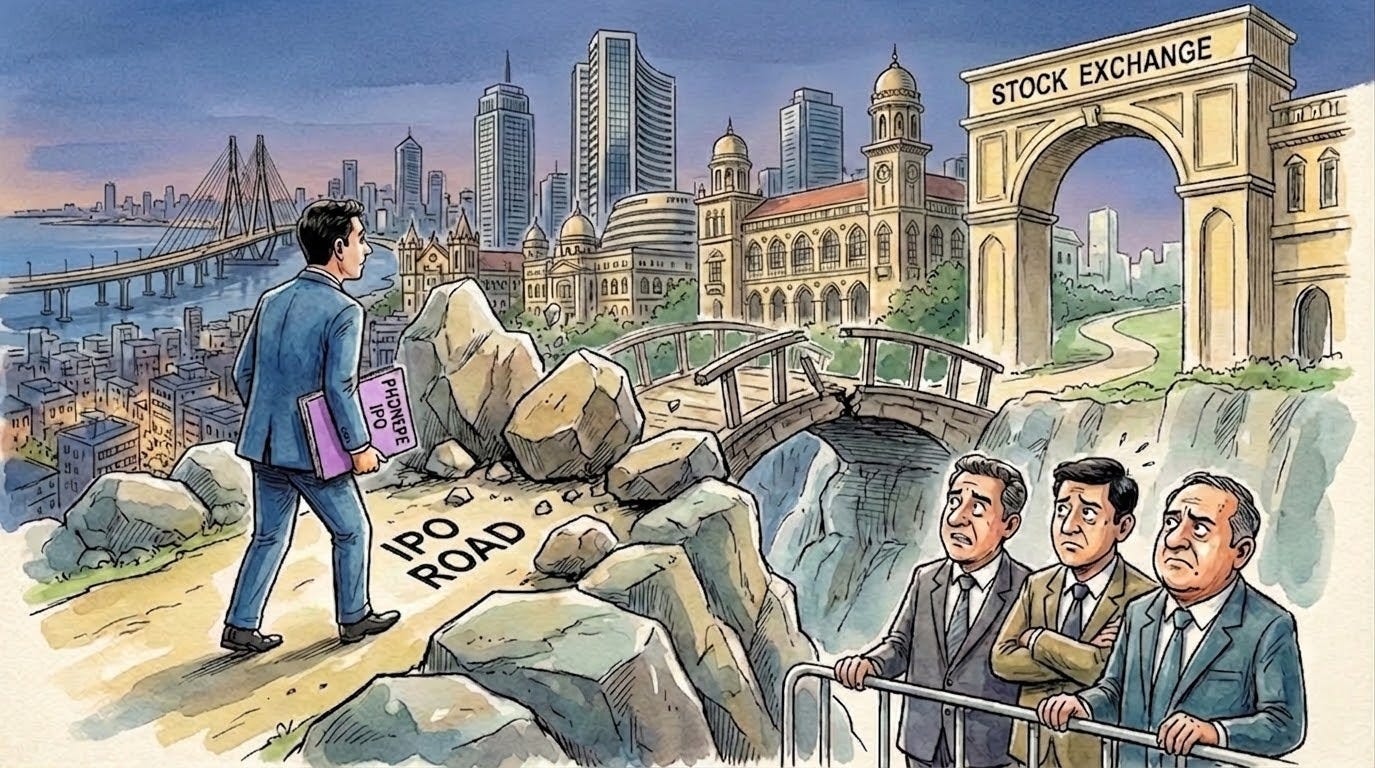
Timing is everything, last week we wrote about three mega IPOs heading to the markets in India and within a day, PhonePe confirmed it has postponed its domestic listing, which had been tipped to raise $1.3 billion.
The payment business said it made the decision based on volatile markets and geopolitical concerns, denying claims that it had seen weak investor interest. But it was widely reported in the media that the company struggled to land the $15 billion valuation it had targeted following an investor roadshow. The target valuation was said to have relaxed to $11 billion, but even that was tough. The Economic Times claimed investor interest was as low as $7 billion.
Certainly, those issues can all be linked. The current issues make public market investments challenging, and that’s multiplied in the case of a new stock headed to the markets to list.

PhonePe “remains committed to a public listing in India,” CEO Sameer Nigam said, but this decision could have a chilling effect on a number of high-profile tech companies that were aspiring to go public this year. Zepto, Oyo, Flipkart, Razorpay, Infra Market and Acko may all be forced to shelve or delay IPO plans such is the negative signal of PhonePe’s postponement.
The company’s success is not guaranteed. My former colleague Manish Singh wrote a detailed analysis of PhonePe’s issue for India Dispatch. In short: it needs to get its large user base to use its platform for more than just transactions if it is to finally stop being a loss-making business. That’s not unlike PayPay, Japan’s dominant payments app, which went public in the US this month at a valuation of over $10 billion.
The question now isn’t whether PhonePe will eventually list, it’s whether India’s public markets are ready to back unprofitable growth stories at Silicon Valley-style valuations. Private investors valued PhonePe at $12 billion during its last raise in 2023 and its original fundraise target was in line with that. But if investors still seek a discount now, then the gap is about what they believe a growth business is worth, not any impact from so-called market conditions.
That’s the long-term concern for Zepto, Razorpay and others that have built strong businesses but remain in growth mode.
Have a great week and thanks for subscribing,
Jon
Chinese tech companies push to monetise their AI smarts
We’ve already written about OpenClaw mania in China, and how it has shifted attention from India’s AI boom, and there are even more updates this week.

Alibaba is making a big push to monetise its AI smarts with the creation of a new AI unit called Alibaba Token Hub. Led by CEO Eddie Wu, the division will consolidate the Qwen model research team, consumer apps, DingTalk and Quark devices with a view to monetisation.
One of those plays looks like an agentic service for enterprises. That’s called Wukong and it coordinates multiple agents to automate tasks including document editing, spreadsheet updates, meeting transcription and research.
The goal is to make $100 billion in additional revenue from cloud and AI within the next five years, a timely goal as China’s tech stocks got whacked hard for failing to turn their AI investments into solid revenue.
With that in mind, Tencent just launched an OpenClaw-based AI bot for WeChat users. It previously integrated the tech for file transfers and other tasks. Baidu, once one of China’s tech elite, is turning its smart speakers into voice-controlled remotes for OpenClaw as it too tries to get in on the act. In another lever pull, Alibaba and Baidu have raised cloud prices by up to 34%.
We touched on the impact of OpenClaw outside of tech companies in last week’s Original story, but Rest Of World has a good explainer on how Chinese cities are offering major perks including free apartments, cheap compute and repurposed data centres to lure AI-powered “one-person companies” building startups without staff or venture backing.
Elsewhere in China AI this week:
Xiaomi released MiMo-V2-Pro, a 1-trillion parameter foundation model with benchmarks approaching OpenAI and Anthropic at around a sixth of the cost
Alibaba unveiled Qwen3.5-Max-Preview, its most powerful AI model to date
Huawei launched the Atlas 350 accelerator card for inference, boasting higher computing power and better performance than Nvidia’s H20
China’s AI optics boom has driven a ~780% surge in Yuanjie Semiconductor Technology’s shares over the past year, turning founder-CEO Zhang Xingang into a billionaire
Super Micro in crisis after co-founder charged for smuggling AI chips to China
The co-founder of Super Micro, Yih-Shyan “Wally” Liaw, was arrested for allegedly smuggling billions of dollars of AI technology into China by routing them via Southeast Asia.
Liaw, a Super Micro board member who remains a close confidant of CEO Charles Liang, and Ting-Wei “Willy” Sun, a Super Micro contractor, are charged with working together to violate the Export Control Reform Act. A third man, Ruei-Tsan “Steven” Chang, is a Taiwan-based sales manager who is currently a fugitive.
Super Micro isn’t named as a defendant in the charge, but its shares fell by 33% on the news. The company retains a $12.3 billion market cap. The company’s VP of Global Trade & Sanctions Compliance, former Intel executive DeAnna Luna, stepped into the role of acting Chief Compliance Officer on Friday.
China
Beijing is reportedly restricting Chinese companies incorporated overseas from seeking initial public offerings in Hong Kong, a move that could slow the city’s IPO boom link
Well, here’s the attempt at dishing out comeuppance: China is moving to penalise people linked to Meta’s $2B acquisition of Manus, with officials summoning executives and seeking to restrict Manus staff from leaving for Singapore link
It was a busy week for Nvidia in China:
It restarted H200 chip manufacturing for China shipments link
Chinese authorities approved multiple domestic companies to purchase Nvidia’s H200 AI chips link
It is also preparing a version of its Groq AI chips for the Chinese market link
And finally, it added Chinese automakers BYD and Geely to its robotaxi programme link
Unitree Robotics, a Hangzhou-based maker of quadruped and humanoid robots, filed for a Shanghai Star Market IPO to raise $610M link
AI coding company Cursor admits its new coding model was built on top of Moonshot AI’s Kimi link
ByteDance is selling gaming unit Moonton to Saudi-backed Savvy Games Group for $6B to double down on generative AI link
Hua Hong has developed advanced chipmaking technology capable of producing AI chips, with its Huali Microelectronics unit preparing a 7nm process, potentially becoming China’s second chipmaker with such capabilities link
Google is reportedly in talks with China’s Envicool to buy data centre cooling systems link
Tencent posted a 13% revenue rise to $28.3B for Q4 2025, with net income up 14% as it ramps up its agentic AI bet link
Ant Group’s quarterly profit fell 91% as the payments firm boosted spending on AI and healthcare link
Tim Cook praised Chinese developers and he received praise from Premier Li Qiang during a rare visit to China to take part in a company event, just days after Apple lowered the fees it collects from local app developers link
Meanwhile, Apple posted a 23% surge in China smartphone sales in the first nine weeks of 2026, bucking a 4% market decline as Android makers raised prices due to higher memory chip costs link
AI pioneer Zhipu is planning a major reorganisation to consolidate all AI product teams, spanning apps and hardware including AI glasses, into a single unit link
TP-Link CEO Jeffrey Chao applied for an expedited US visa through the Trump Gold Card programme, which requires a $1M payment, while the company faces national security probes link
China is playing a growing role in shaping Africa’s surveillance infrastructure, with 11 countries spending over $2B on AI-powered systems relying heavily on Chinese technology link
Apple supplier Murata Manufacturing will start separating its rare earths supply chain in China over the next three years, in a bid to insulate itself from geopolitical turmoil link
China will reportedly allow 12 more banks to handle digital yuan, adding to the 10 that currently access it now link
How Eric Trump became a key ally to Bitmain, a Chinese crypto company that’s been dogged for years by questions about the security of its mining rigs link
India
Google and Accel selected just five startups from more than 4,000 India-linked applications for their latest AI accelerator, rejecting roughly 70% of pitches as superficial “wrapper” ideas link
Former Peak XV managing directors Shailesh Lakhani and Harshjit Sethi launched early-stage venture fund Ambition Capital with a $250M target, backing seed and Series A startups across consumer, AI, deep tech and fintech link
MakeMyTrip, the Nasdaq-listed online travel booking platform, is considering a domestic listing after restructuring its India business link
Travel startup Scapia is in early talks to raise $50-60M in a round led by General Catalyst link
Visa processing startup Atlys raised $36M led by Susquehanna link
Sumit Gupta and Neeraj Khandelwal, the founders of the Coinbase-backed crypto exchange CoinDCX, were arrested over an apparent allegation of fraud, but the company has claimed it is an impersonation conspiracy link
Over 100 VC firms, including Mela Ventures, Blume and Ideaspring, applied for the government’s Rs 1 lakh crore ($12B) RDI fund to boost deeptech startups link
India’s government reportedly privately urged Apple, Samsung and Google to consider pre-installing its Aadhaar biometric ID app on smartphones, though the proposal faced pushback link
Yotta Data Services, which runs India’s largest Nvidia AI processor cluster, is seeking to raise $500-600M at a $4B valuation ahead of an IPO link
Zetwerk, a contract electronics manufacturer, is said to be gearing up to confidentially file for an IPO within weeks, seeking to raise up to $550M at a $4B valuation link
Southeast Asia
Used-car marketplace Carsome raised more than $30M from investors including Hong Kong Investment Corporation and Gobi Partners. No word on the valuation, but Carsome has raised over $300M to date and was previously valued at $1.7B link
Singapore-based digital payments startup dtcpay raised $10M in a Series A round led by Vertex Ventures link
DayOne Data Centres, which we wrote about in ATR earlier this month, is reportedly seeking to double an existing loan to as much as $7B to expand in Malaysia—that would be Asia’s largest data centre borrowing link
Grab’s 2025 revenue grew 20% year-on-year to a record $3.37B with a $200M profit link
Vietnamese companies are racing to launch the country’s first licensed cryptocurrency exchanges as the government moves to curb trading on overseas platforms link
Bloomberg reports that Indonesia’s sovereign fund Danantara has veered off course in a turbulent first year, transforming into a catch-all vehicle for the president’s socialist agenda link
Recruiters tied to Southeast Asia scam compounds are increasingly hiring “AI face models” to carry out deepfake video calls used in romance and cryptocurrency fraud schemes link
South Korea
Samsung to invest record $73B in R&D and facilities in a bid to lead the semiconductor industry in AI link
Samsung is also considering extending memory chip contracts to 3-5 years to stabilise supply and ease shortage concerns as AI-driven demand surges link
A global shortage of memory chips is likely to persist another four to five years, SK Group chairman said link
Reflection AI, a US startup backed by Nvidia, is partnering with Korea’s Shinsegae Group to invest several billion dollars in building a 250-megawatt AI data centre running on tens of thousands of Nvidia chips link
Crypto.com partnered with KG Inicis, South Korea’s largest payment gateway provider, to enable digital assets payments including for tourists who visit the country link
North Korean hackers targeted crypto e-commerce platform Bitrefill, accessing about 18,500 records including emails, crypto addresses and IP metadata link
Hong Kong
Hong Kong is set to launch ClawNet, what it calls the world’s first open-source human-AI agent collaboration network designed to ensure AI agents operate only within permitted actions link
Stablecoin payments startup RedotPay is reportedly seeking up to $150M in fresh funding at a valuation above $4B ahead of a planned US IPO link
Ant Group is close to completing its purchase of Hong Kong-listed brokerage Bright Smart Securities, nearly a year after agreeing the deal and on the verge of clearing mainland China approvals link
Taiwan
Micron Technology plans to build a second manufacturing facility in Taiwan to expand production of advanced DRAM for AI demand link
Foxconn’s Q4 2025 net profit fell 2% to $1.41B despite continued robust demand for AI servers, it missed analyst expectations but revenue did rise by 22% link
The Middle East war is threatening the global semiconductor supply chain by risking shortages of key materials and higher power costs in Taiwan link
Japan
SoftBank plans to build a giant Ohio AI data centre that will be powered by gas plants link
The PhonePe situation illustrates a dynamic that is underappreciated in the broader IPO market discussion: a delayed listing in one major market can create a contagion effect on investor appetite for the entire category. When a company of PhonePe’s profile postpones, it sends a risk signal that reprices uncertainty across comparable businesses. This is the same dynamic at play in the US hectocorn pipeline, where the first major listing will function as a sentiment referendum for every name behind it. The 90-day aftermarket performance of the SpaceX or Stripe offering will either open the window for the entire 2026 cohort or force a meaningful repricing of the queue.