


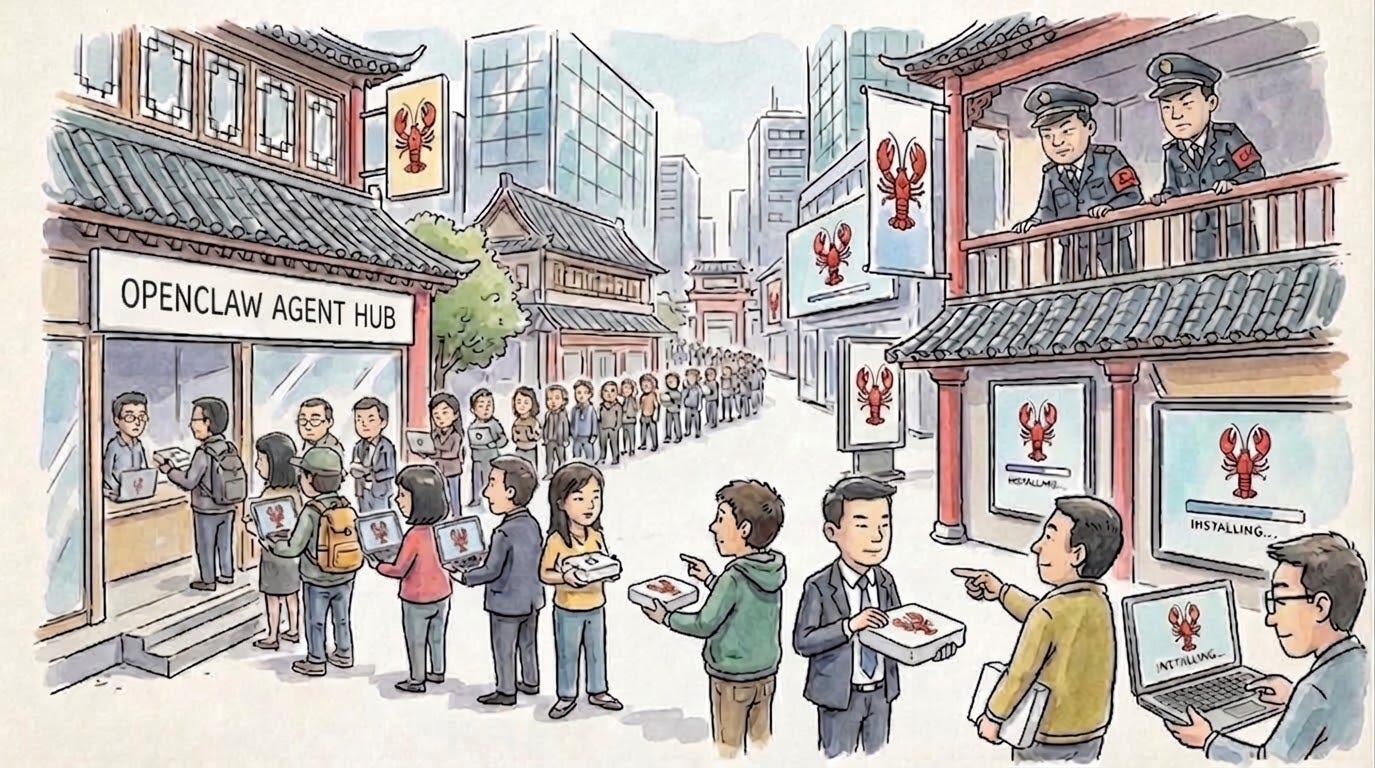
China is obsessed with OpenClaw, the platform for creating AI agents that can carry out tasks.
Last week’s newsletter had a mention of consumers rushing to use it, but a week is a long time in technology and now we can update this to a craze.
Major companies have released OpenClaw-related products, including:
Alibaba introduced a mobile app that installs and runs OpenClaw agents
Kimi has a one-click bridge to install OpenClaw in a browser
Kimi and MiniMax were among the first to offer easy integration
Apple’s Mac mini, a popular option for installing OpenClaw, is sold out across China
Tencent Cloud became an official sponsor of the OpenClaw community
But OpenClaw remains a work in progress. This is a platform that’s evolving on a daily basis with patches, security updates and more. There are horror stories of agents deleting files or taking actions that a user didn’t expect or ask for, as one of Meta’s senior safety executives showed in a recent tweet.

So naturally, great adoption comes with great concerns.
Authorities twice warned government agencies and state-owned-enterprises of the security issues behind OpenClaw. Even major banks were warned, such is the frenzy.
Then there were stories of the users who paid to have OpenClaw installed, and then shortly after they paid someone else to remove it such was the damage caused or difficulty to use it.
That’s the issue with OpenClaw. If you’re not able to install it and use it, you shouldn’t touch it.
There’s no doubt that the elements that make OpenClaw appealing (as someone who has used it for a month, I’d say it can be a magical experience) will make their way to mainstream users.
Every consumer internet company wants to offer a PA-style chatbot waiting on you 24-7 and sitting in your messaging app alongside your friends and family. The version OpenClaw gives is not ready for mass consumption, and China is showing us why.
But it won’t be long.
Tencent is already reportedly building an AI agent for WeChat users which could essentially do what OpenClaw does but with more control and less freewheeling. It could help you book taxis, order groceries and other tasks from WeChat’s ecosystem of mini programs, which are used by some 1.4 billion people.
Meta has added AI to WhatsApp and Facebook Messenger but OpenClaw has raised the bar and given it a clear target to reach.
China is already AI crazy. Alibaba, ByteDance, Tencent and its other huge tech companies have all dived into AI, with the Hong Kong Stock Exchange welcoming the first consumer AI IPOs in the world. Its enthusiasm for OpenClaw was obvious, in hindsight.
That’s all for this week.
Drop me a line if you’re also actively experimenting with OpenClaw, always interested to hear how others are finding it.
Best,
Jon
Now you can follow Asia Tech Review on WhatsApp for the day’s biggest story
India braces for two major IPOs: Reliance Jio and Flipkart
Three major public listings are on the horizon in India in the form of Jio Platforms, the digital arm of Reliance industries, digital payments giant PhonePe and its former parent company Flipkart, the e-commerce giant owned by Walmart.
Jio is likely the furthest from IPO, but a recent change to lower the proportion of shares that companies must sell when they list appears to have opened the door to the Reliance-owned project and the National Stock Exchange.
Now, companies valued above 5 trillion INR ($57 billion) must sell just 2.5% of their paid-up capital, that’s half the previous requirement. They then have 10 years to ensure public shareholding levels reach 25%, with other targets along the way.
Reliance Jio is estimated to be worth $180 billion, it owns the Jio telco, payment and delivery services and numerous consumer apps and is backed by the likes of Google, Facebook and Silver Lake. That valuation is a tough ask for public markets to take on, so slashing the minimum in half here makes the initial fundraising requirement more feasible. Reports suggest that a listing is planned, but there’s likely some way to go before we see that.
Elsewhere, another mammoth IPO is moving down the pipeline as Flipkart reportedly completed its reverse flip, which means it redomiciled its registered HQ from Singapore to India. Regular readers will know that’s a baseline requirement to go public in India, and a move that takes time and comes at great cost with a raft of new taxes due.
But Flipkart is now asking banks to pitch for its IPO as soon as next month (April), according to Bloomberg. That means we could see it go public within the next 12 months, so says Reuters.
First in line, digital payment leader PhonePe will head to markets. The company was once fully-owned by Flipkart, which remains a shareholder alongside Walmart, so there will likely be lessons learned which can be applied to Flipkart’s own process.
That process will get some assistance from a Flipkart old hand after Nishant Verman, an executive who played a major role in the company’s sale to Walmart in 2018, returned to help with the IPO.
In other IPO news: the head of Cars24’s used-cars vertical in India has quit as the company prepares to go public.
PayPay IPO
Japanese payment firm PayPay successfully listed on the Nasdaq raising $880 million at an initial valuation of $10.7 billion.
PayPay’s share price is up 32% from the IPO, giving it a solid start to life as a public company in the US. It may soon expand and go public in Japan, too. Its listing is the largest from a Japanese company in the US for a decade. Line raised $1.1 billion back in 2016, it feels like just yesterday when I wrote about it for TechCrunch.
Line’s challenge was to squeeze more revenue out of a popular messaging app that wasn’t going to beat WhatsApp in any new market expansion pushes. (It also had a dual US-Japan listing.) Paypay’s situation is a little different. It needs to find a way to get its users to do more than just payments, as we wrote when we previewed the IPO last month.
These days Line is part of a SoftBank-backed private group. That gives it some ownership of PayPay, so we come full circle.
China
The Trump administration is set to collect about $10B from TikTok’s US investors, with backers including Oracle, Silver Lake and Abu Dhabi’s MGX paying $2.5B upfront and additional payments until reaching the total link
That deal gives Oracle’s stake in the TikTok US venture a valuation of around $2B link
Meanwhile: Canada will allow TikTok to continue operating, reversing its earlier order requiring the company to close its Canadian division for security reasons link
ByteDance is deploying about 36,000 Nvidia B200 chips in Malaysia through Southeast Asia-based Aolani Cloud, a setup that could cost more than $2.5B as the company powers its global AI push outside China link
ByteDance paused the global rollout of its video generation model Seedance 2.0 amid a series of copyright disputes with major Hollywood studios and streaming platforms. Link
Moonshot AI, the company behind the Kimi AI service, is looking to raise up to $1B in an expanded funding round that could value its business at $18B, more than quadrupling its worth in three months link
Apple will cut App Store commissions in China from 30% to 25% following talks with regulators, small-business rates will drop from 15% to 12% link
Tencent plans to invest several hundred million dollars as a passive financial backer in Paramount Skydance’s acquisition of Warner Bros. Discovery link
Electric air taxi maker Archer Aviation sued rival Joby Aviation, accusing it of misleading US regulators by concealing ties to Chinese suppliers, including a Shenzhen manufacturing subsidiary that allegedly disguised aerospace imports as items like socks and napkins link
Aridge, a flying car developer backed by Xpeng, has raised nearly $200M ahead of a potential Hong Kong IPO link
Nexperia’s Chinese subsidiary began producing its own chips using 12-inch wafers, a size the Dutch parent cannot produce in Europe, as an ongoing dispute disrupts automakers’ supply chains link
Chatbots are emerging as a powerful force driving China’s stock makets as Gen Z day traders flock to use them for investment advice link
China’s chip exports surged 73% to $43.3B in January-February, far outpacing overall export growth of 22% link
Ultrasound BCI startup Gestala, founded by serial entrepreneur Phoenix Peng, raised $21.6M at a $100-200M valuation just two months after launching, marking the largest early-stage funding in China’s brain-computer interface sector link
Chip firm Cambricon posted its first-ever annual profit of $306M with revenue surging to $911M from $168M thanks to Beijing encouraging Chinese AI developers to adopt locally made chips link
Didi posted a Q4 net loss of $43.5M, narrowing from $188M a year earlier, as international revenue jumped 47% while its core China mobility business grew 9% link
JD.com is expanding into Europe with its Joybuy brand, it aims to differentiate with fast delivery of products ranging from Chinese food and appliances to toys and cosmetics link
Food delivery players in Brazil, a $20B market, claim they have been hit by a “coordinated effort” to seal trade secrets after Chinese players entered the market link
India
Apple increased iPhone production in India by 53% to roughly 55 million units last year, meaning a quarter of its flagship devices are now made there as the company reduces exposure to China tariffs link
India is preparing new smartphone manufacturing incentives that would tie subsidies to export performance and local component use, expected to benefit Apple, Samsung and their suppliers link
Delhi plans to launch a fund exceeding $10.8B to strengthen domestic chipmaking, with the scheme expected within two to three months to subsidise chip design, equipment and supply chain development link
The government eased investment rules for Chinese firms in a signal of a shift in New Delhi’s approach toward its geopolitical rival link
In other government moves, it will subsidise half the cost of a $359M semiconductor back-end plant being built by Kaynes Semicon with Japan’s Mitsui and Aoi Electronics, with operations expected by year-end link
Accel is likely to join Rapido’s ongoing $550-600M funding round led by Prosus, which is expected to value the ride-hailing startup at about $3B link
Former Peak XV managing directors Shailesh Lakhani and Harshjit Sethi launched early-stage venture fund Ambition Capital with a $250M target link
Online learning platform upGrad is set to acquire rival Unacademy in an all stock deal—Unacademy’s valuation has fallen from a $3.5B high to under $500 million since the pandemic link
Rapido has now overtaken rivals Uber and Ola to become larger than the two ride-hailing giants combined, that’s based on active user numbers from app analytics company Sensor Tower link
Y Combinator, which has seen its presence in India dwindle despite blockbuster IPOs at the end of last year, will run a ‘summer school’ event in India to drum up interest in its US programme link
Razorpay is targeting large global brands to expand its cross-border payments business, with its clients already including Replit, Airbnb, Decathlon and McDonald’s link
Snabbit, the on-demand home help start founded by the former chief of staff of Zepto, is reportedly raising $50-$60M at a valuation of $350-$400M led by Mirae Asset and existing backer Bertelsmann—it previously raised $30M at $180M in October link
Ride-hailing Namma Yatri, which is already backed by Google, raised $4.4M in a pre-Series A extension led by Juspay founder Vimal Kumar, with participation from existing investors Blume Ventures, Antler and others link
Climate-tech startup Newtrace raised $6.3M from HDFC Bank, Mitsui Sumitomo, Peak XV and others link
India’s neobank Fi, which raised around $169M but is going through cash issues, is discontinuing its four-year-old banking services, which served over 3.5M users, as it pivots to B2B AI technology link
The CBI arrested Darwin Labs co-founder Ayush Varshney for alleged involvement in the GainBitcoin Ponzi scheme link
Southeast Asia
AI video startup PixVerse raised a $300M Series C investment led by Beijing-based CDH Investments at a valuation above $1B, the company was previously backed by Alibaba and Antler and it has now opened a Singapore office to lead global sales—this strategy may sound familiar to readers link
Kast, a stablecoin payment startup headquartered in Singapore, raised $80M at a $600M valuation—its annual revenue run rate expected to reach $100M this year link
Cortical Labs is building two data centres powered by lab-grown human brain cells in Melbourne and Singapore, an experimental approach that could challenge chips from companies like Nvidia link
GoTo forecast full-year adjusted EBITDA of $190-200M, above analyst estimates link
Bridge Data Centres plans to invest up to $3.9B in AI technology development in Singapore, funding research on advanced power systems, next-generation cooling and energy optimisation link
Hong Kong-based Accelerated Infrastructure Capital plans to build a $2.1B AI data center in Vietnam’s HCMC link
Foxconn will invest an additional $39M in Vietnam, although the strategy behind the cash injection isn’t clear link
Remember Singtel’s Innov8 investment arm? Well it is back with a $250M fund to back growth-stage AI startups across the world link
Empyrean Sky Partner, a Singapore-based investment company, completed a $90M first close for its new global tech fund which is targeting $200M link
A Cambodian scam complex used fake police stations and prisonlike cells designed to convince victims over video chat that they were talking to law enforcement link
Mozark, a Singapore-based digital testing startup that measures performance across devices, networks and locations, raised $40M in a Series B round led by IFC and RMB Capitalworks, with backing from Kalaari Capital link
Singapore-based sports intelligence startup Aiko raised $1.5M in a pre-seed round to expand its real-time data platform for broadcasters link
MetaComp, a Singapore-based digital finance infrastructure provider, said it raised $35M across two Pre-A rounds backed by Alibaba and Spark Venture link
South Korea
Coupang is highlighting its American identity as it faces investigations by at least 10 South Korean agencies over a major data leak link
The Financial Intelligence Unit issued a six-month partial suspension notice to crypto exchange Bithumb for alleged AML violations link
Japan
Japan plans to target $253.5B in domestic semiconductor sales by 2040 to capture rising AI and data centre demand, up from about $32B in 2020 and above the earlier $95B target for 2030 link
US startup Nuro’s self-driving vehicles are now operating on public roads in Tokyo with safety operators, marking the company’s first international deployment link
Uber, Nissan and UK self-driving startup Wayve plan to launch a robotaxi pilot in Tokyo in late 2026, integrating Wayve’s AI driving system into Nissan vehicles on Uber’s platform link
SoftBank’s stock is down ~48% since early November on account of scrutiny into the scale of its OpenAI involvement grows link
Rohm and Toshiba are in talks to integrate their power semiconductor businesses, with options including a joint venture as industry consolidation accelerates amid rising competition from Chinese rivals link
Hong Kong
Victory Giant, a Chinese PCB maker already listed in Shenzhen, is preparing a Hong Kong listing for April that could raise over $2B link
AI-driven drug discovery startup Earendil Labs is considering a Hong Kong listing that could raise up to $500M link
HSBC and Standard Chartered are set to become among the first licensed stablecoin issuers in Hong Kong link
Rest of Asia
TSMC is not the only Taiwanese company that’s surging thanks to the growth of AI, as former Bloomberg reporter and ATR friend Tim Culpan explains in his newsletter link
Uzbekistan fintech Uzum raised $131.5M led by Omani sovereign wealth funds, pushing its valuation to $2.3B, up 53% from seven months ago link
Ride-hailing firm inDrive acquired Pakistan-based quick-commerce startup Krave Mart link
Binance accounts allegedly helped transfer more than $1B to Iran-linked entities, involving a 79-year-old VIP Chinese trader and a suspected Iranian gold smuggler link
North Korea IT workers have generated at least $6.8M for Pyongyang by impersonating workers and securing jobs at more than 300 US firms between 2020 and 2024—and now Europe is the new target link