


Welcome back to Asia Tech Review Daily, your curated digest to keep up to date with tech news across Asia.
Every weekday, we will send you 2-3 of the most important items from Asia Tech from the previous day, and a list of other news you’ll want to know.
Hit reply and let us know what you think. What do you like, what do you love and what doesn’t work for you.
SK Hynix breaks more financial records as AI boom pushes valuation close to $600B
South Korea’s memory chip companies are seeing crazy growth thanks to the AI boom and that continued yesterday when SK Hynix announced yet another record financial report.
These numbers are wild. The company posted $35.55 billion in revenue for Q1 2026. That’s the highest for any single quarter in its history and a staggering increase of nearly 3X year-on-year. SK Hynix also saw operating profit increase five-fold to reach $27.9 billion. Operating margin hit a new record of 72%.
What makes this all the more remarkable is that the first quarter of the year is typically lower in demand. That was in a world before AI.
Suddenly, SK Hynix and close rival Samsung are integral to the tech industry, as we wrote back in February when it announced record annual financial results which included a $29.6 billion profit in 2025:
A large part of that was down to its high bandwidth memory (HBM) business that’s used in AI chips from Nvidia and others. SK Hynix has a dominant 61% share of that market, and its sales more than doubled in 2025.
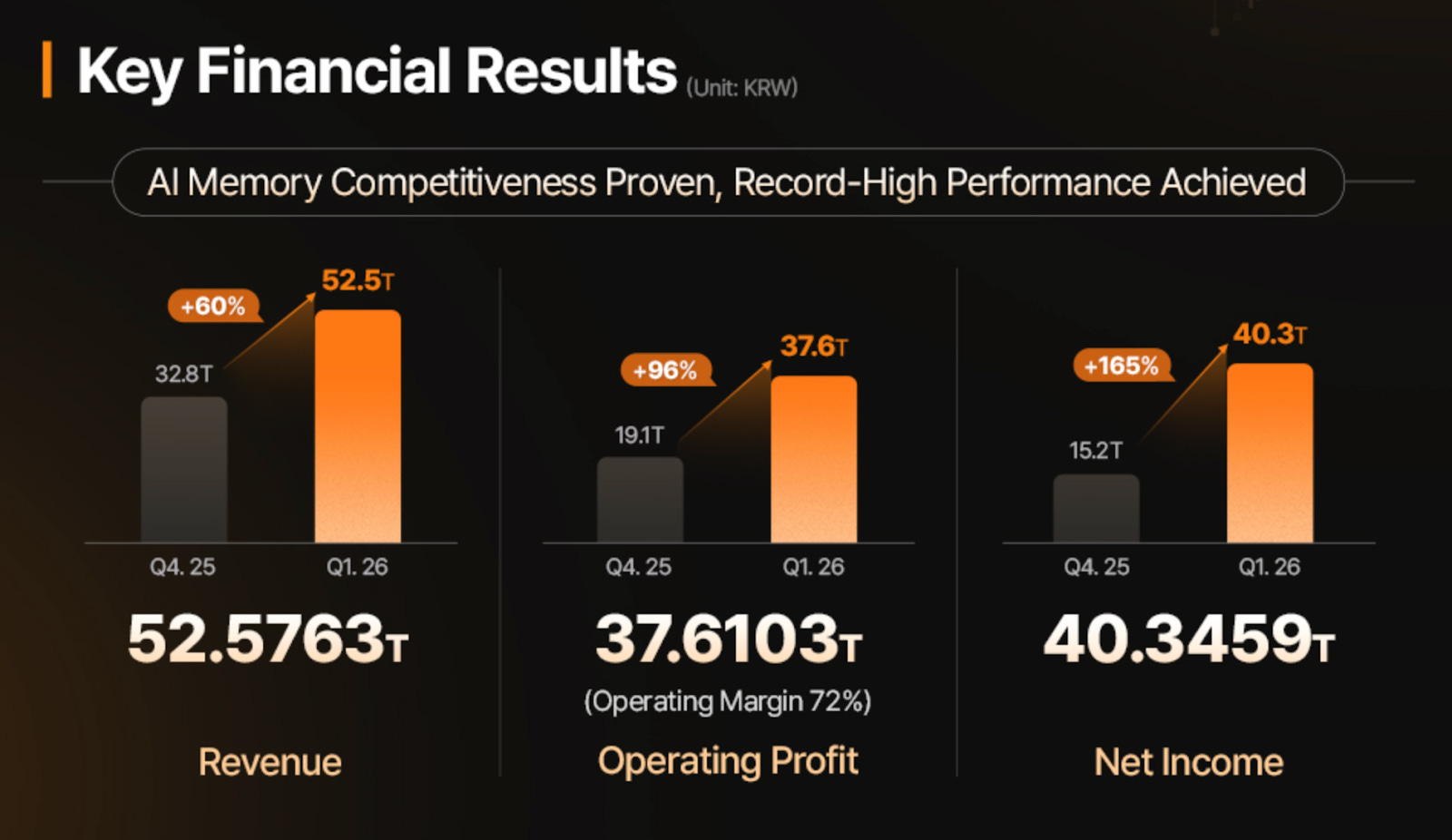
These are quarter-on-quarter numbers!
SK Hynix is already planning to launch a US business to capitalise on AI demand by “delivering optimized AI systems for its customers in the AI datacenter sector.” That venture will be backed by $10 billion in capital, and we are likely to learn more as the year plays out.
Right now, the company has a net cash position of $25.9 billion which will not just go towards developing new memory products, but massively increasing its capacity to ensure AI services can simply continue to run. SK Hynix will spend $13 billion on a new plant in Korea specialising in advanced packaging, an essential part of the process for making products like HBM chips.
SK Hynix shares are up 80% this year to date, with the company’s market cap currently sitting around $586 billion. Samsung is up over 70% during the same period. The electronics giant also announced record Q1 financials when it published its guidance earlier this month, more details will come with its full earnings.
The two companies currently make up more than 40% of the value on KOSPI, South Korea’s closest equivalent to the S&P 500.
Tencent revamps its flagship AI model with ex-OpenAI researcher leading full rebuild
Tencent last December hired former OpenAI researcher Yao Shunyu as chief AI scientist to lead development of its Hunyuan LLM. That change is showing its first results after the Chinese tech giant released its newest flagship model, Hy3, in preview.
The new model takes a very different approach, as you’d expect with Shunyu’s arrival. The model was rebuilt entirely in February with new pre-training and reinforcement learning infrastructure to develop a strong focus on reasoning, coding, agentic performance and following instructions, the team wrote in a release paper.
At the same time, Hunyuan has adopted the familiar Chinese AI style with a move to a smaller and supposedly more powerful model. MiniMax, Zhipu and likely even DeepSeek are pushing to add more power to their models to compete with US peers having already built a reputation for doing more with less. But Tencent was arguably behind in that race so there’s some logic to rebuilding the foundations.
The early benchmark seems promising, comparing Hy3 favourably against Chinese rivals but just behind ChatGPT and Gemini. But the real test is always actual usage, and Chinese models typically fall short of their promises, from my experience at least. (Notably there’s no benchmarking of Claude, which is interesting given Anthropic accused Chinese AI firms of plagiarism.)
It seems likely Tencent has retooled Hunyuan so it can roll it out inside its services. It has done a fair amount with OpenClaw, including launching an English version of its QClaw, which may indicate a gap in its own tech.
Alibaba, meanwhile, just started offering its flagship AI to third parties, starting with China Eastern Airlines. Tencent will feel it is behind.
In other interesting news you won’t want to miss:
Not Asia specific, but a new iPhone launched with technology designed to verify that images were taken on the device, a response to the growth of AI-generated content [Succinct]
Chinese AI companies all now compare themselves to Anthropic and Claude, not OpenAI and ChatGPT [Recode China AI]
AI and data sovereignty is poised to become a big deal in Asia, and along those lines Taiwan is developing its own LLM models for its financial sector [Bloomberg]
Southeast Asia’s data centres are major investment focuses right now with Bain Capital reportedly looking to offload at least 40% in Singapore-based Bridge Data Centres (BDC) at a valuation of $5B [Reuters]
Sri Lanka is investigating how hackers broke into its finance ministry’s computer systems and stole $2.5M [BBC]
India’s mobile app market revenue grew 33% in Q1 2026 but most of the money is for foreign companies [TechCrunch]