


Welcome back to Asia Tech Review, your curated digest to keep up to date with tech news across Asia.
China is about to get its first heavyweight AI IPO validation as Moonshot, the maker of Kimi, lines up a listing for a valuation of at least $50 billion that could raise as much as $5 billion. We’ve seen crazy memestock growth from Zhipu this year, but now Chinese AI firms will need to justify their high valuations and show real revenue growth. That will take time.
Finally, I started a new role last week with PR firm Ellerton. I updated my disclaimer, but the focus of this newsletter will continue as it did when I worked in media, venture capital and consulting. Do get in touch if you need great communications support!
To keep up with our issues, follow us on LinkedIn or WhatsApp. For news as it happens, check out ATR Bulletin, our real-time news site that keeps you in the know.
Moonshot brings a new era for Chinese AI IPOs
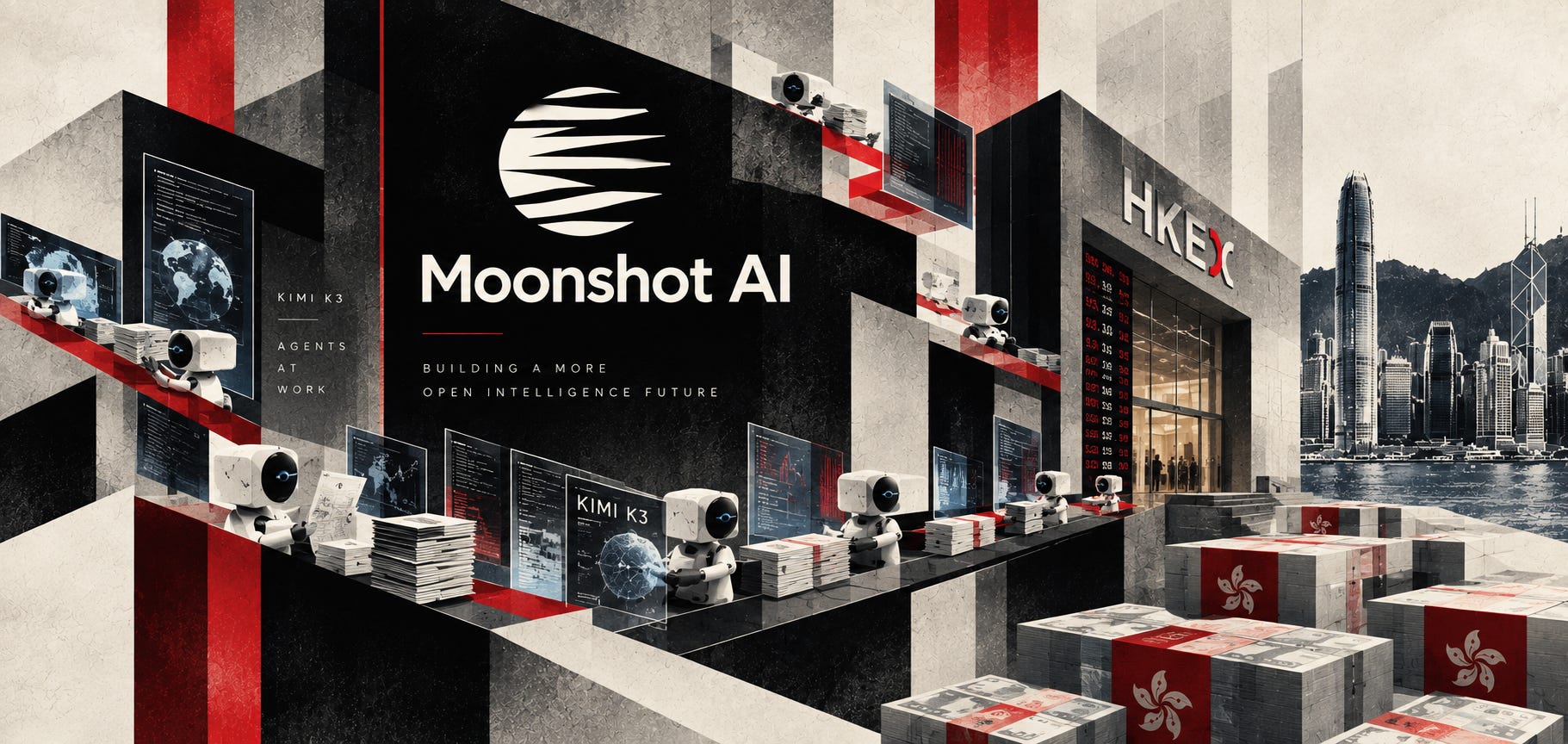
Hot on the heels of the first earnings reports from Zhipu and MiniMax, China’s first listed AI companies, comes the news that they’ll soon be joined by Moonshot AI. The company behind the Kimi models has confidentially filed for its Hong Kong IPO, according to the Wall Street Journal.
Beijing-based Moonshot was last valued at $50 billion, and that’s said to be the target for its IPO which could raise between $3 billion and $5 billion. These numbers would make it comfortably Hong Kong’s largest listing this year.
The figures are achievable. Zhipu (which runs Z.ai) is trading at a market cap of just over $63 billion with its share price up more than 7X this year to date. But Moonshot is coming into a market that isn’t just going up and up. There’s a more realistic feeling and that’s reflected in valuation.
Early backers of Zhipu have logged incredible returns, but the stock has lost more than half its value since the second half of June. Zhipu, meanwhile, is up just 5% in 2026, it currently trades at a $16 billion valuation which is nearly three-quarters down on its March 2026 highs.
The difference has always been that Moonshot wasn’t in a rush to go public. When it raised a $500 million Series C in January, it had more capital on hand than both Zhipu and MiniMax. They rang the IPO bell out of necessity, as their cash in the bank was dwindling. But Moonshot went on to raise a further $3.5 billion in July to further strengthen its balance sheet.
At the turn of the year, Moonshot was valued at a mere $4.3 billion and now it has pulled in at least $8 billion from its backers at a much higher valuation. That’s a very different proposition for public markets. Those two early AI IPOs were a real test of the waters. Nearly nine months later and Chinese AI models have gained recognition and respect, with Moonshot’s Kimi particularly becoming a known brand in global tech circles thanks to impressive releases.
The WSJ profiled Moonshot’s 33-year-old co-founder who got his PhD in the US and turned down Apple among others to return home to China and start the business, bringing Western startup culture with him
Reputation of models is one of the clear gaps between Zhipu and MiniMax, thanks to its GLM model which has won plaudits outside of China in a similar way to Kimi. Zhipu has also changed its business mode to focus on cloud-based services that can reach a global audience. That wasn’t the case at the start of the year when it listed.
We don’t know what Moonshot’s financials look like, other than the company recently crossed $300 million annual recurring revenue. That’s not substantially more than Zhipu and MiniMax, which did $136 million and $117 million respectively in the first half of the year. It remains to be seen how Moonshot will justify a much higher listing price. Potentially, it has grander plans given its cash position and the stage of its business development outside of China, but I’d imagine it isn’t that different to where Zhipu is right now.
Still, this is a new phase for Chinese AI IPOs. With DeepSeek, which is valued at over $70 billion, also preparing to go public over the next twelve months, Hong Kong retail investors are going to get exposure to more mature and crucially more expensive stocks.
That will bring raised expectations. To hit higher valuations, investors are going to want to see a real jump in revenue compared to what they see right now from other Chinese AI firms. Particularly with US duo Anthropic and OpenAI headed to public markets. If Moonshot lists at $50 billion, what will it take for its valuation to appreciate significantly enough for investors to see returns? Given the fierce competition and tough pricing conditions, I don’t know whether that’s realistic at this point.
India Quotient is learning the importance of realised exits
A fund’s returns are only as good as realised profit, as one fund in India is finding out.
Quotient struck gold when it backed ShareChat, a domestic-focused social networking platform in India, with the deal generating a 77X gain on paper. That put the fund on the map and helped generate dealflow and business as a fund backing local winners at a time when numerous Chinese services were banned and Western tech imports faced pressure, as Newcomer explains:
After that spectacular launch on the back of ShareChat, India Quotient went on to raise five funds totaling $320 million. Despite being small by modern VC standards, it has developed a reputation of spotting contrarian themes that proved profitable.
However, ShareChat has undergone layoffs, down rounds and there’s been no big exit yet. That will impact Quotient’s second and potentially third fund, and overall its reputation as an investor. It’s an issue that impacts all funds, but this is a particularly acute example. Newcomer’s post is paywalled but even the preview gives a gist of a topic that is equally as applicable in Southeast Asia and other emerging markets.
Deals
ByteDance secured a $29.6 billion loan, bigger than the $20 billion it first sought, giving the TikTok owner more balance-sheet firepower as it keeps pouring money into AI [Bloomberg]
Indian spacetech startup Astrobase is said to be in talks to raise $40-$50 million in a round led by Peak XV Partners, valuing the company at about $250-$300 million [Economic Times]
Indian fintech Slice raised $100 million at a valuation of about $450 million, a steep reset from its $1.4 billion peak [Moneycontrol]
India-based smart-ring maker Ultrahuman raised $70 million from investors including Qualcomm Ventures at a $365 million valuation [Entrackr]
Gaming giant Krafton plans to invest another $250 million in India over the next 3-4 years to take its total commitment past $500 million and into AI, robotics and deep tech [TechCrunch]
Markets
Philippines fintech Mynt got the greenlight for its IPO to raise $1.5 billion, becoming the first local company to use the regulator’s lower public-float rule for large issuers [DealStreetAsia]

A study shows China’s tech-sufficiency push has seen the number of IPOs on Shanghai’s Star Market this year that target technology bottlenecks has risen from 8.1% in 2022 to 20% [SCMP]
South Korea’s semiconductor exports surged 209% year-on-year to a record $46.65 billion in August, or nearly half of the country’s goods exports [CNBC]
Vietnamese electric taxi operator Green SM plans to expand into the US and Europe ahead of a targeted 2028 Hong Kong IPO [Reuters]
Shein shares fell as much as 10% on their third day of Hong Kong trading, extending the firm’s weak debut [FT]

AI and Chips
Despite being blacklisted by Washington over national security concerns, China’s Inspur has reportedly continued to gain access to some of the most advanced US AI chips through a Silicon Valley subsidiary that appears to exploit gaps in export controls [NYT]
China remains about 15 years behind in cutting-edge chipmaking equipment, according to Zeiss executive Frank Rohmund [Bloomberg]
KEPCO, South Korea’s largest utility provider, proposed that Samsung Electronics pay 20 trillion won ($15 billion) upfront for power through 2031 and SK Hynix pay 5 trillion won ($3.8 billion) [Reuters]
Meanwhile, Korea plans to merge five public power companies under KEPCO in October 2027 to accelerate investment as AI and chipmaking drive electricity demand [Nikkei Asia]
ByteDance is reportedly in preliminary talks with data-centre operators to add 5-6 gigawatts of computing capacity in Inner Mongolia over the next two years [SCMP]
ASML Japan plans to increase its workforce from 500 to 700 people by 2030 to expand support for advanced chip production from local clients [Nikkei Asia]
DeepSeek plans to deploy at least 160,000 Huawei Ascend 950DT AI chips at a new Inner Mongolia data centre [Bloomberg]
Samsung Electronics and SK Hynix are expected to add about 600,000 wafers a month to South Korea’s memory-chip capacity by 2028, while China’s CXMT is also forecast to double capacity to 600,000 wafers a month [Bloomberg]
Japan’s AI data-centre capacity is set to more than quadruple from 1.1 GW in 2025 to 4.9 GW by 2033 [Nikkei Asia]
Tata Consultancy Services and HyperVault committed 700 billion rupees ($7.4 billion) to a 1-gigawatt AI data-centre campus in Hyderabad, one of India’s largest AI infrastructure bets [Bloomberg]
Crypto
Singapore’s central bank proposed legislative changes for stablecoin issuers, moving its regulatory framework closer to launch while planning to ban interest payments and require stress tests and wind-down plans [PYMNTS]
Policy
A year after India banned real-money gaming, offshore betting platforms are still pulling in users and money while the Enforcement Directorate widens a money-laundering probe linked to Parimatch [Economic Times]
India has stalled Alipay+’s proposed link with UPI for cross-border payments over concerns about Chinese ownership, data security and storage/usage of customer information [Reuters]
The Trump administration imposed tariffs of up to 100% on drones, targeting China’s dominance in the market while trying to push more production into the US [NYT]
South Korea’s labour ministry ruled that profit-linked employee bonuses are not subject to mandatory collective bargaining [Nikkei Asia]
Vietnam plans to make parents register and supervise social-media accounts for children under 16, and bar under-13s from posting, commenting or sharing content [TechNode Global]
The US and China will hold their first official bilateral talks focused solely on AI in mid-September, with Treasury Secretary Scott Bessent leading the US delegation [Reuters]
Thailand suspended construction of 49 data centres while it drafts new rules for the power-hungry facilities, with regulations expected within a month as local resource concerns grow [Straits Times]
In other news:
India’s cycle-rickshaws are rapidly giving way to electric models as registered e-rickshaws surge from 78,700 in 2021 to 1.8 million [Bloomberg]
Uber is cutting 200 to 250 jobs in India as part of a global restructuring that will eliminate about 3,300 roles [Economic Times]
PayPal will cut about 220 jobs in India as part of the broader multiyear turnaround plan [Reuters]
A Chinese state-linked hacking group compromised executive laptops at an agricultural conference in Hainan by physically entering hotel rooms and booting the machines from USB drives, bypassing the usual phishing and network-intrusion routes [VentureBeat]
Amazon Prime Video will more than double its investment in original Japanese content over the next two years [Nikkei Asia]
Luckin Coffee is expanding quickly in New York City five years after a fraud scandal nearly derailed the company [FT]
Chinese companies are experimenting with ways to package AI usage tokens for consumers, including credit-card rewards and telecom bundles tied to services such as DeepSeek [Rest of World]
To keep up with our issues, follow us on LinkedIn or WhatsApp. For news as it happens, check out ATR Bulletin, our real-time news site that keeps you in the know.