


Welcome back to Asia Tech Review, your curated digest to keep up to date with tech news across Asia.
When Zhipu, aka Z.ai, and MiniMax went public back in January it was notable that neither made much money at all. Fast forward to their first earnings reports, and revenue growth has blown up thanks to a focus on selling direct to consumers right across the world. Few saw that coming, and the next six months will also be telling as the duo’s business models develop further. What’s for sure is R&D and other spending will continue to accelerate, too.
To keep up with our issues, follow us on LinkedIn or WhatsApp. Please do share Asia Tech Review with people you know who want to get smart about Asia tech.
For news as it happens, follow ATR Bulletin, our real-time news site that keeps you in the know.
China’s AI startups find growth but costs spiral
China’s AI pioneers are growing up with surging revenue, but at a cost. That’s the verdict from the first earnings reports for Zhipu (Z.ai) and MiniMax, the companies that went public in the world’s first AI IPOs back in January.
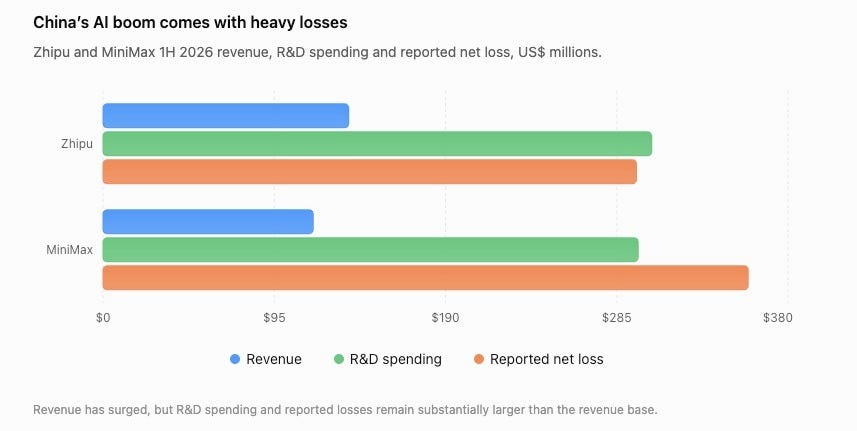
Zhipu has been the more impressive of the two with revenue growing by nearly 400% year-on-year to reach $136 million during the last six months. When I say the companies grew up, Zhipu is the perfect example as it switched its core money-making focus from on-premise deployment to cloud-based products.
That’s reflected in its GLM AI models, which have gained traction in recent months in particular for offering a quality experience at a fraction of the cost of Anthropic, OpenAI and others. Cloud-based revenue went from just 15% of revenue one year ago to 86.5% today. On-premise revenue actually fell as the focus on launching global products that anyone in the world can use, and crucially pay for.
It’s a similar story for MiniMax, which grew its platform and enterprise service revenue by over 700%. Those sales cover its LLM, music AI product and consumer apps around video and image generation, and they went from one-third of all MiniMax sales to nearly two-thirds.
Overall, MiniMax logged an impressive 283% annual revenue jump, coming in at $116.6 million for the last six months, slightly behind Zhipu. January, when we wrote that neither company makes much money at all, seems a long time ago.
If you’re wondering why these are the first earnings reports we’ve seen from Zhipu and MiniMax, Hong Kong does not require listed companies to report quarterly. Results for the first six months and full-year are mandatory, but first- and third-quarter reporting is optional.
The rapid development of AI models this year has allowed Chinese companies to reach global audiences for the first time, in a way that wasn’t possible before. Sure, Tencent launched games that had been hits outside of China and Alibaba had success with e-commerce in parts of Europe, but that’s about the extent of it. Even ByteDance had to alter its core product to find success overseas.
Zhipu and MiniMax, though, offer the same product locally and internationally. Plus, unlike the successes of TikTok, Temu or Shein, international uptake has taken months not years and much less lobbying and localisation. They haven’t reached consumer tech scale, for sure, but there seems to be plenty of growth potential remaining.
This progress, however, has come at a cost. Playing on a global stage means a big increase in spending to keep its products competitive.
MiniMax’s adjusted net loss more than doubled, from $138.7 million to $293.0 million as admin costs like staffing doubled and R&D spending surged 139%. Zhipu’s R&D bill rose a more modest 34% but its cost of revenue ballooned 635%. The narrowed its net loss to $296 million, from a $336.8 million loss a year earlier, but it remains deeply in the red.
Neither company provided financial guidance or forecasts, they instead focused on product development with a focus on enterprise/API growth, building more agentic capabilities and, of course, continued investment in models.
You’d expect that their next results bring more of the same. Spending will increase but revenue should increase at a more rapid rate, given the progress that both have made selling across hundreds of countries worldwide. It will also depend on what trends run through the industry, agentic AI wasn’t as established in January as it is today, for example.
Zhipu and MiniMax will be the first of many public AI companies. Chinese rivals Moonshot, DeepSeek and even Manus have been linked with IPOs in the coming year or so. Plus, in the US, Anthropic and OpenAI have completed initial applications to list, too.
More public companies mean more data, more potential to scrutinise growth and company development, etc. But already, these two firms are producing very unique financial results the likes of which haven’t been seen before.
Markets
Yotta Data Services plans to go public by March 2027 to raise as much as $1.5 billion to fund its AI infrastructure expansion, which includes sovereign cloud products for India. The company recently raised $150 million at a valuation of $3.9 billion. [Reuters]
Deals
Adobe acquired India-based marketing intelligence startup Rilo, bringing in the team’s technology to automate marketing workflows and help brands track their visibility in ChatGPT, Gemini and Claude [TechCrunch]
Beijing-based Tripo AI, which develops 3D-native AI models, raised about $445 million in a Series B round [FinSMEs]
AI and Chips
Kioxia’s chip plant is reshaping Kitakami in rural Japan as it adds a third facility with government backing, though the benefits have been uneven as local businesses compete with the company for workers [Bloomberg]
Hua Hong Grace Semiconductor is investing $2 billion in a new 12-inch fab in Wuxi, adding 55,000 wafers a month as China expands capacity for AI infrastructure and cuts reliance on foreign technology [SCMP]
Policy
Taiwan has intensified its crackdown on Chinese companies accused of concealing their links while recruiting chip talent and seeking sensitive technology, with previously unpublished data showing the scale of its investigations [Rest of World]
China has removed more than 5.61 million pieces of content and 49,000 accounts in a crackdown on AI-generated “slop” across platforms including Douyin, Kuaishou, RedNote and WeChat [SCMP]
In other news:
Reliance Jio is expanding JioPC beyond its broadband subscribers, allowing any Indian internet user to access a cloud-based virtual PC on an existing computer and gain the capabilities to run AI applications [TechCrunch]
JioHotstar is replacing Hotstar in the UK, Canada and Singapore in its first expansion beyond India [TechCrunch]
China-based hackers compromised Cisco routers to monitor organisations, steal credentials and enter other networks, using a campaign dubbed Fire Ant to exploit trusted infrastructure and evade detection [The Record]
Kazakhstan’s Kaspi.kz is expanding its Turkish offering through Hepsiburada, adding shopping loans now and more fintech services next year as it looks to replicate its e-commerce and financial-services model [Nikkei Asia]
Walmart-owned Flipkart is bringing short-form scripted shows to its e-commerce app as it pushes further into content-to-commerce, with Terribly Tiny Tales and Pratilipi among its production partners [Economic Times]
For news as it happens, follow ATR Bulletin, our real-time news site that keeps you in the know.