


Welcome back to Asia Tech Review, your curated digest to keep up to date with tech news across Asia.
Today we look at how time hasn’t been kind to some of Covid’s hottest businesses. Shein is rebuilding its fast fashion business model out in the open, after it went public in Hong Kong this week in a rush. In India, two of the country’s once-fast-growing online learning startups joined forces to plot their own journey to IPO.
A quick mention for Culpium, which has moved to paid subscriptions. Long-time ATR friend Tim Culpan is one of Asia’s longest-serving and most thorough tech journalists. His newsletter will make you smarter.
To keep up with our issues, follow us on LinkedIn or WhatsApp. Please do share Asia Tech Review with people you know who want to get smart about Asia tech.
For news as it happens, follow ATR Bulletin, our real-time news site that keeps you in the know.
Shein is rebuilding its business in public
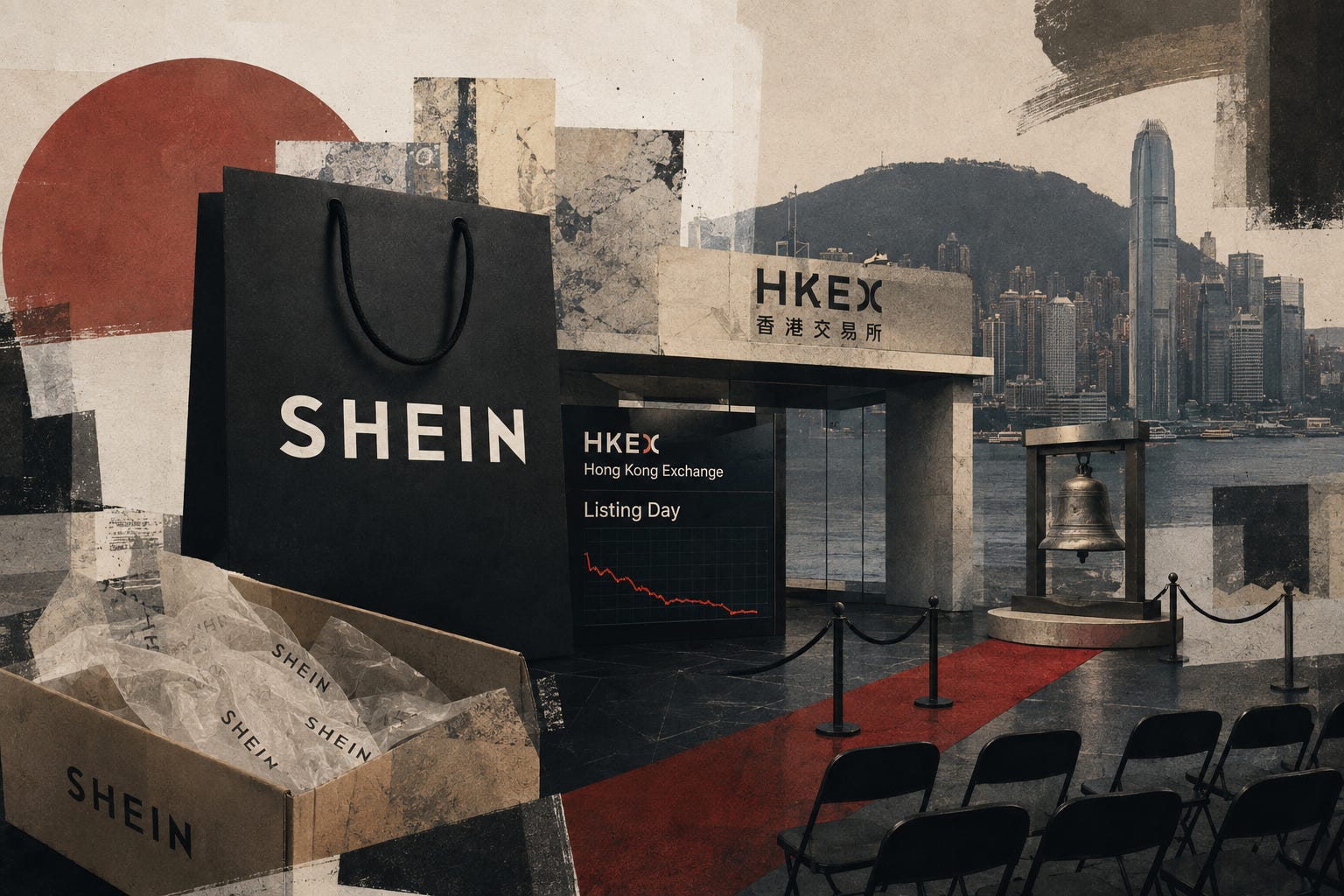
The time to go public is not when things are up in the air, but no matter for Shein. The Chinese fast fashion company rang the bell when it listed in Hong Kong in an IPO that raised $1.74 billion and valued the business at just under $27 billion.
This was anything but a convincing debut from the company, which was once valued as high as $100 billion. There was no pop as we’ve seen with memory maker CXMT or robotics firm Unitree. Instead, Shein’s shares are trading slightly up after recovering from an initial 10% drop.
The company was the hottest property in tech just a few years ago, and an early example of how Chinese companies could go global with real impact and results. But this IPO rush tells a story of mistakes and misfortune when Shein was riding high.
The listing looks rushed, and it is. In going public, Shein has removed a $4.4 billion cash obligation to early investors that it would have faced had it not IPO’d this year. In recent years, the company had tried unsuccessfully to list in the US and then UK, but just came in before the deadline.
The company has plenty of cash on hand, more than $14 billion for that matter, but handing more than a quarter of it in redemptions wouldn’t exactly be prudent.
Typically, companies go public when they’ve long figured out their product-market fit, growth and financials, but Shein is in a unique situation of still needing to turn things around. All while it is a newly publicly traded business.
It tried for years to shed its Chinese tag, playing up its headquarters in Singapore after relocating in 2021 and splashing cash to sponsor lifestyle events, gigs and more in the US and other Western markets. But since pinning its hopes on a Hong Kong IPO, it has embraced its roots in China and even its reclusive founder, Sky Xu, has made more appearances and been quoted more than before.
Beyond the change of narrative, Shein is also shifting its business model from simply being a provider to being an enabler. It made its name as a cheap supplier of fashion items, but post pandemic consumption habits changed and the import tax loopholes it took advantage of in the US and Europe were sealed.
Bloomberg reports that executives describe this new ambition as becoming the “Amazon Web Services of the fashion industry.”
“The AWS for X” is a tortuous simile you hear across many parts of the tech industry, and in this case it appears to mean that Shein will open its supply chain and operations to fashion brands to source from China. An in-house example is coming with Everlane, the US fashion brand that Shein acquired for a discounted price of around $100 million.
The deal is being probed by the US government but, assuming it is cleared, Everlane would tap into Shein’s network of more than 7,500 designers, manufacturers and merchants to streamline its supply chain operation and lower its costs. Shein has more than 20 brands of its own so it has plenty to work on.
We’ve seen ‘China manufacturing via API’ businesses emerge before, and fail, but none have the scale, cash or ambition of Shein which means this shouldn’t be dismissed. But, a change this significant is made even tougher when it’s done as a public-facing business.
It isn’t unprecedented. PDD, which operates Shein rival Temu, built its fast fashion and goods business after it went public. Sea has grown its Shopee business since being listed. But this uncertainty explains why the market is taking a step back from Shein stock.
There are lessons here in how capital is raised, not to mention the complicated and ever-evolving tensions between the US and China. Now, at least, our analysis of Shein’s business can be firmly rooted in its numbers. There will be nowhere to hide.
Two faded Covid unicorns join forces in India in $200M acquisition
During Covid times, online learning startups were among the hottest properties in India. The hype faded significantly since then but there are still some category winners. A major piece of consolidation has made that even clearer after UpGrad completed the acquisition of rival Unacademy in a $200 million all-stock deal.
That price would have been unthinkable back in pandemic times, when Unacademy was worth upwards of $3 billion. Both companies raised close to $1 billion from investors, with UpGrad’s valuation reaching a (slightly lower) peak of around $2.2 billion.
The deal was announced in March, but it took some time to get over the line. TechCrunch reports that Unacademy angel investors are cashing out following the completion. Early backers will still have done well, but the likes of SoftBank, Tiger Global, General Atlantic who came in later will be hoping that UpGrad can come good on their bet on online education in India.
Its Airlearn language learning app is showing progress and the newly acquired business isn’t burning cash as it did before. Combined, the two businesses are at north of $250 million annual revenue, with TechCrunch providing more details:
The deal comes despite Unacademy having about ₹9 billion (about $94.8 million) in the bank and annual revenue of roughly ₹4 billion (around $42.13 million), Munjal wrote. He said most of the startup’s businesses were profitable or close to profitability, and said the company had the option to continue operating independently.
Things could, of course, be worse. Take the example of Byju’s, which has effectively become worthless and dogged by lawsuits and court action between investors and its founder.
UpGrad’s goal is to reach an IPO, and combining the forces of these two is the best bet to get there.
Deals
Nvidia is investing $3.5 billion in Taiwan’s MediaTek through convertible bonds, deepening a partnership aimed at expanding its data-centre chip ecosystem [Bloomberg]
500 Global is reportedly shelving dedicated Southeast Asia funds, meaning future regional bets are likely to come from its global vehicles as the venture market keeps consolidating [DealStreetAsia]
Bengaluru-based Alteon raised $2.5 million to build autonomous aircraft that can stay airborne for more than a year by harvesting ocean winds [TechCrunch]
Magna International is investing another $35 million in Bengaluru-based battery swapping startup Yuma Energy, raising its stake above 51% [TechCrunch]
Markets
Hong Kong’s IPO market has taken off around Chinese company listings. There’s been a lot of speculation that Southeast Asian companies are looking at it for their own IPOs, we’ll get a little taste (pun intended) if and when Jollibee picks Hong Kong for a listing of its overseas assets. Obviously not tech, but might start to clear a pathway [Nikkei Asia]
Chinese memory-chipmaker Longsys is seeking to raise up to HK$6.28 billion ($801 million) in a Hong Kong IPO, extending the rush of AI supply-chain companies tapping public markets [Bloomberg]
SB Energy, the SoftBank-backed AI infrastructure platform, filed for a Nasdaq IPO as it prepares for a listing that could raise $5 billion to $7 billion [WSJ]
Related: OpenAI received warrants worth an estimated $5.5 billion in SB Energy as part of a deal to become a data-centre tenant, tying the ChatGPT maker more closely to SoftBank’s power-infrastructure ambitions [WSJ]
Shanghai-based Enflame Technology, backed by Tencent, is seeking to raise about 6.12 billion yuan ($911 million) in a STAR Market IPO, making it the last of China’s “four little dragons” of AI chipmakers to go public [Bloomberg]
Earnings
Broadly, China’s AI chipmakers are starting to benefit from Beijing’s self-reliance push, but first-half results show a widening gap between profitable leaders and loss-making rivals [SCMP]
In particular, Z.AI’s first-half revenue rose to 954 million yuan ($142 million), missing analyst estimates as China’s AI price war weighed [Bloomberg]
Huawei isn’t public, but it still releases earnings figures: it says first-half net profit fell 36% to 23.81 billion yuan ($3.54 billion), as higher costs and R&D spending outweighed a 9.6% rise in revenue [Reuters]
AI and Chips
Manus has resumed independent operations more than four months after Beijing blocked its $2 billion acquisition by Meta with its original team in place. There’s no official confirmation of which investors were involved in the deal to release it from Meta. [Manus]
Semianalysis looks at how Korea’s trillion dollar efforts to develop sovereign AI have gone, concluding that Nvidia is winning [Semianalysis]
China’s CXMT has begun small-scale production of HBM3E, putting it one generation behind Samsung, SK Hynix and Micron in high-bandwidth memory for advanced AI chips [The Information]
Sony Semiconductor Solutions is working with Saudi Aramco on an AI model that uses image sensors to predict equipment failures at industrial plants [Nikkei Asia]
Japan’s Miyagi prefecture is trying to lure SK Hynix into building an advanced memory chip plant, although the company has denied reports that it is considering the site [Nikkei Asia]
Ajinomoto and Daikin Industries are expanding in Taiwan to work more closely with AI chip customers, as demand for advanced packaging and materials surges [Nikkei Asia]
Micron unions in Taiwan are moving toward possible strike action, demanding changes to the US chipmaker’s bonus system and a larger share of profits for workers [Reuters]
Policy
Big news here with Reuters reporting that India is preparing a framework that would let AI agents make small UPI payments without requiring approval for every transaction [Reuters]
South Korea proposed a record 821 trillion won ($596.92 billion) government budget for 2027, including a sharp push to strengthen its technology sector and compete in the global AI race [Reuters]
Singapore is committing to spend S$220 million ($173 million) over three years on fintech and innovation, including support for AI and at least 1,000 internships [Bloomberg]
India will offer chip-design startups up to 50% of project costs, capped at ₹150 million ($1.7 million), under its new Semicon 2.0 programme [Bloomberg]
A Chinese court has frozen up to 2.14 billion yuan ($300 million) of assets held by Dutch chipmaker Nexperia and its equipment arm [Reuters]
France will begin imposing a penalty on ultra-fast-fashion products this week, targeting platforms including Shein, Temu and AliExpress under a law aimed at reducing fashion waste [France24]
In other news:
China is rapidly electrifying its heavy-truck fleet, with new-energy models making up nearly 30% of sales last year, far ahead of Europe’s roughly 4% share [Semafor]
Apple could lift India’s share of global iPhone production to 30-35% within five years, supported by a new ₹62,500 crore ($7 billion) mobile manufacturing incentive package [Business Standard]
Prosus-backed iFood has asked Brazil’s antitrust regulator to investigate Meituan’s Keeta over allegedly unsustainably low prices [Bloomberg]
Chinese automakers are using AI to target 18-month development cycles, but the push is drawing tougher regulatory scrutiny over safety and testing as competition squeezes margins [Bloomberg]
Chinese rocket maker Galactic Energy successfully launched its Pallas-1 reusable rocket into orbit [SCMP]
Vietnamese automaker VinFast has reportedly suspended plans to manufacture three electric vehicles in India while it reassesses costs, telling suppliers to halt work on the VF3, VF6 and VF7 [Reuters]
For news as it happens, follow ATR Bulletin, our real-time news site that keeps you in the know.