


Welcome back to Asia Tech Review, your curated digest to keep up to date with tech news across Asia.
Today we’re looking at how Chinese AI models might evolve. With major investment windfalls, DeepSeek is leading the charge towards developing its own inference chips to reduce reliance on Nvidia, Huawei and others and potentially unlock major performance gains. There’s also talk that Chinese firms might limit overseas usage of their top models. Lots to ponder.
To keep up with our issues, follow us on LinkedIn or WhatsApp. Please do share Asia Tech Review with people you know who want to get smart about Asia tech.
Outside of Asia Tech Review, I run Fully Drafted, a communications and consulting company focused on traditional comms, thought leadership and investor relations. Get in touch if you think we can help you.
Chinese AI companies are about to look a lot like their US peers
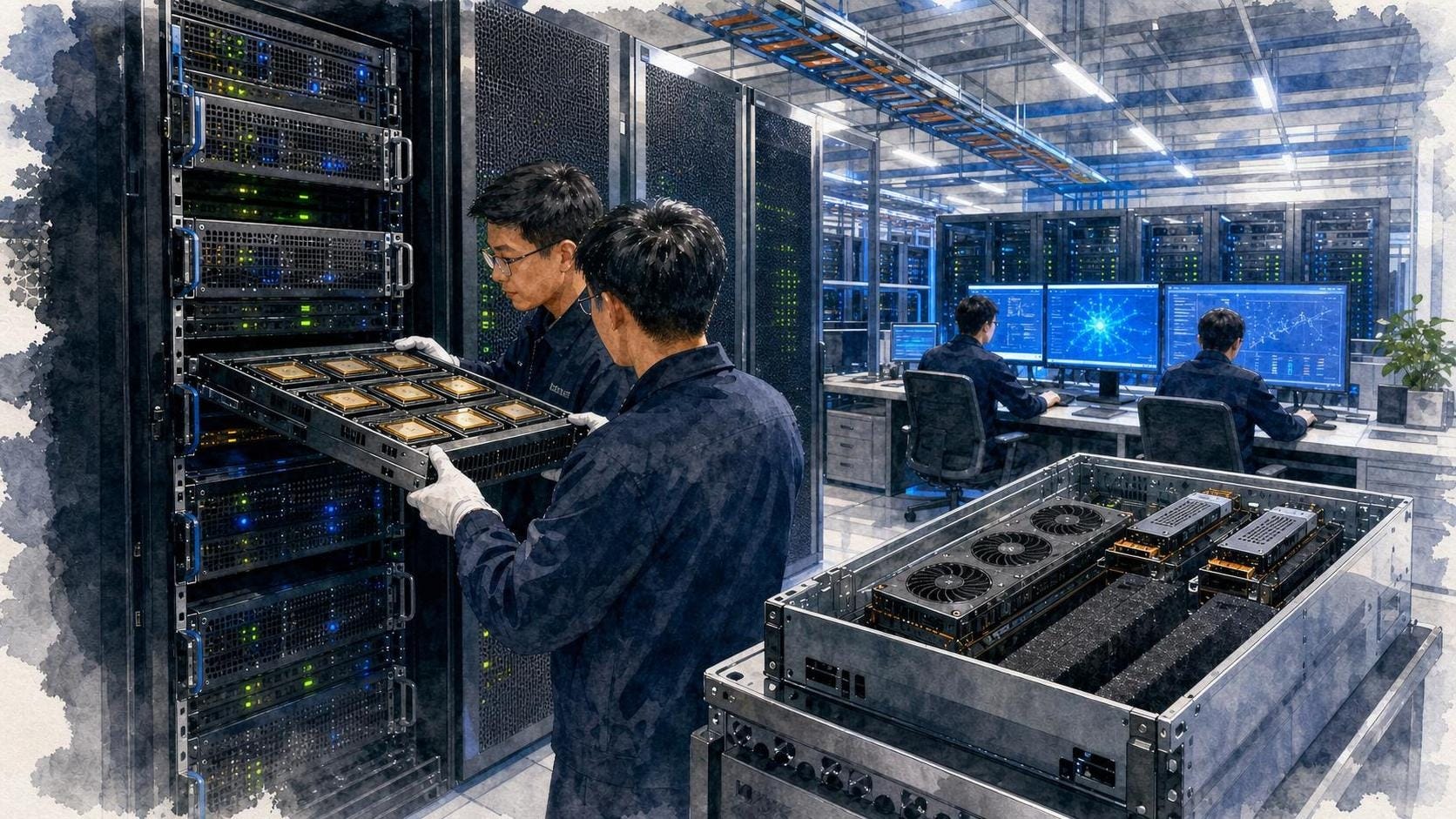
Open source and budget-friendly are what comes to mind when you think of Chinese AI models, but things are showing signs of change.
Developments this week suggest that China’s top AI firms are levelling up their strategies to be more in line with those in the US.
Huge investments mean Chinese AI chips are coming
When DeepSeek raised $7 billion, you’d be forgiven for wondering what that huge pile of cash is for.
The company has managed to build a popular and highly rated AI model, and related services, on a modest budget. It did so under the radar. How does raising a truckload of cash fit with that strategy, and if it doesn’t, what is the new approach?
We have more clarity now after Reuters reported that DeepSeek is developing its own chip for inference in order to reduce its reliance on Nvidia and even Chinese suppliers Huawei for the processors that power its tech. Its own chips and hardware could help DeepSeek produce even better quality models and services.
OpenAI and Anthropic are both reportedly working on their own chips, with Broadcom and TSMC, and Samsung, respectively, their potential partners. For these two, this is about helping unlock greater capabilities, while Chinese companies are also looking to overcome their issues acquiring US technology.
We know China’s self-sufficiency push is giving AI providers options from local companies, chiefly Huawei, but DeepSeek isn’t alone in looking at its own chips. Zhipu AI, the Chinese firm that’s seen its Hong Kong share price soar since its IPO at the end of last year, is also considering it too, according to The Information.
It makes sense that increased capital into the Chinese AI leaders is enabling them to step up and take on strategies that have, until now, been limited to US giants. DeepSeek’s huge funding round is more than we’ve seen for any of its peers to date, and Zhipu may be about to rake in more cash with a planned listing on mainland China after its shares have risen by more than 1,250% since January.
Profitability and international restrictions
Chinese AI firms are levelling up their strategies as the existing approaches hit their buffers.
Alibaba, for example, has been in transition after it reorganised its Qwen AI division and entire AI department with a view to making money and not simply creating popular open source models. The New York Times reported that the company is struggling to turn the popularity of its models into revenue.
This remains an ongoing issue for Chinese companies.
New data from OpenRouter, which aggregates all major models in one place, suggests Chinese AI models are winning more and more US enterprise usage with DeepSeek and Z.ai’s GLM model leading the charge. Chinese models have topped 30% of US companies’ weekly token spend since February 8 and peaked at 46%.
Underwriting all of these changes is the role of China’s government, which could be changing its own position. Reuters reports that Alibaba, ByteDance, Z.ai and others have had conversations with Chinese authorities about potentially restricting overseas access to their most advanced models and future releases.
That would bring it in line with Anthropic and OpenAI and their restrictions not only in China, but non-US markets. The initial release of Anthropic’s Mythos and Fable models of Claude were pulled for all foreign nations, raising concerns across the world and prompting governments to increase their focus on developing their own sovereign solutions.
Are we about to see a huge change to how Chinese AI companies operate?
It’s unlikely to be wholesale, but increased capabilities might allow Chinese companies to offer more premium experiences to either grab market share or sell more expensive services. The AI landscape looks like it is becoming multi-tier, with many users and companies happy to buy more affordable packages without necessarily needing the latest, greatest and most expensive models. Chinese companies will fare better in that market with more advanced options to complement their existing focus on affordability and open source.
In related news: Chinese companies expect to shift 46% of their AI accelerator budgets to domestic chips over the next year, up from 30% today, as US-China tensions push buyers away from Nvidia’s advanced processors [Bloomberg]
Report highlights Singapore’s role as Asian startup scaling hub
Southeast Asia’s funding winter may appear to have rebounded somewhat after Traxn, a data provider covering Asia, found that tech companies in the region raised $7.4 billion in the first half of 2026, more than double the $3.2 billion raised a year earlier.
Don’t take this report with too much authority, however, because the data is supersized by DayOne’s massive $2.5 billion Series C round. That deal in June alone counts for 33% of the total amount raised.
Traxn found that the number of rounds was down, but the number of larger rounds ($100 million-plus) was up from four in the second half of last year to 12 in the first half of 2026.
It wasn’t just DayOne, Supabase raised $500 million, Airwallex raised $320 million and PixVerse closed $300 million. Interestingly, all of these are Singapore-based companies but each one has a founding story that’s away from the country.
Supabase was started by founders who aren’t Asian, Airwallex is originally from Australia and PixVerse is the international business of China-based AIsphere. We’ve written about DayOne a number of times, so readers will recall it is the global business of China’s top data centre provider, GDS.
Traxn’s data alone may not indicate Southeast Asia has arrested its funding slump, but it certainly highlights Singapore’s position as a fundraising and incorporation hub for startups across Asia that want to scale and raise big rounds.
Deals
Shenzhen-based smart glasses startup Even Realities raised a $150 million pre-Series B round led by Meituan and Tencent at a $1 billion valuation [TechCrunch]
Thailand secured $4.1 billion in EV supply-chain investment from Chinese, Korean and Japanese companies [TechNode Global]
B Capital closed its third early-stage fund at $500 million to back young companies working on AI and other frontier tech, India is a major focus after backing winners like Meesho [Economic Times]
Markets
SK Hynix has begun marketing a US listing to sell American depositary receipts worth roughly $28 billion [Bloomberg]
Consumer electronics manufacturer Luxshare, which works with Apple among others, raised HK$24.3 billion ($3.1 billion) in its Hong Kong IPO after selling at the top of its range. Shares begin trading on Thursday [Bloomberg]
Indian electric two-wheeler maker Ather Energy plans to launch a qualified institutional placement as early as next week to raise up to $200 million [Economic Times]
Indian fintech Navi, cofounded by Flipkart cofounder Sachin Bansal, is reportedly preparing to file for an IPO by the March quarter of 2026-27 to raise INR30 billion ($350 million) [Economic Times]
Shanghai Biren Technology is raising HK$7 billion ($892.5 million) through a share placement to ramp up GPU production as it competes with Nvidia in China’s AI chip market [SCMP]
Samsung Electronics posted a monster quarter as operating profit surged nearly 19-fold from a year earlier to an estimated 89.4 trillion won ($58.44 billion), beating forecasts, while revenue is expected to rise 129% to 171 trillion won ($111.8 billion) [Reuters]
LG Electronics expects second-quarter operating profit to jump nearly 150% year-on-year to 1.579 trillion won ($1.03 billion), helped by a US tariff refund and steady profitability in home appliances, TVs and auto parts [Wall Street Journal]
Tencent sold $1.5 billion of Kuaishou shares, offloading about 273 million shares at HK$43.25 ($5.50) each in Hong Kong’s biggest block trade this year. Kuaishou’s share price fell as much as 9.3% [Bloomberg]
Naver Financial and Dunamu, the operator of South Korean crypto exchange Upbit, delayed their planned stock-swap deal for a second time as debate over the country’s proposed Digital Asset Basic Act adds regulatory uncertainty [The Block]
AI and Chips
South Korea’s government plans to launch an investment fund fuelled by tax revenue from the country’s semiconductor boom [Bloomberg]
Tencent launched its Hy3 model, claiming performance comparable to flagship models two to five times its size and greater stability and cost efficiency than its preview version [Tencent]
Chinese web-novel platforms including Tencent, ByteDance and Baidu are tightening limits on AI writing tools after low-quality automated fiction flooded their sites [Rest of World]
In other news
Singapore prosecutors added money-laundering charges against Alan Wei Zhaolun, a suspect in an alleged scheme to divert Nvidia AI chips to countries including China [Bloomberg]
Morgan Stanley expects the global robotaxi market to reach $1 trillion by 2040, with Chinese players Baidu, Xpeng and WeRide set to lead the region alongside Tesla and Waymo [SCMP]
A US federal judge ordered the Pentagon to give Alibaba a reprieve from a lobbying ban while she considers the constitutionality of a measure targeting Chinese companies’ US activities [Bloomberg]
A Samsung union leader’s $26 billion bonus win has splintered the union he leads, as unequal payouts widened tensions between semiconductor workers and staff in loss-making units [Bloomberg]
South Korea’s Supreme Court proposed amendments that would introduce detailed procedures for the seizure and liquidation of digital assets [The Block]
Telegram has reportedly become a paid hub for non-consensual intimate images in India, with users paying as little as Rs 99 ($1.15) through UPI to join private groups that share and trade photos taken without consent [Economic Times]
Apple is starting to resume card payments for Apple Account purchases in India more than four years after suspending them in May 2022, with eligible Visa and Mastercard credit and debit cards returning for iCloud+, Apple Music and App Store purchases [TechCrunch]
Tokyo police arrested a 15-year-old student suspected of using ChatGPT to help automate an attack on Bandai Channel that fraudulently cancelled more than 46,000 user subscriptions and forced the anime streaming service offline for more than a month [The Record]
In a sign of a narrative that might be the start of planning for an IPO: Carousell claims to have reached positive EBITDA in FY25 as revenue grew 18% to $141 million and e-commerce revenue rose 40%, accounting for 45% of total revenue [TNGlobal]
Chinese smartphone sales fell 13% year-on-year during the 618 shopping festival, according to Counterpoint Research, with all major domestic brands except Huawei posting double-digit declines and Honor down 33% while Xiaomi fell 24% [Reuters]