


Welcome back to Asia Tech Review, your curated digest to keep up to date with tech news across Asia.
Alibaba’s transition into AI has been slower than it could have been and certainly more painful, but today it stands one of tech’s most credible forces. Yesterday, it showed its might with a series of big announcements across the holy trinity of AI: models, chips and compute. The markets loved it. Let’s dive in.
To keep up with our issues, follow us on LinkedIn or WhatsApp. Please do share Asia Tech Review with people you know who want to get smart about Asia tech.
For news as it happens, follow ATR Bulletin, our real-time news site that keeps you in the know.
Alibaba makes big announcements on AI model and AI chip plans
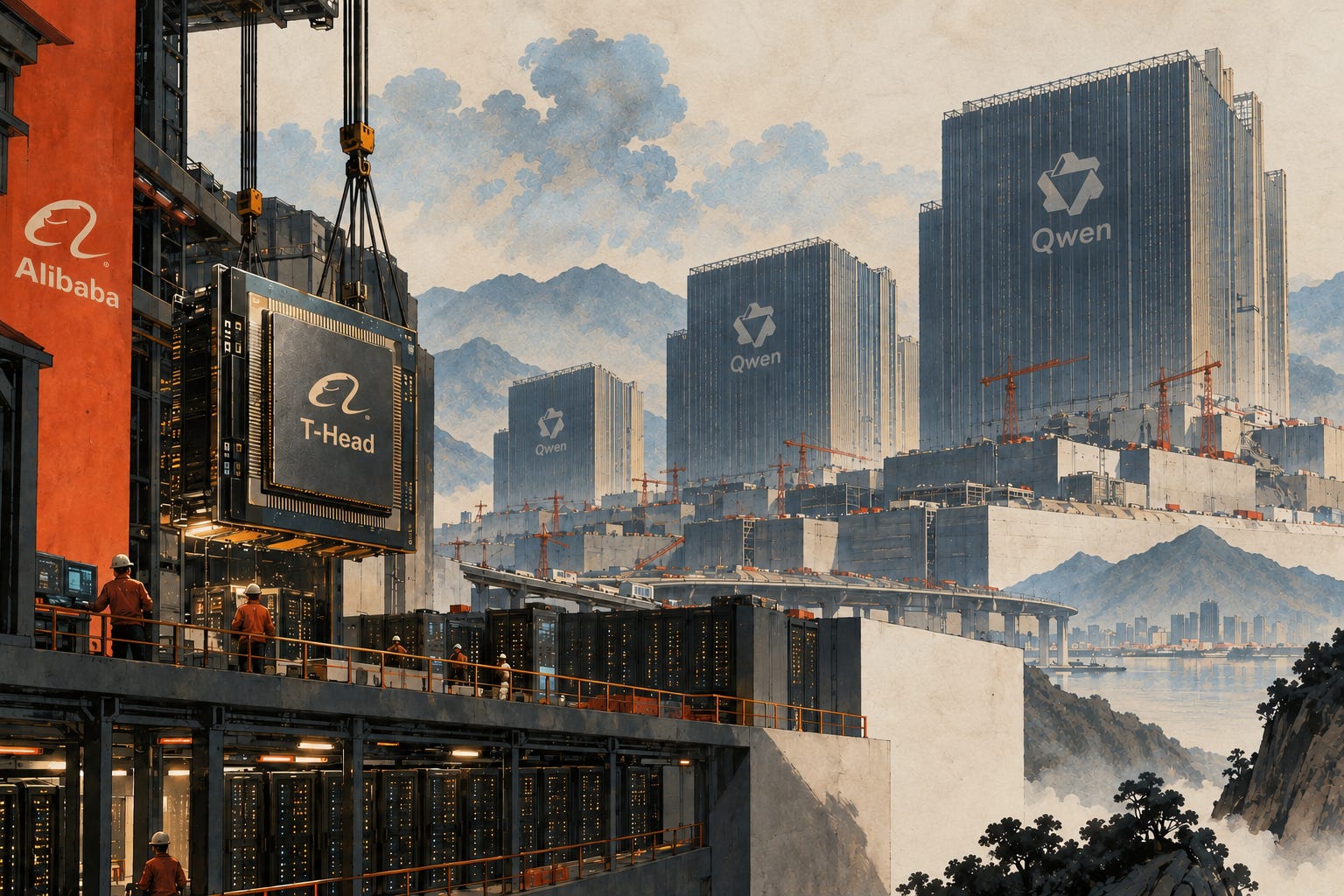
Alibaba’s push into artificial intelligence helped the Chinese company’s share price recover to some semblance of pandemic highs last year. Now, the company is doubling down on AI with ambitious plans for significantly more powerful AI models and a new AI chip on the hardware side.
The headline is arguably CEO Eddie Wu’s announcement that Qwen, Alibaba’s AI, will soon boast models that include 5 trillion-10 trillion parameters in order to tackle “more complex, longer-horizon tasks,” Reuters reported. Its current flagship, Qwen 3.8 Max, has 2.4 trillion parameters so this would be a significant upgrade.
Those upcoming models are currently in training, according to the company, which made the reveals at its annual Apsara event for Alibaba Cloud. Qwen models do not currently train themselves (recursive self improvement, RSI, is a major goal for AI model companies), but Wu said there’s been “meaningful” progress on that front, though he did not provide specifics.
Outside of software, Alibaba’s second big punch was hardware as it announced a new AI chip that would compete with Nvidia and others to slot into AI data centres, Bloomberg reported.
Zhenwu V900, the new chip from Alibaba’s T-Head division, can be combined into 50,000 chip clusters in order to train and power frontier AI models, Wu said.
Alibaba wants to back that up with more compute capacity, with Wu targeting 20 GW of data centre capacity worldwide for Alibaba Cloud by 2032. Europe is a focus with new cloud regions for Turkey, Finland and the Netherlands coming. That’s more modest than goals set by SoftBank, which is commissioning multiple 10 GW plants, but it may be more realistic if Alibaba can source the raw materials it needs, which the whole industry is battling for.
E-commerce was always Alibaba’s bread and butter. It rode high with a record share price of nearly $305 in late 2020, valuing it at over $850 billion, as the Covid-19 pandemic saw online spending surge. As the world came out of lockdown, the company looked flatfooted, particularly when generative AI boomed following the launch of ChatGPT in early 2023.
But, after a sustained rebuild and the return of the likes of Jack Ma, Alibaba’s AI pivot began to strike a positive chord with investors last year, sending its shares to nearly $180 by September 2025, their highest price for four years.
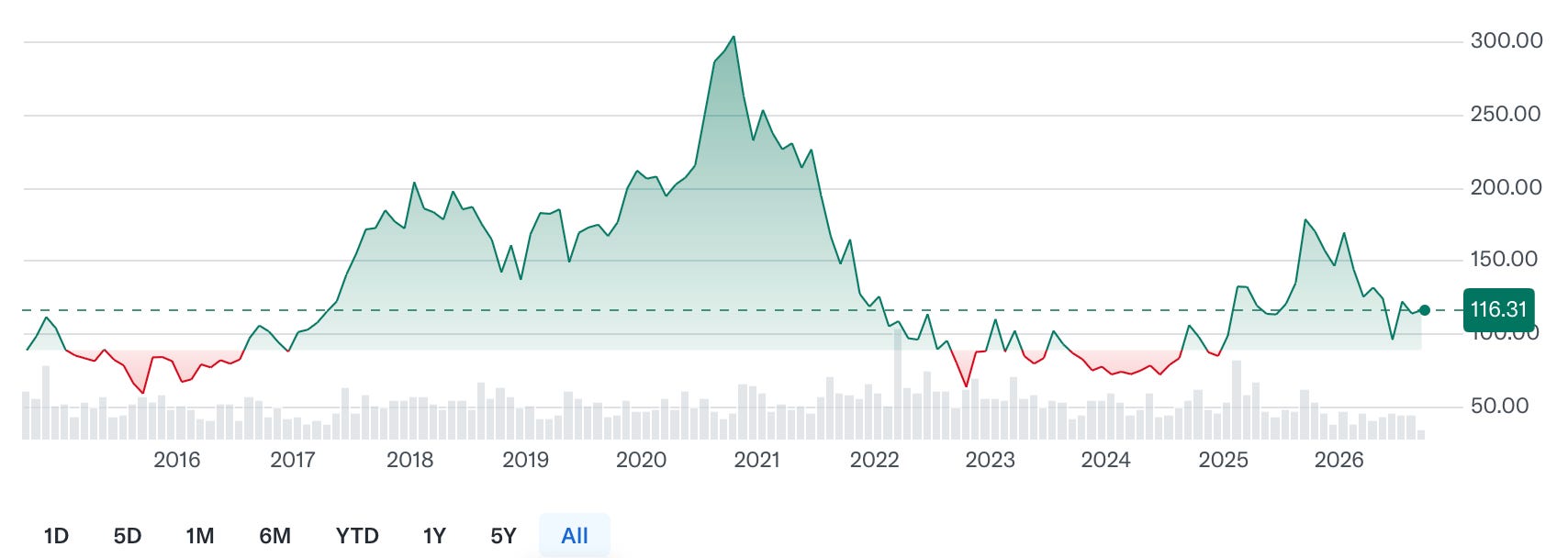
Alibaba has pledged to spend $53 billion on cloud and AI infrastructure, but the share price has fallen since those heights. Still, the firm has picked up plaudits for a strong approach to AI. That included developing Qwen into a strong and capable model, particularly in the open weight category, whilst building AI into the core of Alibaba’s commercial businesses. The company has taken a more long-term view than competitors like Tencent, although the latter has taken a leaf out of Alibaba’s book by rebuilding its core model.
These new developments are a continuation of that push, and markets reacted positively with Baba shares up as much as 5%. To continue the positivity, Alibaba will need to show proof points of the strategy, which will take time to show results.
AI at the centre of upcoming Trump-Xi meeting
While Alibaba was out revealing its future plans, the US and China’s relationship over AI is reaching a notable moment with President Trump set to meet President Xi this week.
In the lead-up, the two countries have established a formal dialogue around AI. But Xi is not likely to bring Chinese tech executives with him to Washington for the meeting. That’s a shame. If not only for the fact that these events often make some remarkable photo opportunities.
Then there’s Anthropic’s allegations that pretty much every Chinese AI firm is distilling from Claude, which would make for good dinner table chat.
The Information reports that China’s internet regulator isn’t so amused. It is said to be investigating DeepSeek and Moonshot AI after Anthropic claimed the two companies sent sensitive state data directly to its Claude service.
There may not be major deals, according to Trump. But, as always, who can know.
DeepSeek and co may not be in Washington, but the company will brief the UN Security Council on AI risks. That feels like a strong validation, even if not from the White House.
Deals
Indian e-commerce startup CityMall is reportedly in talks to raise 4 billion to 5 billion rupees ($47 million to 58million) in a round led by Jungle Ventures at a valuation of about 40 billion rupees ($470 million) [Economic Times]
SoftBank is seeking to raise more than $11 billion through a bond sale to fund the third tranche of its OpenAI investment, including $10 billion of dollar bonds and €1 billion ($1.2 billion) of euro bonds [FT]
Singapore-based Nexstrom raised $12 million from Xora, Foothill Ventures and SEEDS, taking its total funding to $15 million as it develops 2D-material deposition equipment for next-generation chipmaking [TechCrunch]
Indian agentic AI startup Sol, founded by former Cred executives, raised $4 million from General Catalyst, Nexus Venture Partners, Z47’s DeVC, Peercheque and Cred founder Kunal Shah [Economic Times]
Markets
Shares in Chinese fibre-optic equipment maker Ligent Technologies rose as much as 19.2% on their Hong Kong debut after its HK$5.67 billion ($723 million) IPO, riding demand for AI-related equipment [Nikkei Asia]
SoftBank-backed SB Energy has slowed plans for an IPO at a valuation of about $50 billion as investors question demand for AI data centres, while the company has yet to bring one online [FT]
Kakao opposed a proposed US ADR listing of Kakao Mobility based solely on TPG’s stake, blocking an exit route for the private equity firm that would have raised no new capital for the company [Reuters]
Accel and Tiger Global-backed digital lender Moneyview is seeking a valuation of 598.5 billion rupees ($600 million) in its IPO, about 20% below its 2022 valuation [Economic Times]
AI and Chips
Well that didn’t take long: US investors are questioning whether a planned 4,000-acre AI and manufacturing hub in the Philippines can proceed amid protests and online opposition to the Washington-backed Pax Silica Initiative [Bloomberg]
DeepSeek is reportedly planning to use more domestic chips for AI model training, with Huawei expected to begin delivering training chips as early as the fourth quarter [The Information]
Taiwan broke ground on an advanced-packaging park in Kaohsiung where TSMC will build a technology-validation lab and talent-training centre, with operations expected to begin in the fourth quarter of 2029 [Reuters]
Singapore-based BDx Data Centers has broken ground on its 640MW Jatiluhur AI data-centre campus in West Java, having secured 845MVA of grid capacity from Indonesian utility PLN [The Business Times] [Disclosure: BDx Data Centers is an Ellerton & Co. client]
Chinese AI startup Moonshot’s Kimi K3 model is now available through Amazon Bedrock, giving its open-weight models a route to more commercial customers [SCMP]
Xiaomi is open-sourcing its MiMo-V2.6 models, including its new flagship MiMo-V2.6-Pro, while rolling out a faster Pro-UltraSpeed version [Xiaomi]
Tencent launched its Hy Image 3.5 Preview image-generation model and is integrating it into Yuanbao and its film-editing and design tools as it competes with ByteDance and Alibaba [Bloomberg]
China is accelerating nuclear research to meet AI data-centre power demand, with more than half of the world’s 58 conventional reactors under construction located in the country [FT]
In other news:
Nothing CEO Carl Pei announced plans to spin off budget smartphone and electronics unit CMF into a standalone, majority Indian-owned business with its own management and research teams [Bloomberg]
Indonesia’s challenger banks Superbank, SeaBank and Bank Jago are gaining customers with high deposit rates and consumer-platform ties, with Superbank’s deposits rising 89% to 15.9 trillion rupiah ($889 million) in the first half of 2026 [Nikkei Asia]
Hong Kong’s Animoca Brands and Nasdaq-listed Currenc have suspended talks on a reverse merger that would have taken Animoca public, citing deal timelines and changing market conditions [The Block]
PhonePe has received initial approval from the UAE central bank for licences covering retail payments, card schemes and stored-value facilities [Reuters]
Taiwan’s export orders surged 71.4% year on year to a record $102.96 billion in August, driven by global AI demand and marking a 19th straight month of growth. Orders totaled $704.99 billion in the first eight months of 2026, up 55% from a year earlier. [Focus Taiwan]
For news as it happens, follow ATR Bulletin, our real-time news site that keeps you in the know.