


Welcome back to Asia Tech Review, your curated digest to keep up to date with tech news across Asia.
It’s been a big week for Chinese open weight AI, and especially Alibaba which released a landmark new model as it crossed 3 billion downloads to date, more than any other company on earth. This week we also look at AI growth for the economies of Singapore and Malaysia, and our news includes a Unitree IPO explainer, a failed Uber merger in India and China has a new tech king.
To keep up with our issues, follow us on LinkedIn or WhatsApp. Please do share Asia Tech Review with people you know who want to get smart about Asia tech.
Finally, in ATR news, say hello to Asia Tech Review Bulletin. Bulletin is a real-time news feed for Asia’s technology industry that our team of two has quietly built in recent months. If you’re as obsessive about the news as we are, you might enjoy being able to easily scroll headlines and company updates. Stay tuned for more!
Qwen is the world’s most downloaded open weight AI

It was a good week for Alibaba after Qwen was crowned the world’s most-popular open-weight AI with more than 3 billion downloads of its models to date. Qwen overtook Meta, Google and its other Chinese rivals in the last six months to take the top spot but, beyond that, it also released a potential game-changer for open-weight AI.
Qwen3.8-27B is the open weight version of the newest model it introduced earlier this month (Qwen 3.8 Max). That means you can download it locally and run it, train it, etc. With Qwen3.8-27B, though, the model can run on some laptops since all its minimal requirement is just 17GB of RAM. Granted that doesn’t work for all laptops (like the MacBook Air I’m using right now) but it’s a major step forward for a frontier-level model.
And the newest Qwen very much is frontier-level. It outperforms Qwen3.7-Plus, Alibaba’s previous flagship, and benchmarks above Anthropic’s Opus 4.6 Max, which was released in February and powered a lot of early agentic AI products.
Putting what was state-of-the-art AI on anyone’s laptop for free six months late is a feat. It is obvious but worth saying that laptop-downloadable open weight models will not only become more powerful, but their footprint will get smaller and available for more devices.
Already, Qwen3.8-27B has clocked over 250,000 downloads and it is likely to help Alibaba grow that 3 billion number at a much faster rate. This success doesn’t generate revenue itself, however. Alibaba seems to have a long-term plan for AI, but it also restructured its Qwen division and has put focus on driving revenue from its AI businesses. Things are much better than they were as recently as 2024 when it underwent a painful rebuild.
The timing of the newest Qwen launch is apt since Hugging Face, which hosts open weight model downloads, found that Chinese open models are increasingly now the infrastructure layer that developers are building on. In Europe, for example, open weight models are growing in popularity as ‘sovereign’ options even though they are built in China.
The Hugging Face report on the state of AI in the first half of 2026 found that Chinese labs are setting the pace on open models, with Qwen the most dominant model ahead of compatriots DeepSeek, Z.ai, Moonshot (behind Kimi) and MiniMax. Qwen has more derivatives than any other company, nearly double that of Google in second, and its 39 million downloads per month are nearly double second place, that’s Google again on 20 million.
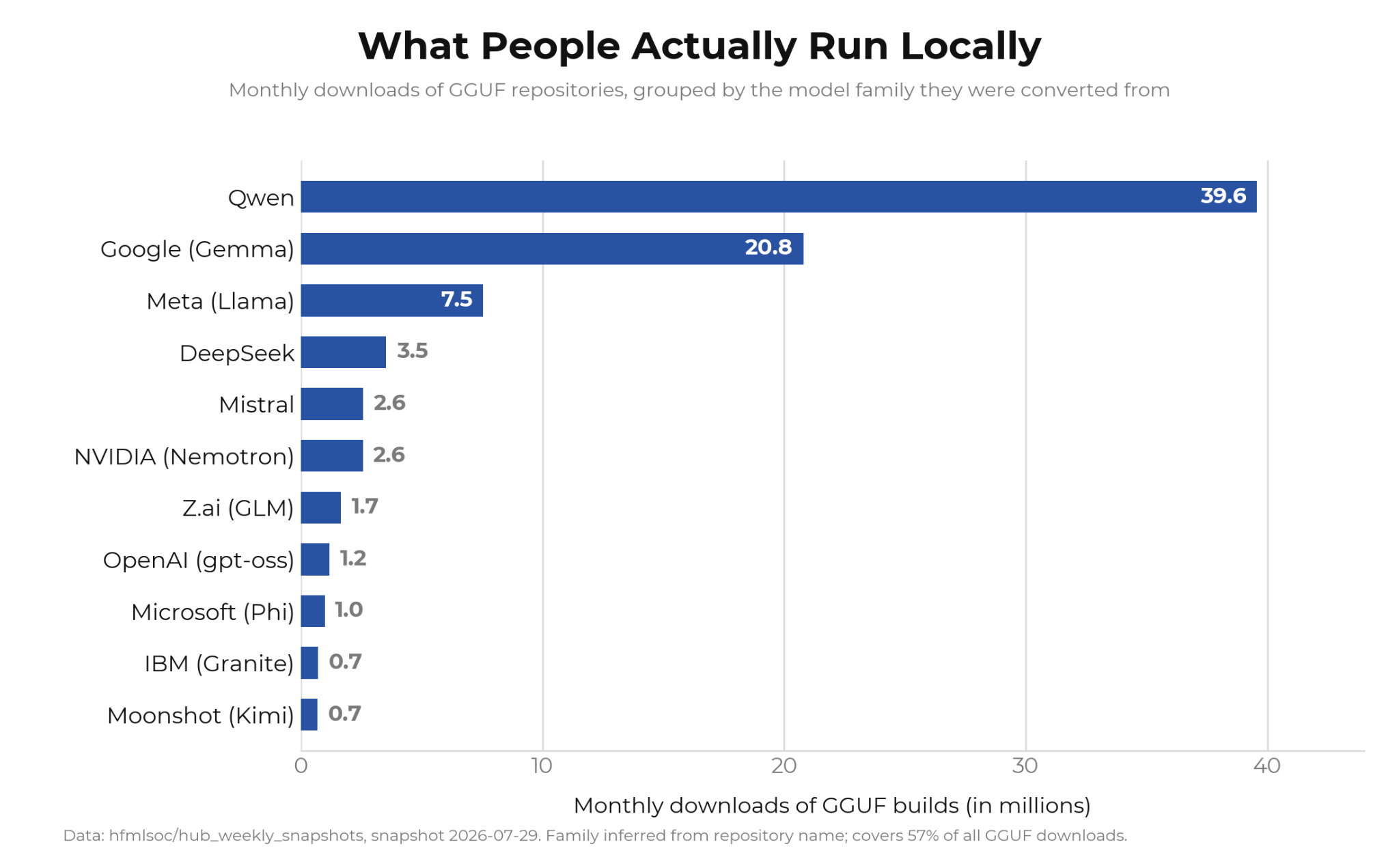
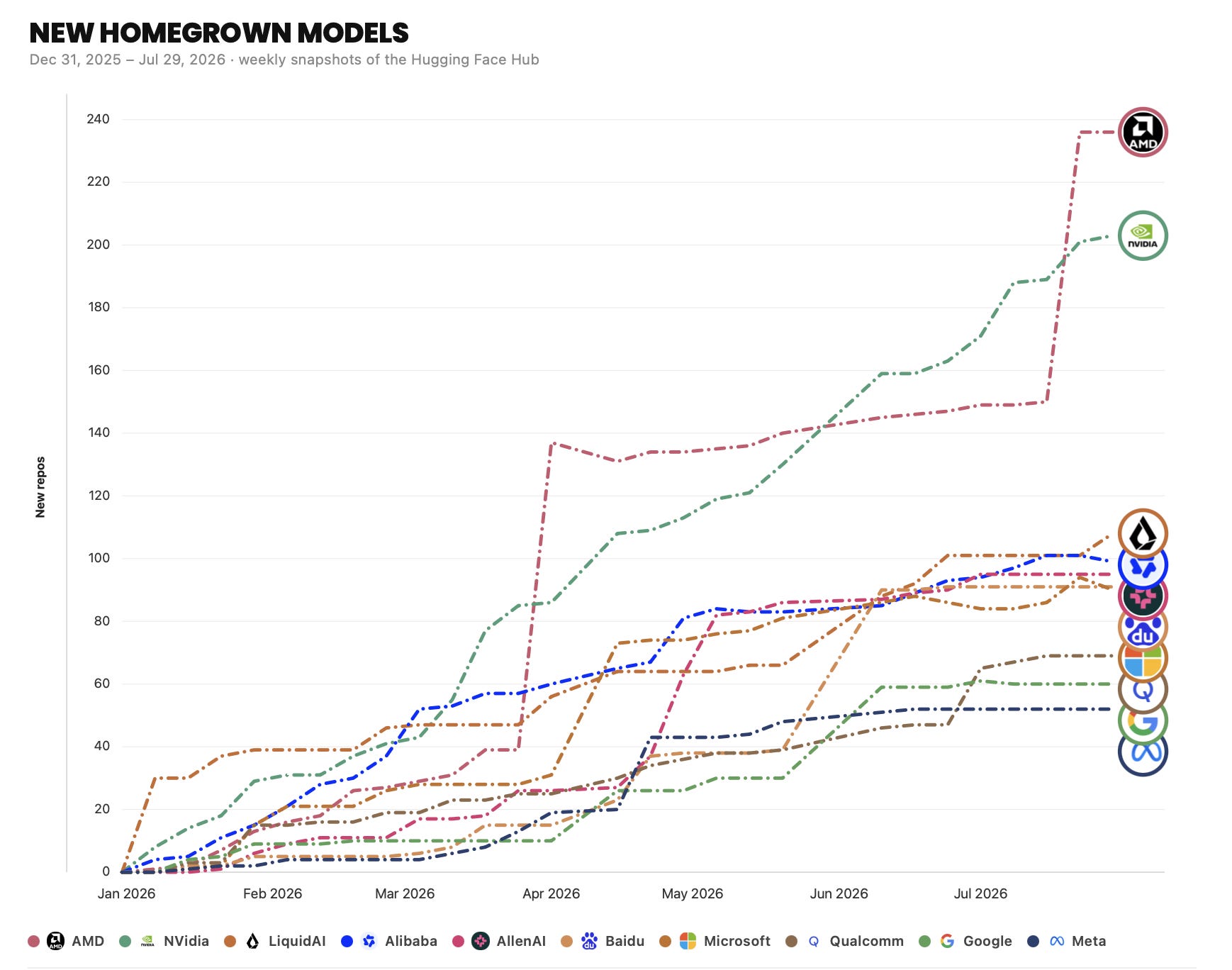
These are insights anyone following the market will know, but the sheer scope of Chinese open weight models is wild when visualised. As is the growth of models from AMD and Nvidia.
“Hardware vendors have realized that open models are a way to sell chips: a model optimized for your hardware and freely available is the clearest proof that the hardware works,” Hugging Face explains.
It wasn’t just Qwen in the spotlight this week.
DeepSeek launched a new team to build AI agents. The company also quietly released an updated version of its flagship model (DeepSeek-V4-Pro-0813) and, in a move that was anything but low key, raised prices by as much as 4X during peak periods. Its pricing remains competitive but this is seen as a monetisation step before an IPO.
Not to be outdone, Z.ai released GLM-5.3, an open-weights AI model it claims is its strongest coding model ever and MiniMax launched version 3 of its music generation model.
AI powers Singapore and Malaysia GDP growth, but long term questions remain
I’ve often asked how Southeast Asia is going to monetise the AI boom, and we are getting our first pieces of confirmation that it is through selling picks and shovels, aka data centres. Singapore and Malaysia last week released encouraging GDP data showing economic growth powered by AI spending.
Singapore’s Ministry of Trade and Industry reported that national GDP grew 6.1% in the first half of the year. It highlighted “robust global AI-related demand” that boosted electronics, engineering and equipment supplies.
We know Singapore is a regional (maybe even global) hub for technology, but Malaysia is also bringing in the money with its data centre play. Its central bank data showed 6% growth in the first half of 2026 thanks to 7.5% manufacturing growth and 6.6% growth for construction.
Singapore has upgraded its growth forecast for the year to 4.5-5.5% from a previous 2-4% estimate. Malaysia is looking at around 5%, which is on par with last year’s 5.2%.
Southeast Asia is well positioned to be a data centre destination for companies across China, the US and beyond, while it is also a manufacturing outpost for companies like SK Hynix. There’s sure to be revenue around those opportunities, but countries in the region still lack the infrastructure to build their own national and sovereign AI and compute strategies, as I wrote in May.
A reliance on OpenAI, Anthropic, DeepSeek or the countless others is a problem when access to models, or even pricing, can change. When we see broader adoption of AI-based services, this can impact governments, key companies and the economy at large unless there are local alternatives. There’s no easy answer, but it’s a valid question to ponder as these countries are celebrated for impressive economic growth.
It isn’t just Singapore’s economy that’s growing impressively, its stock market is also making a comeback, as The Economist notes.
Deals
We know Manus is about to be independent but reports reiterate that Tencent is set to become its largest shareholder by acquiring Meta’s stake along Hongshan Capital and ZhenFund. The deal is likely to be at the same valuation Meta paid, around $2.5 billion, and the Manus founders will have their travel restrictions lifted. [Nikkei Asia]
It has been revealed that Uber and Rapido held talks in May to merge their India ride-hailing businesses, but the deal fell apart over its proposed structure [Economic Times]
Alibaba has reportedly sold gaming unit Lingxi Games to PE firm Trustar Capital for more than $1.5 billion [Bloomberg]
Singapore-based retail commerce company Graas raised $17 million in a Series B led by LemmaTree, the investment firm founded by Temasek. It also acquired product-data platform Trustana [TechNode Global]
Mirae Asset Venture Investments India raised Rs 1,125 crore ($134 million) in the first close of its second flagship India fund, which targets early-growth startups. The goal is to raise a total of Rs 1,800 crore ($214 million), that would be nearly 5X the size of its first fund [Economic Times]
Markets
CXMT overtook Tencent as the world’s most valuable Chinese company, it reached a market value of nearly $550 billion last week, ahead of Tencent’s $510 billion [Bloomberg]
Robotics company Unitree is raising ¥6.1 billion ($904 million) in a STAR Market IPO at an implied ¥61 billion ($9.04 billion) market cap, after selling 5,215 humanoid robots last year. Here’s a good guide to the listing and Unitree’s financials. [RoboStrategy]
Japan’s SRI International and LY Corp’s Z Venture Capital are launching a $19-32 million fund to import Silicon Valley technologies by backing deep-tech startups in AI, space, defence, robotics and advanced manufacturing [Nikkei Asia]
Indian contract manufacturer Zetwerk is reportedly preparing to publicly file for an IPO that could raise up to $400 million potentially as soon as September [Bloomberg]
China’s newest listing will be chip designer Kiwimoore after it confidentially filed for a Hong Kong IPO, targeting a valuation of about $2 billion [Reuters]
Earnings
Didi returned to profit in the second quarter as the ride-hailing firm posted net income of 869 million CNY ($129 million) thanks to record transaction volumes in China and international growth [Reuters]
China’s top chipmakers SMIC and Hua Hong saw second-quarter profits surge 262% and 386% respectively, as demand for domestic AI chips accelerates amid US export controls [SCMP]
JD.com reported its first quarterly revenue decline since its 2014 listing, with second-quarter revenue falling 2.9% to 346.4 billion CNY ($51.4 billion) as it pulls back from price competition amid weaker Chinese consumer demand. Net income rose 15% to 7.1 billion CNY ($1.05 billion), beating expectations [Bloomberg]
AI and Chips
China’s YMTC entered the world’s top three NAND flash suppliers for the first time, taking 14% of global NAND bit shipments in the second quarter and edging past Japan’s Kioxia. Samsung led with 25% and SK Hynix followed with 22% [SCMP]
SK Hynix is betting $720 billion that the AI boom will keep memory demand surging, launching one of the world’s largest chipmaking expansions as it races to double production capacity and cement its lead in the high-bandwidth memory market [CNBC]
Japanese autonomous-driving startup Tier IV plans to develop open-source AI semiconductor designs for automakers, aiming to reduce reliance on foreign chip technology [Nikkei Asia]
NXP Semiconductors is expanding its assembly and test facility in Malaysia, a move expected to more than double the plant’s output when fully operational [GlobeNewswire]
Foreign investment in Japan’s semiconductor industry reached ¥6 trillion ($37 billion), boosted by government subsidies and the latest image sensor venture between Sony and TSMC [Nikkei Asia]
Apple developed a large language model specifically for China in partnership with Alibaba, marking a shift from its reliance on third-party AI models for the market [Reuters]
Crypto
Hong Kong-based stablecoin payments company RedotPay has reportedly delayed plans for a US IPO as it seeks regulatory approvals and addresses legal issues, it could now list next year at the earliest [Bloomberg]
DigitalX, a Mirae Asset affiliate that runs South Korean crypto exchange Korbit, plans to raise about 50 billion KRW ($35.3 million) through a new share issuance [The Block]
Policy
South Korea is introducing mandatory investment classes for first-time single-stock investors after a frenzy among retail traders raised concerns about speculative trading and financial losses [FT]
Also in South Korea, the government is planning an underwater data centre off the coast of Ulsan to create space for AI infrastructure at an estimated cost of 51.1 billion won ($35.4 million) [Nikkei Asia]
A former US National Science Foundation official oversaw computer science research grants while participating in Chinese government talent programs without disclosing the ties, NSF documents show [Bloomberg]
The Trump administration is imposing 100% tariffs on Chinese drones it deems a national-security risk, escalating its efforts to curb China’s dominance of the fast-growing commercial drone market [FT]
The Trump administration is also opposing Apple’s plans to source memory chips from China, as soaring AI-driven demand creates shortages and pushes up component prices [WSJ]
Meanwhile, the US is preparing to pressure dozens of countries to choose between rival American and Chinese AI blocs, warning they could be excluded from Washington’s Pax Silica coalition if they also join Beijing’s competing framework [Reuters]
In other news:
Indian workers are increasingly being hired to train the robots that AI companies hope will replace human labour [Bloomberg]
Microsoft has shut at least 15 branch offices and joint ventures in China over the past five years as it scales back its presence in the market, corporate filings and company sources show [Reuters]
And finally, here’s a mad stat: more than 53 million Chinese now work as ride-hailing drivers or food couriers, that’s up 10 million in just two years [FT]