



Welcome back—we don’t typically publish on Sundays, but this is a guest post from Thailand-based high school student Pannawish Le on Thailand’s AI Passport initiative to increase AI adoption.
We will return with our regular newsletter tomorrow. Enjoy the rest of your weekend
Thailand’s push to get millions using AI is losing momentum
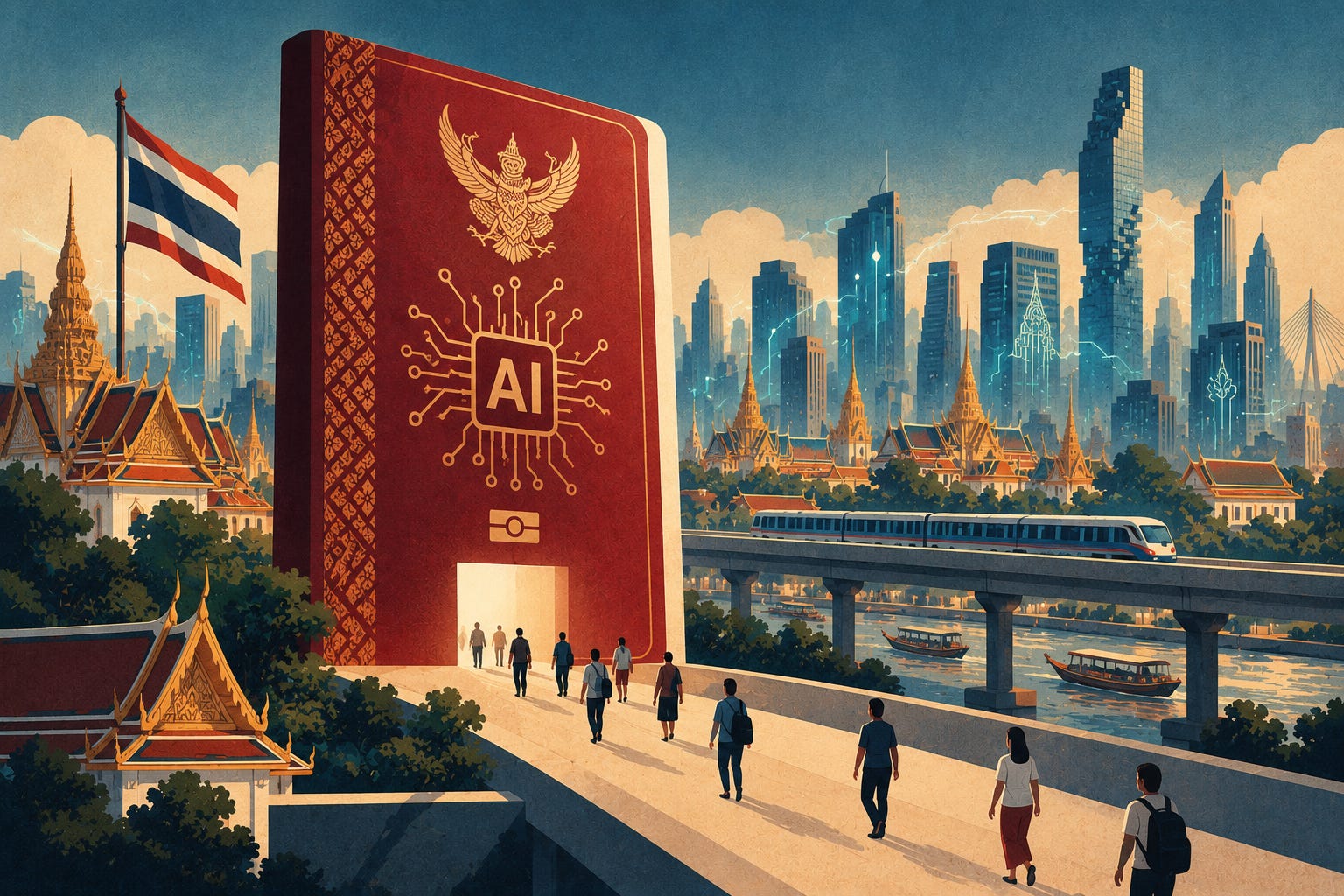
These days, many people spend money to get access to ChatGPT or Claude, but what if your government gave it to you for free? That’s what’s happening in Thailand, where a budget of up to 1.6 billion THB ($48.5 million) is funding free access to AI subscriptions.
TH-AI Passport launched at the end of August with the goal of increasing AI adoption rates, proficiency and training. Over the next year, it will provide subscriptions for up to five million Thai citizens who can access more than 14 services for free, including ChatGPT, Claude, Google Gemini and DeepSeek, through one platform.
Participants must be aged 15 or over, and they qualify for the access by completing learning courses. The programme originally targeted 10 million citizens, but it was halved. The target of five million is focused on 10% of what the government called the economically active population of 50 million people.
TH-AI Passport was created to level the playing field between Thailand and its neighbours in the AI race. But basic questions can be raised around slow adoption and whether there will be even modest return on investment for this ambitious programme. Many of Thailand’s neighbours are developing economic strategies to embrace the benefits of AI, leaving the Thai initiative at risk of looking like a populist policy act with little-to-no impact.
TH-AI Passport is run by TH Consortium, a partnership between Thai technology firm Turnkey Communication Services and Human Intelligent, which won the government contract.
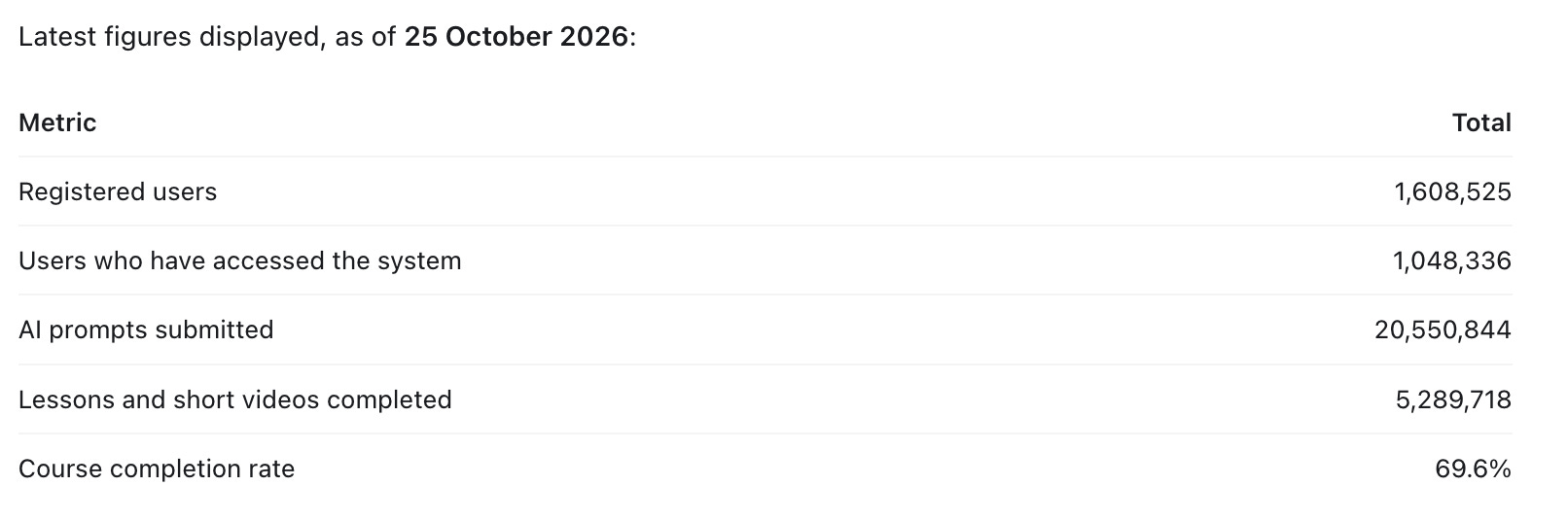
In response, the government enlisted Google and telecom operators to give the programme additional reach to boost adoption. But it is struggling to reach its goals. Two months in, TH-AI Passport has 1.6 million registered users, as of 25 October, up from 1.55 million at the end of September. At that rate of growth, it’s likely to fall far short of its five million target.
Educational focus
More important than the number of people who use TH-AI Passport is the quality of access provided because that will ultimately build behaviour and impact. The programme provides two separate tiers, the Beginner and upgraded Innovator tier. The beginner tier gives access to only one model, Gemini 3.1 Flash Lite, which is accessible without having to sign up. The Innovator tier provides access to over 30 different AI models, with each user given 10,000 credits to spend.
To reach the Innovator tier, TH-AI Passport users must earn 100 points per month by completing short quizzes and learning modules in the programme. The points can be gained by carrying out tasks in the online portal such as watching educational videos.
TH-AI Passport has a budget of up to 1.6 billion THB ($48.5 million), with government payments tied to the number of eligible users who actively use the programme.
That simplicity means the programme’s statistics on areas like AI literacy hold less weight. Even though each user is given a pre/post skills assessment, there has been no qualitative data shared from the programme. Instead, it is just statistical with over three million lessons, a 73% completion rate and 250,000 certificates issued, according to a BangkokBiz News report.
In early September, the minister of digital economy admitted growth was slower than expected. The government added Google to the roster, with 500,000 available licenses, and mobile operators introduced dedicated packages to give unlimited access to the programme for less than $1 per month. Still, it remains to be seen what impact these changes will have.
Likewise, it’s too early to know what impact these courses and learnings will have on broad AI adoption, and even the users who have completed the courses. But the overall landscape of AI training programmes is beginning to heat up in Southeast Asia. To Thailand’s credit, TH-AI Passport was the first of its kind to launch in the region and the government has been responsive.
Southeast Asia races for AI adoption
TH-AI Passport is one of the Thai government policies aimed at building AI and technology into the economy amid competition across Southeast Asia, where a number of nations are investing in upskilling their working population to reap the benefits of AI productivity.
The government aims to increase AI adoption among working-age Thais to at least 20% by 2027. Speaking in parliament in May, the digital economy minister said Thailand needed to reach 22-23% from its estimated 10.7% AI adoption to catch up with Vietnam’s 23.5% and make strides towards Singapore’s 60.9%.
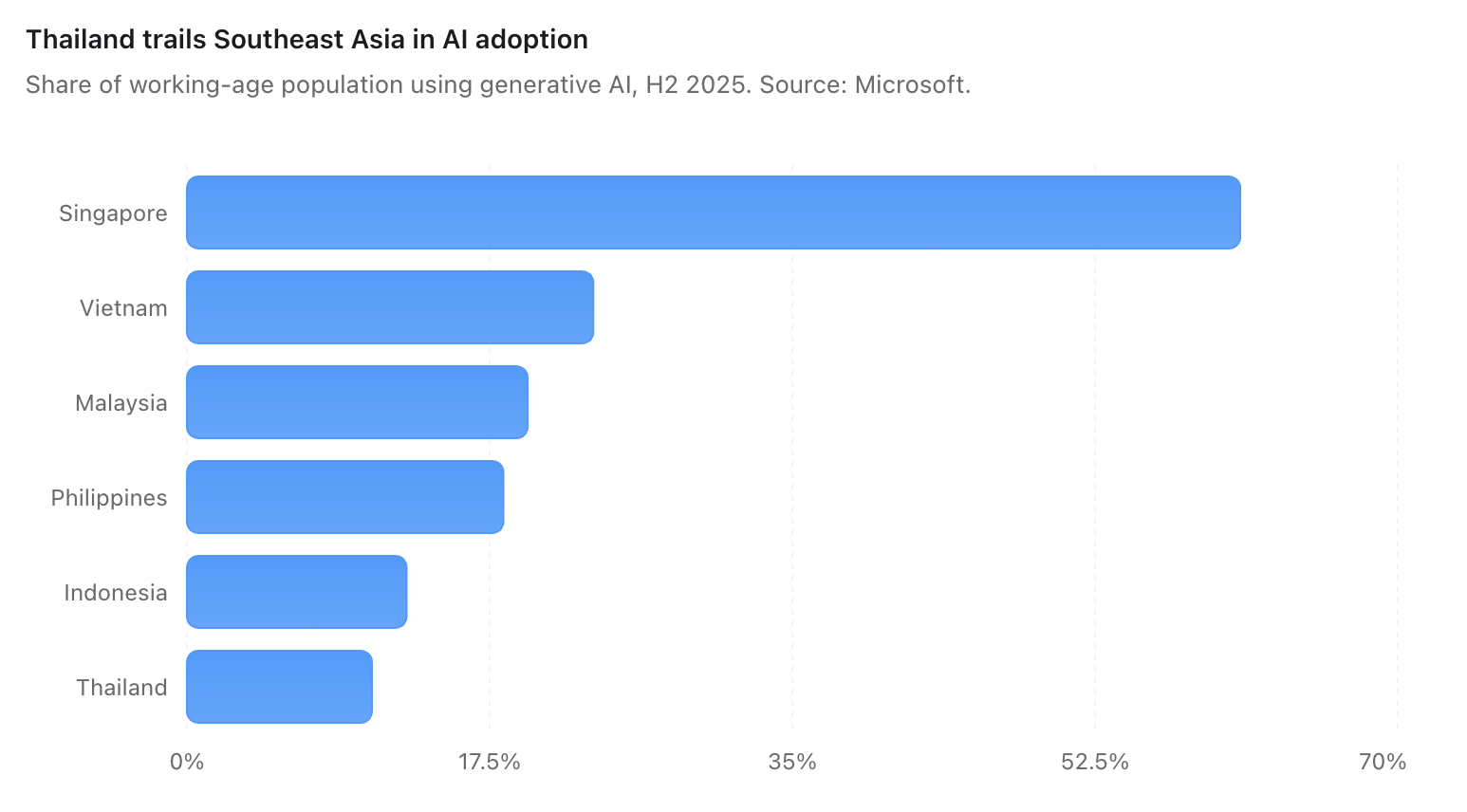
TH-AI Passport alone won’t close this gap, but it is part of a trend across Southeast Asia where governments are seeding AI training and subscription to boost adoption rates.
US AI companies turn their focus to India and Southeast Asia

In this week’s ATR Original we look at how the global artificial intelligence (AI) battle has entered a new era: the emerging market growth period. And the first stop is India.
A look at Thailand’s neighbours leaves the AI Passport programme looking underwhelming.
Singapore launched its own AI literacy programme in September, offering citizens six months of free access to premium models once they complete an eligible course. Prime Minister Lawrence Wong admitted the country has too many learning programmes, and that the approach will be streamlined to boost adoption.
Unlike Thailand, the Singapore AI programme includes a list of evaluative metrics such as whether users will continue using the AI after the 6 month period and whether it supported perceived capability. Although it may not be fully clear whether the evaluation criteria is measured on robust grounds, it shows that they’re highly valuing the long-term gain from the project.
Elsewhere, Malaysia expanded its AI untuk Rakyat programme at the end of August to include three months of free AI subscription access. It is targeting a more modest 100,000 Malaysian citizens between 18 and 30 who sit six courses to qualify.
Also in August, Vietnam, already praised for being further ahead of the curve than Thailand, announced a national program to train at least 10 million workers in basic AI skills by 2030. The target also includes upskilling 10,000 specialised AI professionals and at least 1,500 research experts, but no details have been released.
Slow user growth and questions over financing
The Thai government in August announced a partnership with OpenAI to create an accelerator programme to build “AI-first” businesses in the country. Ten startups took part in the inaugural cohort, with deputy prime minister Dr Yodchanan Wongsawat optimistic that this is just the beginning for the accelerator and Thailand’s collaboration with OpenAI and other AI companies.
In a speech, Dr Wongsawat laid out an ambition for Thailand’s economy to tap into technology, and AI in particular, around areas such as food, education and health. South Korea’s economy is the model many nations look to. But Korea has a technology industry that is building out the global AI economy, while Southeast Asian countries are grappling with more fundamental needs, such as ensuring high levels of AI adoption in business.
TH-AI Passport is one policy in that battle, but it has been a political hot potato right from when it was conceptualised to now. Critics have rounded on the programme given its underwhelming start.
Dr. Karndee Leopairote, MP from the Democrat Party, Thailand’s opposition party, urged the State Audit Office to examine how payments are calculated. She claimed that money is paid for each counted user without the contract between the government and TH-Consortium (contractor) requiring proof that users learned real skills.
The programme’s future beyond its first phase is also uncertain. A proposed 900 million THB ($27 million) allocation for a second phase was removed from the government’s 2027 budget. The digital economy ministry said it had withdrawn the proposal after consulting the Budget Bureau, and would assess demand and the first phase’s results before considering an expansion.
The decision does not affect the existing programme, but it leaves questions over whether funding will be available to continue it.
Then there’s the fact that the program has just 745,000 active users from the current registered base. For long term skills development, retention is an essential metric to gauge, but there is still not enough clarity on long-term development that the program can generate.
At this point, the programme would be expected to make a dent through adoption and activity. But awareness of it appears modest, with little sign of publicity or any fanfare to encourage Thai citizens to enjoy free access to cutting-edge technology that could positively impact their work and general lives.
There may be cues to take from Malta, the European island nation which partnered with OpenAI in May to give free access to paid ChatGPT programmes for its 6000,000 citizens. Malta is a far smaller nation, but AI companies have as much interest in reaching new users as governments. Now that OpenAI is more active in Southeast Asia and Anthropic has an office in Singapore, we’re likely to see many more national collaborations.
“We believe that, like electricity, intelligence should be available for people, businesses, and institutions to use as much as they need, where and when they need it,” OpenAI on its Malta partnership.
TH-AI Passport in its current form appears to be living on borrowed time. With funding for a second phase removed, the government will need to decide whether, and how, to continue the programme once its first year ends.