


Welcome back to Asia Tech Review, your curated digest to keep up to date with tech news across Asia.
SK Hynix has gone from a little known component maker in Korea to a meme stock that’s gaining popularity across the world, and introducing regular traders to concepts like HBM, Kospi and more. Following its huge US listing, we dive into the company in more detail today, it feels bubbly to me but the company has a compelling narrative to support a lot of future growth.
To keep up with our issues, follow us on LinkedIn or WhatsApp. Please do share Asia Tech Review with people you know who want to get smart about Asia tech.
Inside the SKy Hy US listing
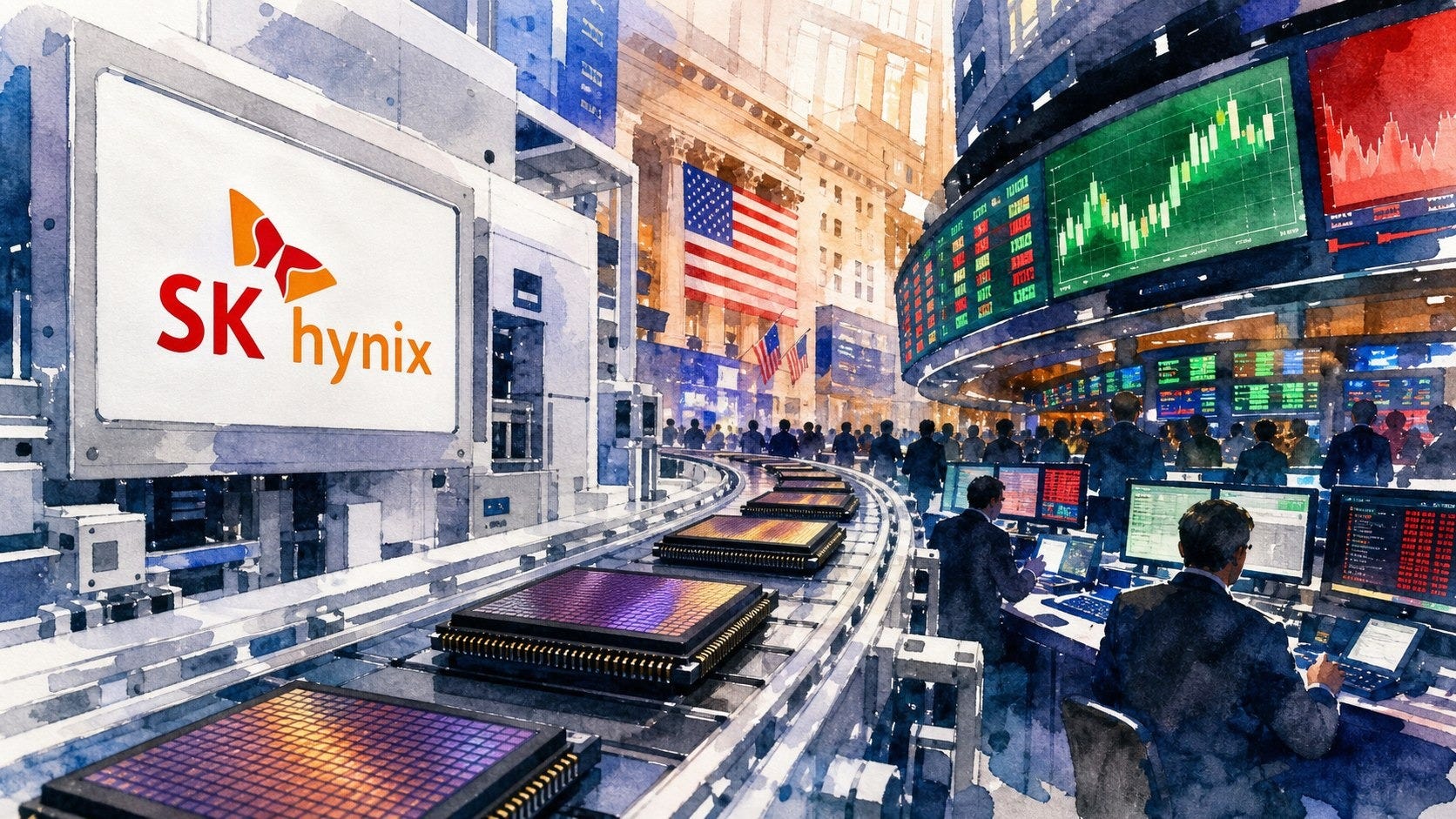
AI IPOs are booming and SK Hynix just delivered America’s largest listing from a foreign company after it raised $26.5 billion through an ADR (American Depositary Receipt) offering on the Nasdaq.
The Korean firm’s share price closed the day 13% higher on its US debut, but shares in Seoul are down by 10% at the time of writing on Monday. Analysts told Reuters that investors are taking profits after the landmark US deal but there are also concerns.
CEO Kwak Noh-jung has said publicly that next year will see the worst supply shortage in memory chip industry history. We know SK Hynix, Samsung and other memory players have already sold their inventory for the coming years, but Kwak told Reuters that demand will outstrip production capacity “even beyond 2030.”
The proceeds of the listing, and its incredible stock market gains, will be funneled back into expanding manufacturing to alleviate this memory chip crunch.
Many had probably not heard of SK Hynix until a year or two ago, but the business has become a meme stock for investors seeking wild returns from the days of GameStop during the Covid-19 pandemic. Not unlike the US gaming retailer, SK Hynix was born from ruins. A creditor-led bailout from Hyundai in 2003 saw the business eventually acquired by Korea’s SK Telecom in 2012. (It’s a hell of a story with banks, credit, failure to sell and then a little luck/vision.)
The firm is booming as SK Hynix offers a direct proxy to the AI story since it specialises in memory chip solutions, particularly high bandwidth memory (HBM) that’s become essential for AI chip processing.

Fellow Korean firm Samsung has also been a major beneficiary of the demand. It forecast record quarterly profits of over $58 billion last week, but Samsung’s business is broadly diversified making it less interesting for some investors punting on the memory demand.
SK Group Chairman Chey Tae-won told Bloomberg that he believes the company will never be able to keep up with demand, such is the insatiable appetite and need for advanced memory.
“We spent almost 30 years finishing the completion of the internet infrastructure. When it comes to AI, I believe that the AI industry size is much, much larger than the internet,” he said in the money quote from the interview.
The company is busy securing new supply deals and ramping up its production capacity. It may even issue more US shares, in line with its plans to invest upwards of $35 billion in the American market.
We’ve not seen a stock like this hit the US market before. Instinctively, it feels like a bubble but the argument for future growth is compelling. Anthropic and OpenAI’s IPOs, and the look into their financials, may well be a very key moment in what happens next.
Shein gets the nod to go public in Hong Kong
Speculation in recent years has linked Shein to an IPO in the US in 2023 and then the UK, but it now looks like Hong Kong could be the destination. The fast fashion retailer has received regulatory approval from China to proceed with a Hong Kong listing, a year after it started the process.
There’s no word on how much Shein might raise or when a listing might come. But the China Securities Regulatory Commission, which confirmed it had approved the listing, wrote on its website that Shein would offer 341.6 million shares through HKEX.
The Financial Times reported that Shein’s valuation has been cut to around $30 billion from a peak of $100 billion in 2022, and lower still than its 2023 valuation of $66 billion.
A listing would mark a notable change in approach for a company that has positioned itself as a global business while minimising links to China. Shein has focused on building a business in the US and Europe, sponsoring events and awards to help develop a local brand and connections. It moved its global HQ to Singapore, as other Chinese firms have done, but ultimately Hong Kong’s growing public markets are where it will reach retail investors.
Don’t expect a blockbuster IPO. Given how AI stocks have grown this year in Hong Kong, anything is possible, but Shein looks like it has come to market a little late.
Deals
Tencent is negotiating to become Manus’s largest shareholder as investors move to unwind Meta’s $2 billion acquisition of the Chinese AI agent startup following a Beijing order to reverse the deal [Financial Times]
Japan’s top convenience store chain, Seven & i Holdings, is reportedly in talks to accept an investment of up to 300 billion yen ($1.9 billion) from SoftBank and its PayPay payments affiliate [Nikkei Asia]
India approved Vivo’s manufacturing joint venture with Dixon Technologies, clearing the China-linked smartphone partnership announced in December 2024 under the country’s stricter investment review rules [TechCrunch]
Markets
We know Chinese memory chipmaker CXMT could have China’s biggest IPO of 2026 with plans to raise around $4.3 billion, but now Bloomberg reports it plans to double output and build a full supply chain from design to assembly [Bloomberg]
Nexchip Semiconductor began trading in Hong Kong after raising HK$6.98 billion ($890 million), with the Hefei-based wafer foundry pricing shares at the top of its range but still at a 57% discount to its Shanghai-listed stock [Bloomberg]
First Z.ai, now MiniMax (which also went public at the start of this year) plans to raise up to HK$14.54 billion ($1.9 billion) through a sale of new shares and convertible bonds [Bloomberg]
MiniMax CEO Junjie Yan has reportedly told staff he will forgo salary until the company reaches AGI, he also pledged to give up 5% of his personal equity for employee incentives, open-source work and AI ecosystem efforts [The Information]
AI and Chips
Taiwanese DRAM chipmaker Nanya Technology plans to spend more than T$200 billion ($6.2 billion) on capital expenditure in 2027, roughly quadrupling this year’s outlay as AI-driven memory demand rises [Reuters]
Chinese AI coding tools including ByteDance’s Trae and Alibaba’s Qoder are gaining attention after Beijing flagged security concerns around Anthropic’s Claude Code [SCMP]
Zhipu founder Tang Jie is said to have told staff that frontier AI should remain broadly accessible rather than controlled by a few companies, saying security comes from wide participation and oversight rather than technical barriers, and pointing to Zhipu’s open-source GLM-5.2 release as proof of that approach [Bloomberg]
In other news:
Nikkei found that roughly 20% of USB drives surfacing as top picks on Amazon carried multiple reviews flagging inflated storage capacity, with some fake-capacity devices linked to China-origin malware concerns in Japan [Nikkei Asia]
Grab plans to expand its Vietnam EV charging network fifteenfold by 2028 as the company builds infrastructure around its electric ride-hailing fleet [Nikkei Asia]
Malaysia Prime Minister Anwar Ibrahim plans to debut an agentic AI avatar of himself to help the public use government services [Bloomberg]
China dropped its numerical target for urban job creation in its 2026-2030 labour plan, saying annual goals will be set flexibly while pledging to address the employment impact of AI and shifting global trade [Bloomberg]
SIG (Susquehanna International Group), one of ByteDance’s biggest shareholders, is reportedly winding down its China-based venture investment team, with managing director Tim Gong expected to leave and launch his own fund [The Information]
Tokyo bars and clubs are returning to cash payments after the sudden bankruptcy of credit processor Zentoshin caught them unawares and disrupted card settlements [Bloomberg]