


Welcome back—last week we launched ATR Daily, an email every weekday that analyses 2-3 of the must read stories of the day across Asia’s tech scene.
It’s intensive, but the daily is in response to the current state of media as we see it. Consuming news has changed drastically. It’s harder than ever to keep up with what’s happening, what’s important and what’s not, especially in Asia where media coverage is not as dense as the US.
These days, I come across news via group chats or social media algorithms but articles rarely offer analysis or cut through the fluff. We need a place we can trust to get up to speed with news that’s going on in the region.
Your support will mean a lot to the small team behind ATR, so consider subscribing and sharing with people who will find it useful. And let us know what works and what doesn’t.
Have a great week, we’ll be back tomorrow.
Jon
Salmon catches $100M in fresh funding for Philippines digital banking push

Southeast Asia may be in the mindset of a funding and sentiment depression, but that isn’t stopping digital banks in the Philippines from raising capital. The latest deal saw Salmon pull in $100 million, $60 million of which is in equity with $40 million in debt to expand the bank’s digital lending and general services.
Salmon has a pretty unique story. It was started by three former executives at Russian digital bank Tinkoff, which expanded to the Philippines in 2016. Tinkoff looked at a digital license when the Philippines moved to issue them at the tail end of the pandemic.
The trio, however, opted to go solo. But, instead of snagging a digital banking license, they entered the field last September by acquiring Rural Bank of Sta. Rosa, a 60-plus year old bank focused on rural areas, following an 18 month wait for approvals. Now it is turning the bank into a digital player.
TechCrunch reports that Salmon is adding products like revolving credit lines, installment loans, cash loans, motorbike loans and deposits as it looks to build out a full suite of services. The debt component of the round, which is provided by the Nordic bond market, will be used to finance loans to customers.
Salmon has now raised $310 million, which comprises $160 million in equity and $150 million in bonds. Its investors include IFC, Abu Dhabi’s sovereign wealth fund, Antler, Spice Expeditions and Washington University Investment Management Company.
The Philippines has six officially licensed digital banks, and a handful of others that took the Salmon route including Sea’s digital bank and Netbank, which raised undisclosed funding last week.
The Philippines is also becoming an attractive destination for startups focused on Indonesia that seek expansion opportunities, particularly around payment and physical commerce. The rest of Southeast Asia caught a startup chill, but the Philippines looks to be continuing its growth.
DeepSeek’s new model is finally here and it divides opinion already
Following months of speculation, DeepSeek released its newest model (the not-so-creatively-named V4) and already it has received a mixed reaction.
First of all, let’s look at what DeepSeek V4 isn’t.
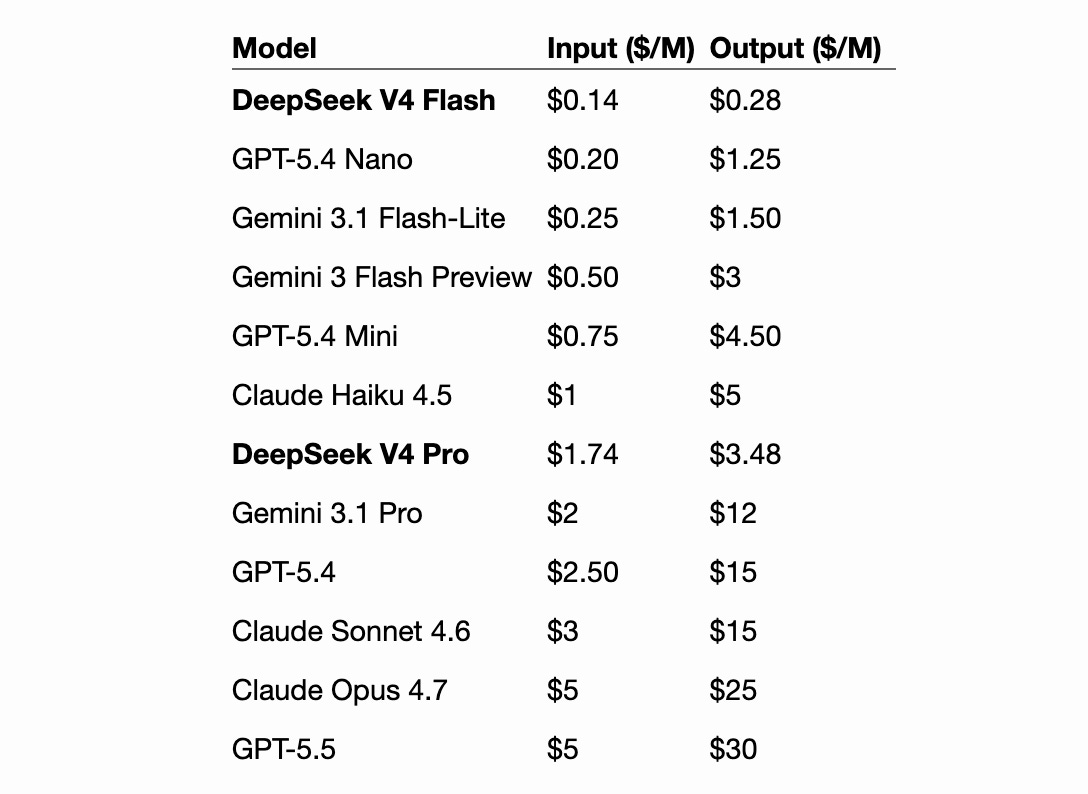
This is not going to be a replacement for Anthropic’s Claude Opus model (or its upcoming Mythos) or ChatGPT 5.5, which was just launched by OpenAI. But early tests do suggest that V4 gets close to these frontier models at just a fraction of their price, as Simon Willison points out in his well-read newsletter.
DeepSeek-V4-Flash is the cheapest of the small models, beating even OpenAI’s GPT-5.4 Nano. DeepSeek-V4-Pro is the cheapest of the larger frontier models.
Here’s his price comparison chart to hammer the point home.
Early criticism, however, has focused on performance and the fact that DeepSeek hasn’t closed the gap on its two big US competitors. In fact, it didn’t even benchmark against their newest models. Indications suggest it is pretty far behind them.
Those comparisons may miss the point, however.
The new DeepSeek release has tighter integration with China’s domestic chip ecosystem than ever before. Indeed, Huawei’s new Ascend 950 AI chip, which competes with Nvidia products, will support V4 on release. That indicates that DeepSeek has been working closely with its peer to ensure collaboration that can potentially help wean China-based companies off of a reliance on Nvidia and other US firms. Or just give more capability to Huawei’s AI offerings.
The arrival of the new model comes at an interesting time.
DeepSeek is reportedly in talks to raise its first external capital, having been self-funded entirely to this point. Alibaba and Tencent are said to be among those in conversations over taking a 2-3% stake of the business at a $20 billion valuation.
On the other side, a host of other Chinese companies announced major AI releases last week.
Moonshot AI released Kimi K2.6
Tencent put out an entirely re-engineered version of its Hunyuan LLM, the first release under the management of its new head of AI who is ex-OpenAI
Alibaba rolled out a new version of Qwen, and announced plans to embed its model in cars and its first commercial deals
Tencent also released an English version of its OpenClaw product, QClaw, for international markets
There’s never a dull moment in the world of AI in China.
China
Honor’s humanoid robot won a Beijing half-marathon in 50 minutes and 26 seconds, beating human runners and showing rapid progress in Chinese robotics link
Huawei launched its first AI glasses, starting at 2,499 yuan ($367), with features including voice interaction and payments link
ByteDance’s net profit fell more than 70% in 2025 as AI spending weighed on earnings despite strong overseas growth led by TikTok Shop link
Chinese authorities have tightened controls on domestic AI startups, warning firms including MiroMind not to move talent or research abroad link
Nvidia’s H200 AI chips have not yet reached Chinese buyers despite conditional US approval, with Beijing clearances still a hurdle link
Dutch military intelligence said China had drawn level with the US in offensive cyber capabilities link
Micron lobbied US lawmakers to tighten export curbs on chipmaking equipment used by Chinese rivals link
The White House accused China of industrial-scale efforts to siphon intellectual property from US AI labs link
China’s top market regulator launched a six-month crackdown on internet advertising, including misuse of AI link
ByteDance’s planned R$50B ($9.5B) Brazil data centre became a flashpoint between AI infrastructure demand and local opposition link
Chinese regulators moved to bar tech firms, including AI startups, from taking US capital without prior approval link
iQiyi plans to use AI to produce a significant share of its films and series as part of a wider overhaul of its content platform link
The US told diplomats to warn governments about alleged intellectual property theft by Chinese AI firms including DeepSeek link
DJI and Insta360 are accelerating their global push as US scrutiny intensified and Western rivals came under pressure link
Huawei will invest up to 80B yuan ($11.7B) over five years to strengthen computing power for its smart driving systems link
State Grid Corporation of China plans to deploy thousands of AI-powered robots to inspect substations and maintain ultra-high-voltage lines link
Tencent jumped into the Kazakhstan market after it bought a 3.2% stake in fintech and e-commerce business Kaspi.kz for just over $500M link
India
Razorpay is preparing to confidentially file for an IPO, targeting a $600-700M raise at a $5-6B valuation link
India’s central bank cancelled Paytm Payments Bank’s licence over compliance failures link
Sarvam AI is reportedly in talks to add Glade Brook Capital to its $320-350M funding round at a valuation of about $1.5B link
Sarvam is among the Indian AI labs in advanced talks with the defence ministry over a $36M Centre of Excellence for military AI link
House help on-demand startup Snabbit is raising at least $50M at a valuation of around $400M in a round led by Susquehanna Venture Capital, according to TechCrunch link
Meanwhile rival Pronto is said to be close to sealing a $20M investment at a valuation of around $200M—TechCrunch (again) reports that high profile angel investor and former Stripe executive Lachy Groom will lead the round link
Krafton, Naver and Mirae Asset launched a $718M India-focused fund targeting consumer internet, AI, and deeptech startups link
Apple has been accused of failing to provide information requested by India’s antitrust regulator, prompting the Competition Commission of India to speed up penalty proceedings link
Dunzo cofounder Kabeer Biswas’s concierge startup M raised $12.2M from Peak XV Partners, Blume Ventures and Cred at a $35.9M valuation link
OpenAI partnered with Infosys to bring AI tools including Codex into the Indian IT company’s Topaz platform link
India’s in-app purchases crossed $300M in the first quarter, up 33% year on year, but much of the spending flows to foreign companies not local ones link
WhatsApp rolled out prepaid mobile recharges in India through a partnership with PayU link
Zomato agreed to drop a contract clause that penalised restaurants for offering cheaper meals to walk-in diners link
India’s IT sector faces record Gen Z churn as companies overhaul recruitment, training and retention link
India is now among a set of “limited countries” where Facebook and Instagram “automatically restrict content, at scale and based on local law requirements,” according to a source link
Southeast Asia
Singapore’s financial regulator pressed banks to close cybersecurity gaps as concerns over Anthropic’s Mythos AI model spread across Asia link
Bain Capital is reportedly looking to sell at least a 40% stake in Singapore-based Bridge Data Centres in a deal that could value the company at about $5B link
The Wall Street Journal looks at how Cambodia’s cyber-scam industry has grown into a vast transnational network of call centres tied to powerful local interests, exploiting trafficked workers and victims worldwide link link
The US sanctioned Cambodian senator Kok An over alleged links to scam compounds that stole millions from American victims link
Apple launched Tap to Pay on iPhone in Malaysia, letting businesses accept contactless payments on their devices link
Singapore is rapidly emerging as a neutral ground for AI companies that need to navigate complicated US-China tensions link
Singapore’s Cobo launched Cobo Agentic Wallet, a crypto wallet product designed for management by AI agents link
Vietnam and South Korea launched a cross-border QR payment service link
Singapore police arrested a 26-year-old man accused of leaking the unreleased animated film The Legend of Aang: The Last Airbender link
Singapore’s Tazapay partnered with ClearBank for Asia-Europe payments link
Nium and Coinbase teamed up for global stablecoin payments and settlement link
Taiwan
Taiwan’s financial sector launched a project with 16 lenders to build a sector-specific large language model link
TSMC plans to open an advanced chip packaging plant in Arizona by 2029 link
TSMC delayed adoption of ASML’s high-NA EUV machines costing more than €350M each until at least 2029 link
TSMC unveiled a process technology roadmap through 2029, including A12, A13 and N2U, while A16 slipped to 2027 link
AI chip demand is pushing Taiwan and South Korea past Europe’s biggest stock markets as investors pile into semiconductor companies link
Japan
A Japanese court ruled that detailed plot summaries could constitute copyright infringement in a case involving Godzilla Minus One and Overlord link
Japan’s finance minister is set to meet with major banks to discuss the potential threat of Anthropic’s new Mythos AI model link
Sony’s autonomous ping-pong robot Ace competed against and at times beat top human players in Tokyo link
Japan is considering a social media ban for minors link
SoftBank is seeking a $10B loan backed by its stake in OpenAI to fund its AI push link
SoftBank plans to convert part of its Osaka factory into a battery production line for AI data centres link
South Korea
SK Hynix announced another set of impressive record financials for Q1, with operating profit surging five fold to Won37.6T ($25.4B) and revenue nearly tripling link (we went into more detail in the Daily last week)
SK Hynix plans to invest about $13B in a new South Korea plant to meet AI memory demand link
SK Hynix bonuses tied to the AI boom were set to rise towards $900,000, highlighting inequality concerns in South Korea’s chip sector link
SK Hynix reported a record quarter, with operating profit surging fivefold to Won37.6T ($25.4B) and revenue nearly tripling to Won52.6T link
Samsung workers rallied at its Pyeongtaek chip complex to demand higher bonuses and threatened to strike link
A South Korean court jailed a former Samsung researcher for seven years for passing semiconductor technology to China link
South Korea told US lawmakers it would not single out American tech firms or impose unnecessary regulatory barriers link
Coupang stands accused of squeezing growth from small merchants in South Korea as regulators and politicians debated how to rein in the platform link
North Korea
North Korea-linked hackers are thought to be the culprit behind a near-$300M cryptocurrency heist from Kelp DAO in a breach tied to cross-chain infrastructure provider LayerZero link
North Korean hackers are also thought to have stolen up to $12M in cryptocurrency by targeting web developers’ personal devices link
Hong Kong
Victory Giant, a supplier of printed circuit boards for companies like Nvidia, raised $2.6B in Hong Kong’s largest IPO of the year—its share price rose nearly 60% on the first day of trading link
AI video startup PixVerse, backed by Alibaba and others, is reportedly weighing a Hong Kong IPO as early as this year link
Rest of Asia
Sri Lanka is investigating a Finance Ministry cyber breach that allowed hackers to steal about $2.5M link