


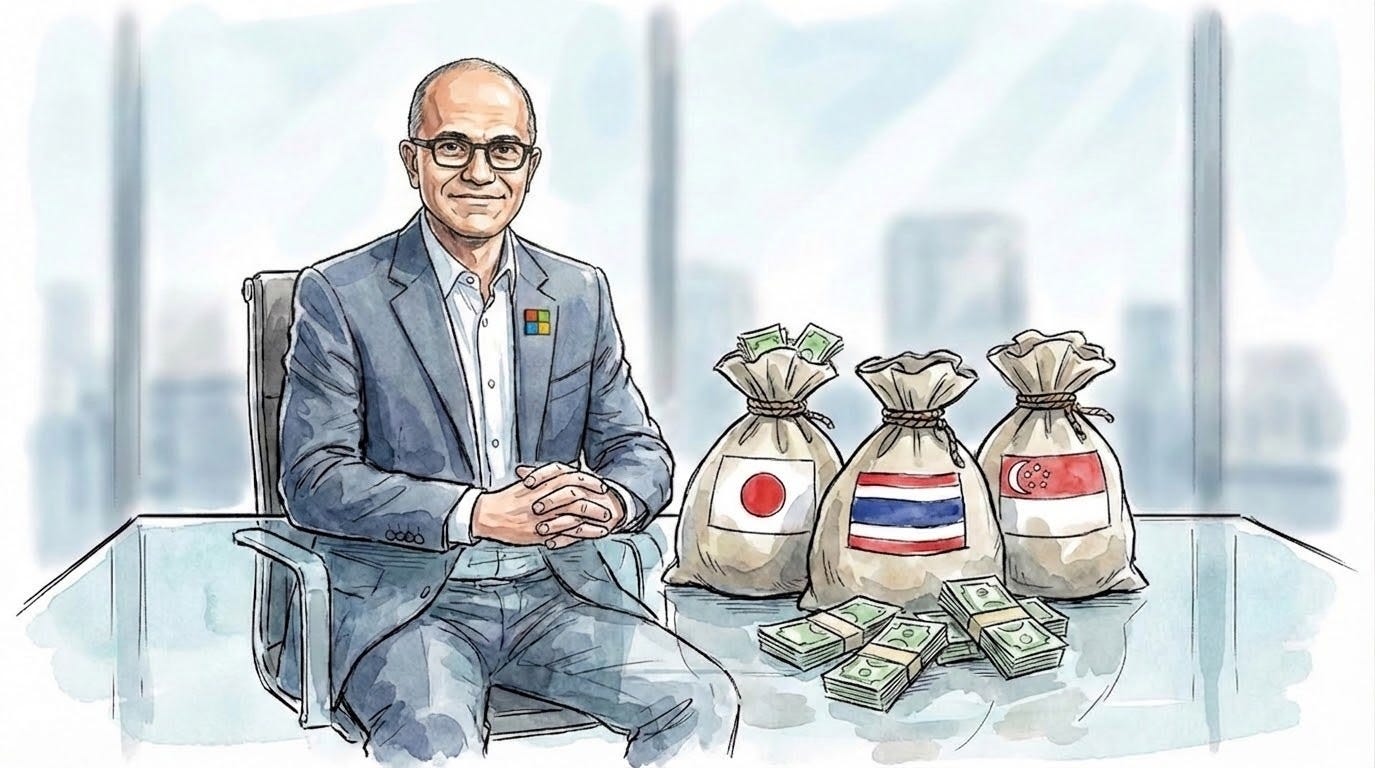
Welcome back, Microsoft had a busy week after it announced three investment commitments across Asia.
In Japan, it will invest $10 billion across the next four years to expand its cloud and AI infrastructure in the country. That’s an initiative carried out alongside Sakura Internet and SoftBank, and it also includes a plan to train one million AI engineers.
The US firm said it will keep all data processing within Japan’s borders, thereby providing an answer to concerns around data sovereignty. Although that’s by no means definitive since Microsoft is a US company and not a Japanese one.
In Southeast Asia, Microsoft announced that it will invest $5.5 billion in cloud and AI infrastructure in Singapore until 2029 and in Thailand it pledged $1 billion over the next two years for a similar programme.
Cloud companies have spent the last few years making commitments to build out their computing capabilities across Southeast Asia and other parts of Asia to make their economies ‘AI ready.’ Last October, Google made a similar $1 billion commitment to Thailand, and it previously committed to spend $5 billion in Singapore where it opened a Google DeepMind Research Lab.
These commitments are often ushered in with much fanfare and events with high-level politicians, Thailand’s PM hosted Microsoft’s announcement event. But they leave longer term questions around true data sovereignty and whether these markets can really compete on the development of AI services.
In related news: DayOne, the Singapore-based data centre firm we recently wrote about, announced plans to invest $7 billion to expand in Malaysia and Singapore’s BDx Data Centers secured a $320M loan to expand its data centre campus in Jakarta.
That’s all for this week’s issue—have a great week,
Jon
If you want more Asia Tech Review, follow us on LinkedIn, Telegram or WhatsApp where we share news as it breaks.
China’s markets are turning more sceptical about AI
China’s markets are unsure of the value AI can bring. Chinese tech stocks just had their weakest quarterly growth for three years.
The Hang Seng Tech Index, which counts 30 companies including Alibaba, Tencent and Xiaomi, is down 12% year-on-year and 30% since October. Combined earnings for its members fell by 30% year-on-year in the final quarter of last year.
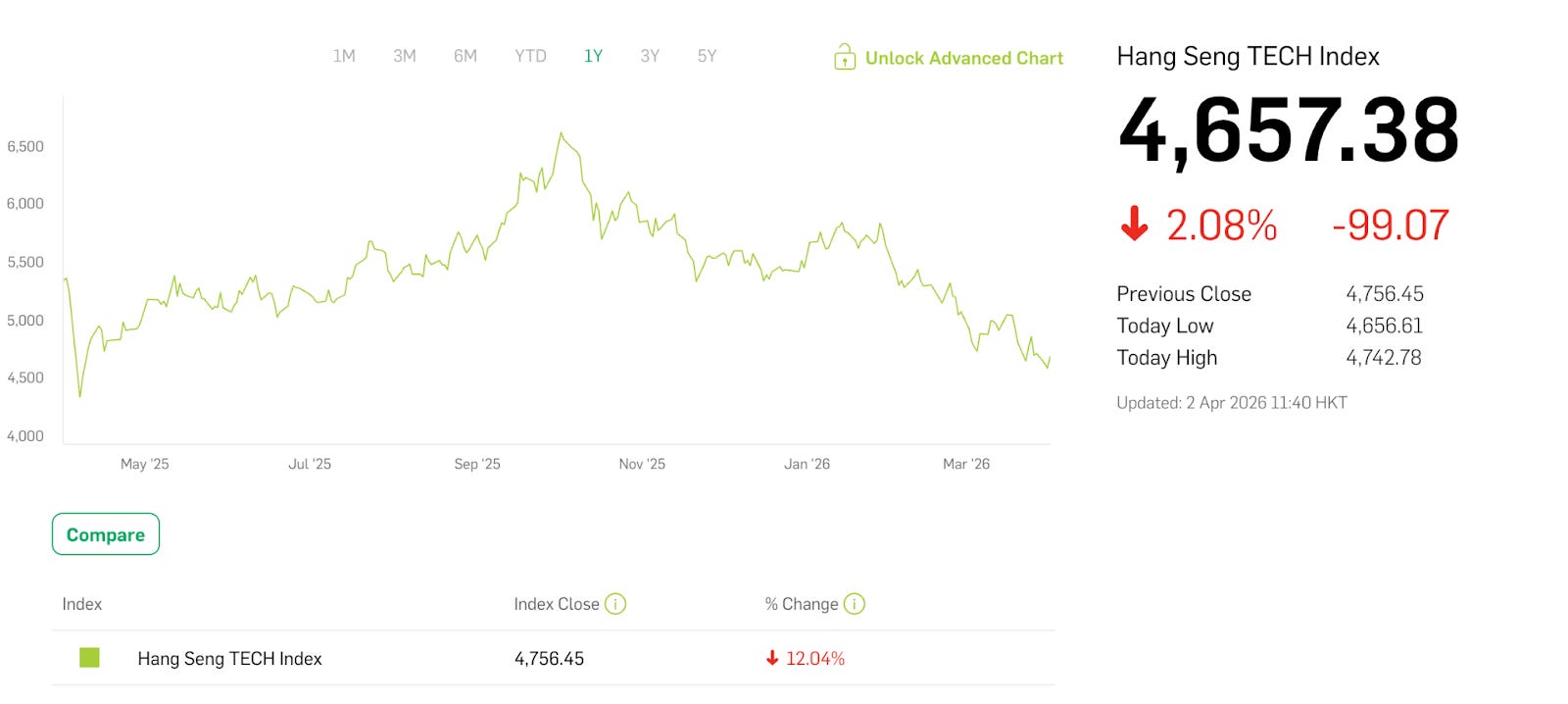
Investors are divided on whether the huge investments in AI can pay off, and whether Chinese government policy will hinder and help.
Alibaba just reorganised its AI play with a new business unit driven by CEO Eddie Wu that’s focused on monetisation. The departure of key leads within its Qwen division hinted that its previous open source approach might not continue. Tencent, meanwhile, has rolled out OpenClaw-based agents to its WeChat messaging platform, which has over a billion users and services like shopping, food, taxis and payments.
Now we wait to see the impact. One area investors are bullish on is AI companies, two of China’s pioneers are profiting handsomely from going public in Hong Kong in January.
Zhipu, which develops Z.ai, has seen its stock price increase 500% since listing while MiniMax’s shares are up 180% over the same period. No wonder Moonshot, the maker of Kimi, is looking to list in Hong Kong. It opted to stay private, raising $500 million in December. Now it is said to be raising another $1 billion with an IPO before the end of the year.
Still, there are doubts about profitability for all three. That could be where their backers, which include giants like Alibaba and Tencent, may come into play.
CoinDCX founders go after fraudulent websites following impersonation arrest
The founders of India-based crypto exchange CoinDCX spoke publicly for the first time after they were arrested and then released on bail following an alleged case of scamming an individual.
It emerged that the complainant had lost nearly $90,000 to a scam that used a similar name to CoinDCX to defraud unsuspecting victims.
“The fraud at the centre of this complaint was carried out through a fake website by impersonators who have absolutely no connection to our platform, our systems, or CoinDCX. No money moved through CoinDCX. No transaction occurred on our exchange,” wrote CoinDCX co-founder Sumit Gupta on X.
In response, the company said it is now launching a network to fight fraudulent websites, backed by an initial $12 million commitment. “This could happen to any founder,” Gupta said.
China
DeepSeek’s upcoming new model, V4, will reportedly run on Huawei’s latest chips—that’s led to a surge in orders from the likes of Alibaba, Tencent and ByteDance which increased Huawei Ascend 950PR prices by 20% link
But DeepSeek’s chatbot suffered a seven-hour outage in China, its biggest since its 2025 debut link
Alibaba unveiled Qwen3.5-Omni, a multimodal AI model that processes audio, video and text in a single system as it continues to push efforts to monetise its AI tech link
Meanwhile, Chinese companies including Alibaba Cloud and Zhipu AI have opted not to open-source their latest AI models to push revenue link
OpenClaw deepened its China push through partnerships with Tencent and ByteDance, which added native QQ integration and more for its agent skills registry link
ByteDance bolstered its controversial video-generation model Seedance 2.0 with “advanced” watermarking and IP protection guardrails following criticism from Hollywood for alleged IP theft when it went viral in February link
Robotics company Unitree, which supplied the dancing robots at the CCTV Spring Festival, filed to raise $610M in a Shanghai IPO—China Talk profiled its unique business which is profitable but may suffer the effects of US-China tensions link
Huawei’s revenues grew at its slowest pace in three years in 2025, as declining cloud sales and weak smartphone growth dented its comeback from US sanctions link
GPU makers Biren Technology and Iluvatar CoreX reported sharp revenue growth in their first post-listing results, they’re both in the red but seeing demand for domestic Nvidia alternatives link
Zhipu AI’s first post-IPO earnings missed expectations, revenue jumped 131.9% but net losses rose by 60% as spending surged link
Shenzhen launched China’s first 10,000-card AI computing cluster powered by Huawei chips, delivering 11,000 petaflops link
Baidu’s Apollo Go robotaxi fleet suffered a system failure in Wuhan, with multiple driverless cars stopping mid-journey, stranding passengers and blocking roads link
China detained Li Xiong, a fugitive Cambodian finance tycoon accused of running a global money-laundering network, escalating its crackdown on cross-border scam syndicates link
Chinese GPU and AI chipmakers seized ~41% of China’s AI accelerator server market last year, chipping away at Nvidia’s dominance link
UBTech shares surged after the robotics firm reported 2025 revenue up 53%, sales of its humanoid robot rose 23-fold link
The FBI deemed a recent China-linked cyber intrusion into a sensitive surveillance system a major incident posing significant risks to US national security link
Chinese technology is becoming central to America’s humanoid robots, with companies including Tesla relying on suppliers like Unitree, highlighting Beijing’s growing hold over hardware link
China is rapidly embedding AI into its classrooms, with pilot schools already using it to grade artwork, track students’ facial expressions and flag mental health risks link
Ping An Insurance claims it automated nearly 60% of accident and health claims using AI, with some settled in under a minute, but investors remain sceptical the technology can lift its valuation link
India
India calmed foreign investors by clarifying it won’t apply stringent tax-evasion rules to pre-April 2017 investments, after a Supreme Court ruling ordered Tiger Global to pay taxes on a $1.6B stake sale link
Caller ID app Truecaller announced it hit 500M monthly active users, doubling its base in five years—that includes more than 350M users in India and some 4M paid subscribers link
India barred Chinese surveillance firms Hikvision, Dahua and TP-Link from selling internet-connected CCTV equipment, aligning with US legislation link
The government proposed changes to its IT rules to make government advisories legally binding on Meta, Google and X—non-compliance could strip platforms of safe harbour protections link
Bharti Airtel’s data centre arm Nxtra is raising $1B from Alpha Wave Global and Carlyle at a $3.1B valuation as Indian conglomerates race to build AI infrastructure link
Fidelity sharply marked down the value of its investment in conversational AI startup Gupshup to $3.35M from its original investment of $16.2M in 2021 which came at a $1.4B valuation—the new implied valuation is $280-300M link
Gaming firm Nazara Technologies plans to raise $59M via a preferential warrant issue link
India approved 29 proposals worth $751M under its electronics component manufacturing scheme as it targets expanding the sector to $500B by 2031 link
B2B manufacturing marketplace Zetwerk is reportedly in talks to raise $59M in pre-IPO funding at a $3B valuation link
India’s smartphone exports surged 55% to ~$11B in the first half of the fiscal year, but Middle East tensions are snarling trade routes link
Bengaluru-based trading platform Sahi is reportedly in talks to raise $60-80M from Accel, Bessemer and SIG at a $250M valuation link
Oracle will cut ~10,000 jobs in India as part of a global restructuring that’s affecting ~30,000 employees, with reductions focused on technical roles link
Southeast Asia
GIC is said to be in talks to lead a $500M investment in database startup Supabase at a $10B valuation, doubling its previous round link
PolicyStreet, the Malaysian insurtech startup, raised $21M in the first close of its Series C round led by Cool Japan Fund with Altara Ventures and Gobi Partners link
Cambodian lawmakers unanimously adopted a new law targeting online scam operations with up to life in prison, following a government pledge to shut them down by the end of April link
Malaysia’s digital banks collectively served 2.4M customers with $1.04B in total deposits by end of 2025, according to the central bank’s annual report link
Grab and WeRide launched robotaxi services in Singapore, the first public service of its kind in Southeast Asia link
Circulate Capital, a Singaporean fund, raised $220M in the first close of its second fund to back recycling and circular supply chain ventures across South and Southeast Asia link
Indonesia’s J&T Global Express reported double-digit revenue growth and a profit surge in 2025 as parcel volumes topped 30B for the first time link
China’s pivot to Vietnam is blunting Trump’s tariff strategy, with Vietnam now the top US supplier of laptops and game consoles as firms move final assembly out of China while keeping core production there link
Japan
TCL will buy a 51% stake in Sony’s global home entertainment unit for $472M, taking control of a joint venture including Bravia TVs while Sony retains 49% link
Rapidus chief Atsuyoshi Koike is leading Japan’s effort to re-enter advanced semiconductor manufacturing, with the government-backed company aiming to begin mass production of cutting-edge chips next year link
Japanese firms including Mitsubishi, SMBC and Toyota Ventures backed a $147M Africa-focused fund by Novastar Ventures link
South Korea
AI chip startup Rebellions raised $400M at a $2.34B valuation, led by Mirae Asset and the Korea National Growth Fund, as it targets US expansion ahead of an IPO link
South Korean exports hit an all-time monthly high in March as companies front-loaded semiconductor orders amid Middle East supply chain fears, with chip shipments up 151.4% to $32.83B link
Wrtn is preparing a US launch, it has generated over $8M in monthly revenue from AI storytelling apps with fewer than 500K users link
Hong Kong
Zhongji Innolight, a Chinese optical components supplier to Nvidia, confidentially filed for what could be one of Hong Kong’s largest IPOs this year link
Manycore Tech, a spatial intelligence startup that’s often referred to as one of Hangzhou’s ‘six little dragons,’ is close to a Hong Kong IPO link
Yuanjie Semiconductor shares surged nearly 9X over the past year as the optical chipmaker eyes a Hong Kong listing link
iQiyi, the Baidu-backed streaming company, filed confidentially for a Hong Kong listing link
Rest of Asia
Taiwan is probing 11 Chinese firms for illegally poaching tech talent link
A profile of Pakistan’s crypto regulator Bilal Bin Saqib, who used crypto diplomacy to help Pakistan win over President Trump link
A North Korean-linked hacking group was tied to a supply chain attack on axios, one of the internet’s most widely used software libraries link
Crypto platform Drift confirmed $280M stolen in a hack, with early assumptions pointing to North Korea but that’s not been proven for sure yet link