


Welcome back to Asia Tech Review, your curated digest to keep up to date with tech news across Asia.
Happy Friday, we don’t often dive into crypto topics but this week has seen a major security scare sweep across Asia. Evidence of spyware in Ledger’s hardware devices threatens the safety behind the principle that you can own your assets independently. A key supply chain has been compromised, and we don’t yet know how it happened or the full extent of the impact.
To keep up with our issues, follow us on LinkedIn or WhatsApp. Please do share Asia Tech Review with people you know who want to get smart about Asia tech.
For news as it happens, follow ATR Bulletin, our real-time news site that keeps you in the know.
Crypto’s core tenet of self-hosted finance is under pressure
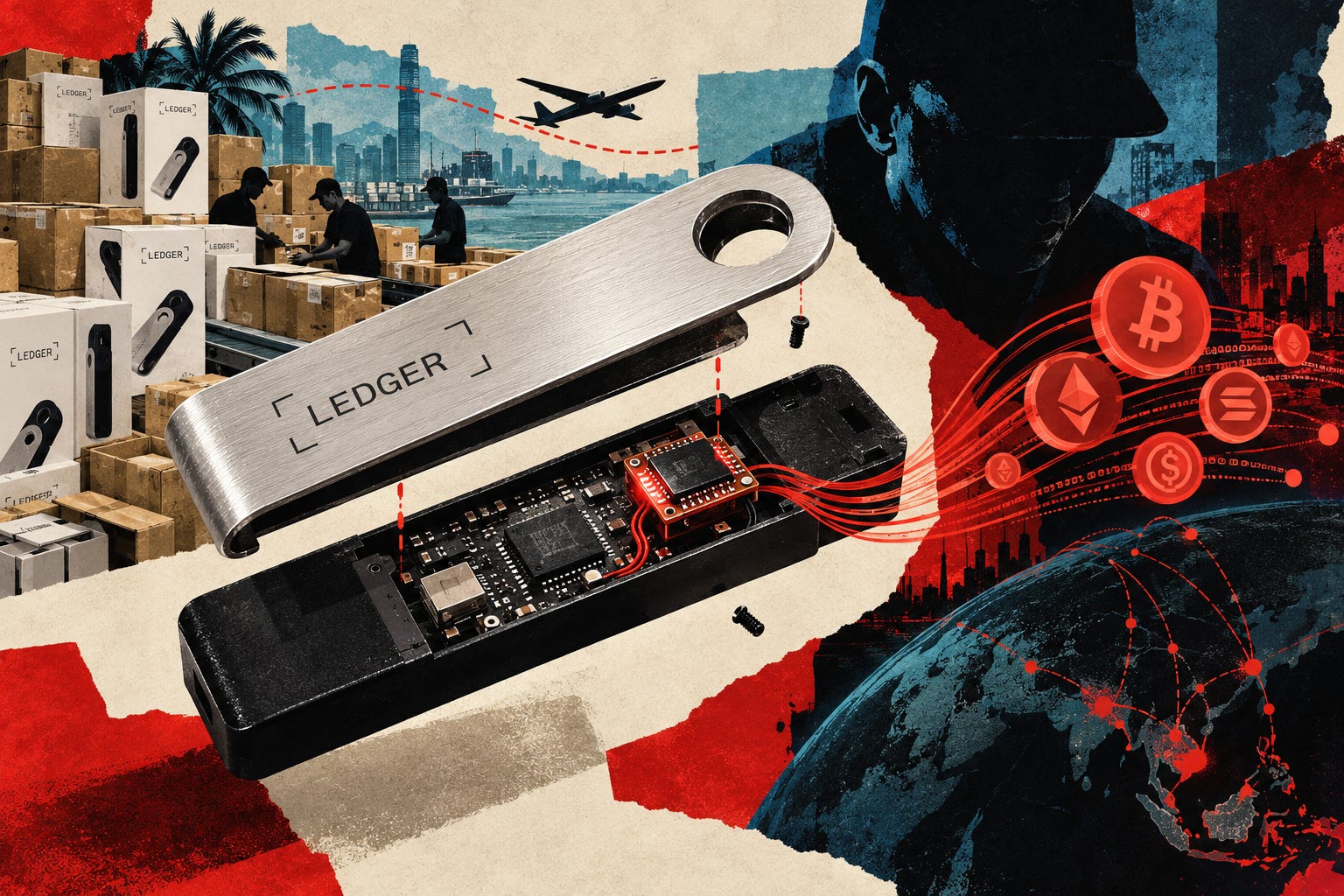
A serious issue undermining the security of self-hosted crypto wallets has emerged in Asia after spyware implants were found inside Nano X hardware wallets from Ledger, one of the market leaders. The wallets themselves were bought in Malaysia, Germany and Singapore (Changi Airport, no less) from Ledger resellers, suggesting that the product has been doctored to enable user wallets to be drained.
If you’re not familiar with crypto wallets, the revolutionary factor is that you can keep your assets yourself, without relying on a third party like an exchange or, in fiat asset terms, banks and other custodians. Software security is sufficient but it is usually advisable to augment that approach with a hardware wallet, like Ledger’s Nano. It acts as a physical key, securely signing transactions so you can access and move assets without exposing your private keys online.
The spyware found on these three hardware keys could grant a third party remote access to any wallets they’re used to secure. But this doesn’t look like a random issue.
Long-time crypto figure Mark Karpelès, who you may remember was previously the founder of the Mt Gox exchange which went bankrupt after a hack more than a decade ago, found the spyware. He noted that the reseller in Southeast Asia, CryptoBilis, was recently acquired by a Chinese national, which raised suspicion of a supply chain attack.


There’s no direct link between the change of ownership and discovery of spyware, and a Europe-based reseller’s product was also affected.
Personally, I owned a couple of Ledger devices. I’ve always purchased them directly from the company, but these incidents raise concern over the safety of all hardware wallets going forward. Self custody is a major feature of cryptocurrency wallets, but the growing sophistication of AI, emergence of quantum computing and the uncertainty of supply chains is pushing the argument that custody of coins with exchanges or even via ETFs may be safer.
For now, Ledger has ceased sales via these partners. This is a story that’s sure to have important updates soon.
Apple Intelligence finally gets the green light to launch in China
Apple Intelligence is finally coming to China after it received approval to add Alibaba’s Qwen and Tongyi Wanxiang models to Apple devices. The launch is expected for December through the planned iOS 27.3 launch.
It’s been nearly two years since Apple introduced the product to its devices worldwide, bringing its own flavour of personal AI services that include image editing, writing assistance, upgraded Siri and more. But its launch in China has been subject to finding the right partnership deals and then getting the regulatory green light. Apple Intelligence was expected to launch last May, but the Chinese government has been very careful with AI products. Unsurprisingly, an Apple AI service wasn’t likely to be fast-tracked.
Notably, though, Apple Intelligence won’t include Siri and other newer features in China. This will very much be a local flavour, which probably will mean it is watered down and effectively an Alibaba show.
Japan’s SmartNews reportedly plots IPO at reduced valuation
A few years ago, Japan’s SmartNews was heralded as one of the pioneers that might save media. A distribution app that had buy-in from media outlets, the concept was different from needing to fight for attention in today’s algorithmic era.
SmartNews reached a $2 billion valuation in 2021, making it a rare global success story from a Japanese startup. Now, the Tokyo-based company is said to be preparing for an IPO, according to Bloomberg, but the bad news is that its valuation will be significantly lower at around 50 billion yen, or $317 million.
The 14-year-old firm explored a potential sale, but without success, Bloomberg claims. Back in 2023, SmartNews laid off nearly half of its US and China teams as cracks in its model began to emerge.
Deals
DeepSeek is reportedly leading a seed round worth tens of millions of dollars for robotics startup Winverse AI, valuing the former Tencent scientist’s company at about $400 million [Bloomberg]
Indian AI startup Sarvam is said to be in talks to raise $250 million to $300 million at a $3 billion valuation, which would double its value from a deal closed four months ago [Economic Times]
There’s a new fund in town after Singapore’s Antares Ventures secured more than $50 million for its first deep-tech fund, which is targeting $100 million [WSJ]
Thailand-based earned-wage startup Salary Hero raised $7.6 million in a Cento Ventures-led Series A to expand into Malaysia [Fintech News SG]
Indian advanced-materials startup Scimplify raised $25 million from Hitachi Ventures and others to expand US manufacturing for semiconductor, defence, energy and AI-infrastructure customers [Entrackr]
Google.org committed $15 million to The/Nudge to build AI tools for India’s small businesses, covering credit access, markets and compliance [Entrackr]
Hyderabad-based Skyroot Aerospace is seeking $300 million to scale rocket production after its first orbital mission, at valuations of up to $3 billion [Economic Times]
Indian caller-ID startup Equal AI has attracted early investor interest for a growth round at a valuation of up to $1 billion as it pursues a larger share of Truecaller’s market [Bloomberg]
Japan’s Omron plans to buy US computer maker OnLogic for about 100 billion yen ($630.5 million) to combine industrial controls with AI systems for factories [Nikkei Asia]
Markets
Indian manufacturing platform Zetwerk is preparing an IPO of up to $525 million at a 270 billion rupees ($2.8 billion) valuation, with trading expected to begin on 23 October [Bloomberg]
Moonshot AI’s CEO and CTO are in talks to settle a dispute with former venture Recurrent.ai ahead of the Chinese startup’s planned Hong Kong listing [Reuters]
Meanwhile, Bank of America has dropped talks to help arrange Moonshot AI’s planned Hong Kong IPO as US scrutiny complicates Wall Street’s China AI business [Bloomberg]
Mukesh Ambani’s Jio Platforms plans to raise up to $3.2 billion at a valuation of up to $108.3 billion in India’s largest IPO to date [Reuters]

Printed-circuit-board maker Suzhou Dongshan Precision Manufacturing is sounding out investors for a Hong Kong listing that could raise $2 billion to $3 billion [Bloomberg]
Asian chipmakers fell sharply as investors questioned the funding required for AI infrastructure, with SK Hynix down more than 10% and Samsung Electronics down 7.1% [CNBC]
AI and Chips
OpenAI CFO Sarah Friar warned that companies using low-cost Chinese AI models could face cybersecurity risks [Bloomberg]
TSMC executives met Texas officials and began more serious discussions over a potential US expansion in the first half of 2026 [Culpium]
CXMT says it has made progress on a high-density 4F-square memory-cell design and plans a server-memory product using it by the end of 2026 [Nikkei]
Chinese technology companies reportedly bought more than 1 million Nvidia gaming and workstation chips this year because domestic AI-chip supply still trails demand [FT]
Chinese AI-chip maker Iluvatar CoreX launched a supernode that packs 144 GPUs and 18 CPUs into one cabinet for AI training and inference [SCMP]
Alibaba launched Qwen Glasses N1 from 2,999 yuan ($450), positioning the device as a gateway to its AI assistants and services [Bloomberg]
Anthropic officially opened its Singapore office and agreed to work with the city-state’s Ministry of Digital Development and Information [Anthropic]
Japan will invest up to $21 billion in two New York chip factories operated by GlobalFoundries under a wider US trade deal [Reuters]
ASML expects China to account for about 20% of sales this year after shipments to the market rose 109% quarter on quarter in the third quarter [SCMP]
ByteDance is in advanced talks to buy custom data-centre chips from Taiwan’s MediaTek, giving the chipmaker a second major ASIC customer after Google [Bloomberg]
SK Hynix is seeking Washington’s approval to export US chipmaking equipment to China as part of talks linked to a planned US factory [Reuters]
TSMC is open to collaborating with Elon Musk’s Terafab project, but says it must retain control of any fabrication plants [Bloomberg]
Elsewhere, TSMC will build another 3-nanometre factory in Tainan, with production scheduled to begin in the first half of 2028 [The Information]
Japanese startup Solafune and Tohoku University plan to launch an AI-powered Earth-observation satellite by the end of the decade, processing imagery in orbit to cut costs [Nikkei Asia]
Data centres
Australia’s Firmus, the data centre firm backed by Nvidia, shelved its $5 billion Australian IPO after investor concern over AI valuations and the cost of building infrastructure weakened demand [Reuters]
Relatedly, Blackstone-backed AirTrunk delayed its planned Singapore REIT IPO, which was expected to raise $1.5 billion, until 2027 as higher rates and volatile markets weaken demand for AI-infrastructure listings [Bloomberg]
But there’s still plenty of money flying around: DayOne filed to go public in the US, but before that happens it secured 15 billion ringgit ($3.67 billion) from seven banks, including DBS and Standard Chartered, to expand its Johor hyperscale data centres [Reuters]
Bridge Data Centres is seeking to more than double its Malaysian loan to $6.6 billion, while a separate $6 billion Thailand data-centre loan has stalled after construction suspensions over energy use [Bloomberg]
Bitdeer signed an eight-year agreement for a 60 MW Cyberjaya data centre, taking its secured AI-cloud capacity to 333.5 MW ahead of its 2028 target [TechNode]
Singapore’s Princeton Digital Group is seeking a syndicated loan of up to $1.2 billion for Malaysian data-centre expansion [Bloomberg]
Tencent raised $5.7 billion in a debt sale, with proceeds largely earmarked for AI capital expenditure and chip purchases [Reuters]
China Mobile tripled capacity at its Hohhot data centre in Inner Mongolia to 20,100 petaflops [SCMP]
NTT Data is in final talks with Anthropic on a 500 MW Osaka data centre that could cost 1 trillion yen ($6.3 billion) and begin partial operations in 2028 [Nikkei Asia]
Crypto
Taiwan blocked domestic access to Coinbase and Kalshi over suspected election betting ahead of local polls [Bloomberg]
Policy
US regulators are questioning banks about their use of advanced AI, including Chinese models and autonomous systems, amid cybersecurity and financial-stability concerns [Reuters]
India delayed a planned 0.4% charge on eligible UPI merchant transactions above ₹2,000 ($22) until after Diwali following retailer pushback [TechCrunch]
AI is cutting the cost of scam operations tied to Chinese criminal networks, allowing them to scale beyond Asia’s fortified compounds [Bloomberg]
India’s food regulator plans stricter rules for Blinkit, Swiggy Instamart and Amazon Now, including manufacturing dates, expiry dates and batch numbers on listings [Bloomberg]
North Korean hacking group Kimsuky targeted Ukrainian diplomats, security officials and policy experts with fake conference invitations and malicious documents [The Record]
US authorities raided more than 40 Texas homes over remote IT-worker schemes alleged to have funnelled millions of dollars to North Korea [The Record]
The IMF and World Bank launched the Bangkok Blueprint, a 12-point plan developed with the Bank of Thailand to coordinate responses to online financial fraud [Bloomberg]
Malaysia plans to use Chinese satellite technology to improve flood forecasts and warnings during the northeast monsoon [Bloomberg]
The EU is negotiating with China to lift sanctions on a Chinese company in return for relief for a German supplier to ASML [Bloomberg]
Microsoft won a US court order to seize domains used by three Chinese-linked phishing platforms that have sent more than 750 million messages since January [The Record]
In other news:
Grab is adding microdramas and mobile games to its app as it looks for advertising and cross-selling opportunities beyond rides and deliveries [Bloomberg]
A new report forecasts Southeast Asia’s e-commerce market will nearly double from $197 billion in 2025 to $400 billion by 2031, while checkout preferences remain sharply fragmented by country as cash on delivery declines [Fintech News Singapore] [Disclosure: Xendit is an Ellerton & Co. client]
Singapore’s online-grocery market is projected to grow from $1.48 billion in 2025 to $3.24 billion by 2034 as Grab and Foodpanda expand beyond restaurant delivery [Nikkei Asia]
Singapore has attracted $1.3 billion in climate-tech funding since 2020, around 80% of Southeast Asia’s total, as green-energy policy and patient capital draw startups [Nikkei Asia]
China’s smartphone shipments fell 15.4% year on year to 57.9 million units in the third quarter, while Huawei was the only major vendor to post double-digit growth [Reuters]
Vietnamese ride-hailing company Green SM launched its all-electric taxi service in Los Angeles, its ninth international market [LA Times]
Indian venture firms including Peak XV, Elevation, Z47 and Blume are expanding in Silicon Valley to follow founders moving to the US and get closer to the AI startup boom [Newcomer]