


Welcome back to Asia Tech Review, your curated digest to keep up to date with tech news across Asia.
Chinese AI companies aren’t waiting for their American peers to go public. StepFun, founded by former Microsoft China and Asia research executives, is the latest heading for a Hong Kong IPO, with its embedded AI models in more than 40 million smartphones and, through a Geely tie-up, targeting over one million vehicles.
To keep up with our issues, follow us on LinkedIn or WhatsApp. Please do share Asia Tech Review with people you know who want to get smart about Asia tech.
StepFun joins China's AI IPO queue, unwinding offshore structure for Hong Kong listing
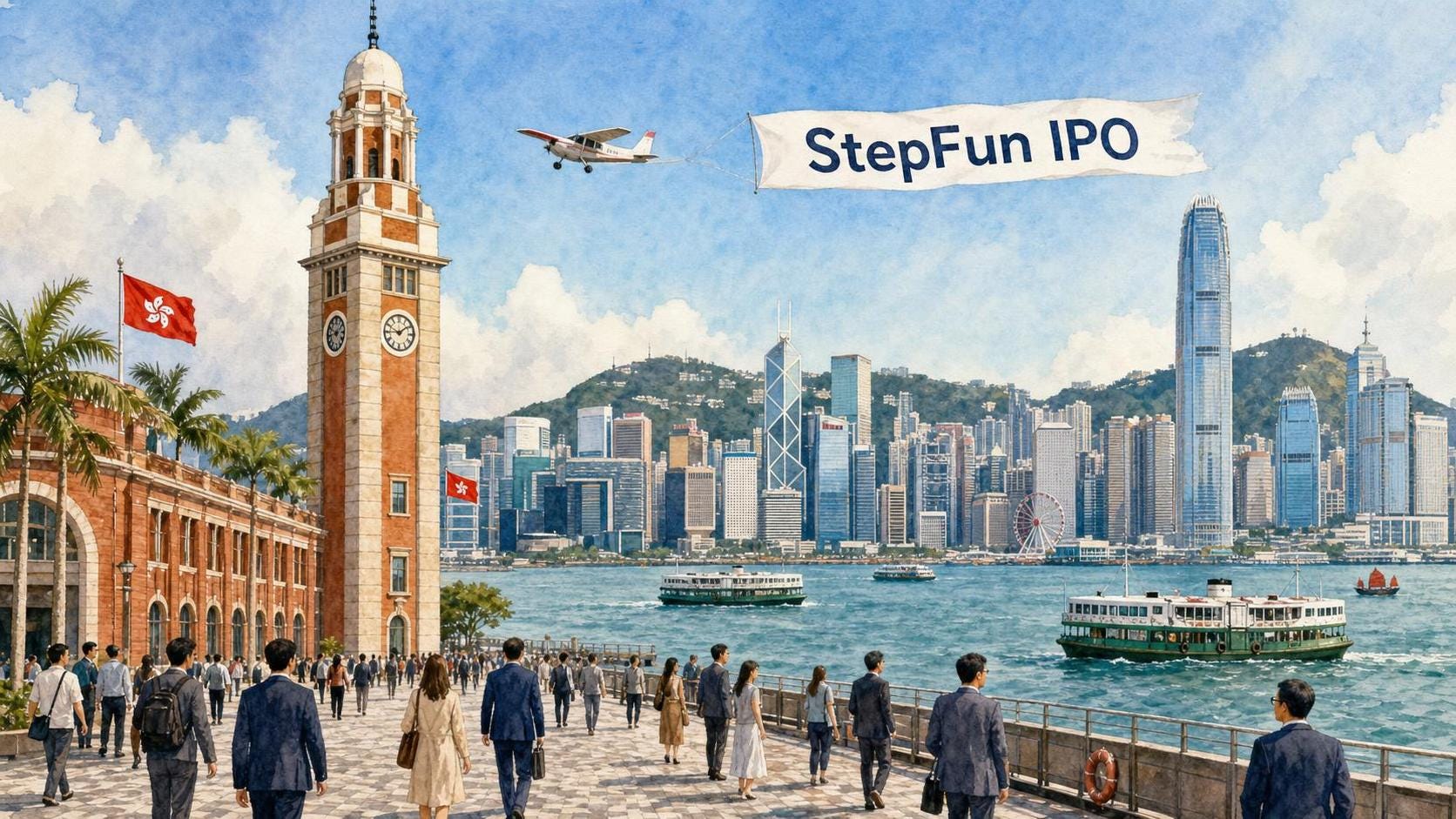
OpenAI and Anthropic have both started the process to go public, but China’s AI IPOs are moving forward even faster. On the heels of MiniMax and Zhipu’s Hong Kong listings at the turn of the year comes StepFun, which is the latest to line up for HKEX.
The company is tipped to raise as much as $500 million from its IPO at a valuation that could reach $12 billion, according to The Wall Street Journal. Despite a lower profile outside of China, StepFun has been red hot with investors raising upwards of $3.5 billion. That includes a $2.5 billion round in May.
StepFun reminds me of the old days of China tech as few of these deals were announced officially, which makes it tricky to track its financing with certainty. Still, that massive round was larger than the IPO proceeds MiniMax and Zhipu netted. It missed on their insane share price growth, but it can hit public markets better capitalised and with a differentiated story.
You may not be familiar with StepFun, but you shouldn’t ignore it or lump it in with others as its business model is quite different to Western rivals. The company was founded by former Microsoft China and Asia research executives and it focuses on embedded AI, so putting smart and capable AI features and systems inside devices, cars and more.
It has consumer and developer services but its specialism is as an infrastructure layer connector. StepFun has deals with Geely, Huawei and others which use its base models, often alongside their own, to build AI systems. Its products are in more than 40 million smartphones, and Geely, which has links through StepFun chairman Yin Qi, is aiming to reach over one million vehicles with StepFun’s help.
StepFun has also reportedly unwound its ‘red chip’ structure, an offshore setup commonly used by Chinese startups to raise foreign capital. That makes it more domestically anchored, a necessity in the current climate as it prepares for a Hong Kong listing.
As you might expect, it has strong ties within China. Partnerships with Biren, Cambricon, Moore Threads and others are designed to optimise StepFun’s models for Chinese chips and reduce reliance on Nvidia.
We should know more soon, as StepFun is said to list on Monday.
Moonshot AI seeks $30B valuation in new funding round
Speaking of private AI companies soaking up money, Bloomberg reports that Moonshot AI is in the market to raise $2 billion at a valuation of $30 billion. It also notes that Moonshot’s ARR reached $200 million in April, lots of caveats apply to those figures, especially for AI companies
In a show of how hot the market is right now, this round is supposedly coming just after Moonshot closed funding led by Meituan which values it at $20 billion. Prior to that, its previous fundraising came in December when it was valued at (just) $4 billion.
Obviously a lot has happened in the last six months, chiefly those IPOs from MiniMax and Zhipu which gave a new level for valuing Chinese AI companies. More importantly, it showed that retail markets in China are more than ready to invest in AI companies.
Unsurprisingly, Moonshot, which you’ll recall is behind the Kimi AI model and service, is moving towards an IPO of its own. Back in April, it, like StepFun, unwound its red chip structure to set itself up for a China-focused listing.
We know the two public AI firms are exploring additional listings and, related to that, South China Morning Post looked into the disparity between MiniMax, which trades at HK$148 billion (US$19 billion), and Zhipu, HK$540 billion (US$69 billion).
“Analysts attribute the swing to Zhipu’s stronger AI model capabilities and enterprise focus, and warn the gap could widen as MiniMax faces looming share lock-up expiries while Zhipu gains fresh liquidity through Stock Connect,” it concluded. The firms were added to the Hang Seng Tech Index on Monday, a big jump in acceptance for AI stocks.
Things will only get more challenging for Chinese AI firms as the impact of DeepSeek’s new V4 models fully plays out. Already, the ultra-low price point has sparked a price war that is going to tighten margins even further. We noted back in December that it was already hard enough for them to make money.
Meanwhile, China’s Ministry of State Security has warned that “AI relay services,” which bundle access to overseas AI models through a single interface, pose risks of data leaks, privacy breaches, and unauthorized cross-border data transfers.
Deals:
Singapore-based Silicon Box, which specializes in panel-level semiconductor packaging and chiplet integration, raised $77.65 million in debt financing from Ares Management, InnoVen Capital, January Capital and Abound Capital. There’s an option to add another $75 million. The round follows a $150 million equity raise. [Silicon Box]
Indian fintech Navi is in talks to raise $250-300 million at a post-money valuation of $1.8-2 billion. [The Economic Times]
Temasek led a $300 million round for London-based AI startup PhysicsX, which builds AI models for manufacturing jet engines and semiconductors, at a $2.4 billion valuation [Bloomberg]
Markets:
Indian quick commerce company Zepto filed an updated draft red herring prospectus with SEBI on Monday for a $1 billion (Rs 9,500 crore) IPO, edging closer to one of the year’s most anticipated new-age listings. [The Economic Times]
The company posted a 75% jump in quarterly revenue to Rs 7,498 crore ($898 million) in the fourth quarter of FY26, while narrowing its net loss to Rs 1,539 crore ($184 million) [The Economic Times]
Japanese taxi-hailing app Go priced its IPO at the top of its range, raising $553 million at a valuation of $1.1 billion [Bloomberg]
Chips & AI:
Hangzhou-based Prinano claims to have cracked mass production of photonic chips without deep ultraviolet lithography, a breakthrough that could slash manufacturing costs by 90%. [South China Morning Post]
Alibaba created Token Foundry, a new AI unit that merges its Tongyi Lab and Future Life Lab under CEO Eddie Wu [South China Morning Post]
In other news:
A Cambodian crackdown is said to be driving scam networks toward Sri Lanka, lured by infrastructure and visa-free access [Bloomberg]
The US added Alibaba, Baidu, and BYD to its list of companies believed to be aiding China’s military. [Reuters]
FPT Corporation and NVIDIA have launched Nemotron-Personas-Vietnam, an open-source synthetic dataset designed to help developers build AI systems tailored to Vietnamese language, culture, and economic context. [TechNode]
Nvidia’s Korea tour continued with a deal with LG that expands its robotics partnership to deploy humanoid robots for industrial use cases [Bloomberg]
Nvidia and LG Group are building a shared AI factory to accelerate LG’s expansion into robotics, autonomous driving and data center technologies [Nvidia Blog]
Samsung Electronics’ co-CEO, who is head of its chip division, said he discussed cooperation in next-generation foundry chips with Jensen Huang during his recent trip to Seoul [Reuters]
India’s top six IT firms grew combined revenue to $103.1 billion in FY26 from $95.9 billion in FY23, but headcount stagnated at 1.9 million and active tech job openings hit a two-year low [The Economic Times]