


Welcome back to Asia Tech Review, your curated digest to keep up to date with tech news across Asia.
DayOne’s mega US IPO to raise $5 billion may be on the rocks. That’s according to reports that suggest America’s tightening of chip exports to Southeast Asia has forced its postponement. An industry worth tens of billions to Southeast Asia is now at the crossroads. Elsewhere, India’s Paytm is making moves in Southeast Asia’s fintech space.
To keep up with our issues, follow us on LinkedIn or WhatsApp. Please do share Asia Tech Review with people you know who want to get smart about Asia tech.
For news as it happens, follow ATR Bulletin, our real-time news site that keeps you in the know.
It seems today is not the day for DayOne
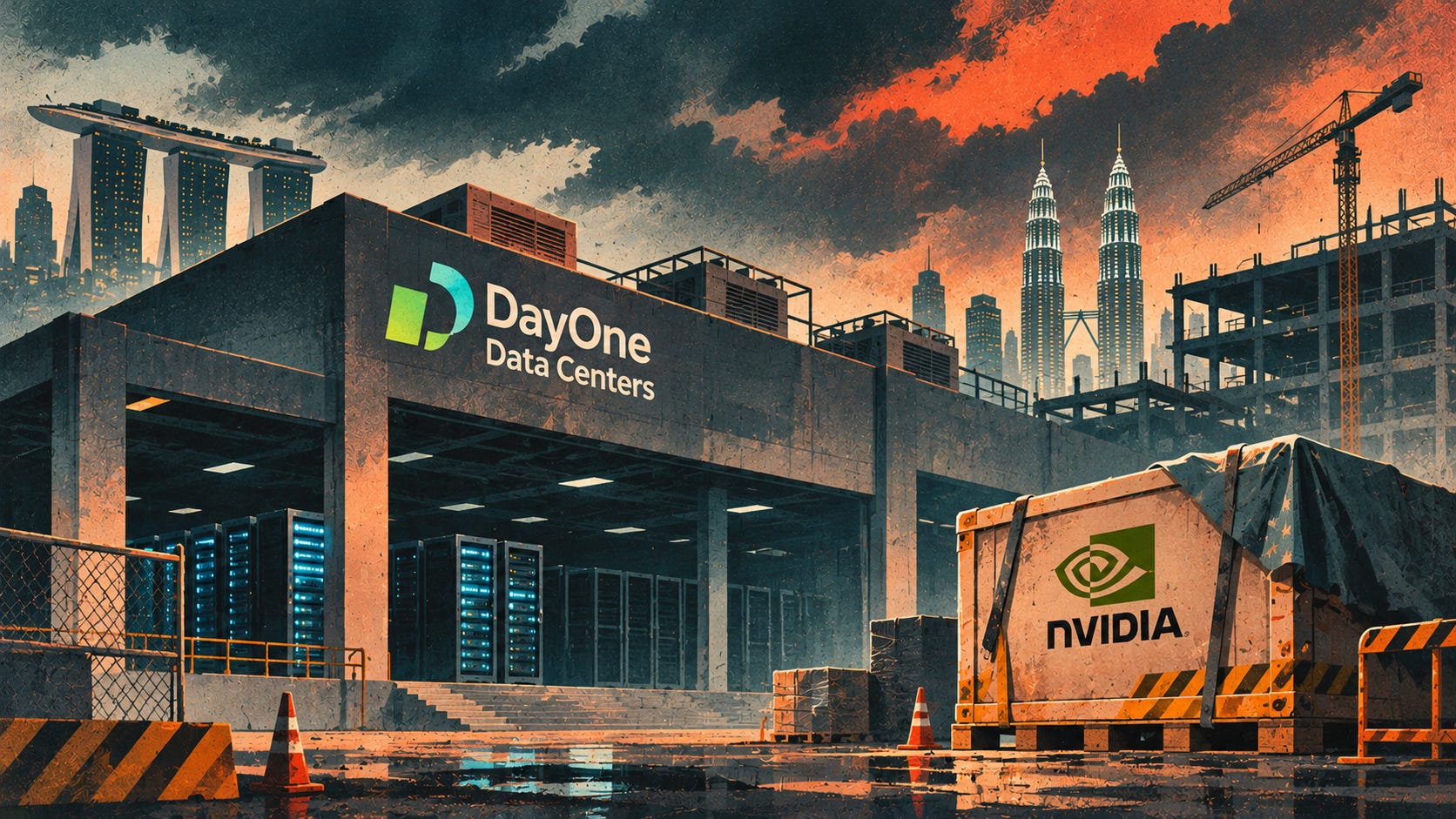
DayOne Data Centers’ planned US IPO looks like it may be postponed, according to Bloomberg. The Singapore-based company filed papers in October for the proposed listing, which reportedly would have raised $5 billion at a $20 billion valuation, but it is said to have got cold feet following the new interim US rules to limit remote access to AI chips in Southeast Asia.
The rule change means data centre operators in Southeast Asia cannot give Chinese firms access to certain chips without a licence. That spells uncertainty for providers who work with firms in China. We already know that DayOne counts ByteDance as its largest client, supplying 70% of its revenue, as we wrote in October:
A client like TikTok, which has pledged to spend as much as $25 billion on data centres in Southeast Asia, is clearly potentially very lucrative, but the reliance feeds into concern around the potential impact of an AI bubble.
If the bubble pops, data centre players like DayOne stand to be hurt significantly, as the company itself admits.
“Accordingly, our business has been and we expect will continue to be highly dependent on our relationships with our customers and we expect such customers to continue to account for a large percentage of our revenues and capacity,” it wrote.
The DayOne IPO encapsulates the data centre opportunity in Southeast Asia. The company itself is a spinout of China’s largest data centre operator (US-listed GDS) and its clientele and pace of expansion are typical of the industry in the region. Its listing presented a rare chance to look through the books of the fast-paced industry in one of its core growth markets, but the final act of listing will have to wait.
Well, Jensen Huang’s Nvidia exit has popped the bubble for many others in Southeast Asia beyond DayOne.
We noted last week that Aolani Cloud, which similarly counts ByteDance as an anchor client, saw a proposed $480 million loan to buy Nvidia GPUs stall following the US interim ruling. Other lenders are said to be (understandably) holding fire on doing more deals for Southeast Asian data centres. Nikkei Asia reports that at least two Nvidia server partners have suspended shipments to Southeast Asian clients following the tightening of US controls.
Bloomberg reports that even the CEOs of some data centre firms aren’t exactly sure how the new US change will affect their business. Some are said to be pursuing sites outside of Southeast Asia, with one unnamed Chinese provider targeting Spain as they look to beef up their Western customer base.
But the rules are having wider implications beyond data centres.
In the world of smartphones, TSMC has halted shipments to Chinese smartphone companies that include Xiaomi as technically those trades fall under the new rules. It seems likely that they will get licences fairly quickly. The same can’t be said for DayOne, Aolani and others.
Data centre spending in Malaysia is closing on $100 billion, with Southeast Asia claiming “a sizable slice” of the $49 billion in credit that’s gone into the industry across Asia Pacific, according to the same Bloomberg report. The big worry will be that there’s no resolution which leads to drastically lower financing, unfinished data centre developments and economic impact across the region.
Paytm plans Singapore expansion with $21M investment
Away from the very real concerns around data centres, Paytm is expanding into Southeast Asia after it announced plans to invest up to 2 billion rupees ($21.4 million) in Singapore-based lending startup Funding Societies.
Publicly listed Paytm will take a 19.1% stake in CardUp, a payment processing business that Funding Societies acquired in 2022 after it raised a $294 million Series C round. CardUp helps companies manage payments and cashflow using credit, which complements Funding Societies’ core business of SME and business lending.
The deal will see Paytm expand to Singapore by providing its payments and lending technology to CardUp to enable new services on the ground. Earlier this year in its Q2 results, Paytm announced plans to pursue this partner-led approach to expansion into markets where the local entity can give it a strong head start, although it didn’t rule out launching its own entities with “attractive payment margins, large proven profit pool and moderate operational overheads.”
Singapore isn’t a place where it can simply pitch up, hence this deal is aimed at giving Paytm that fast start. The company picked out PayPay, the Japanese payment firm it co-created with SoftBank, as the ideal example of the partner approach. PayPay raised $880 million through a US IPO back in March. That deal was unique, since the business was massively boosted by SoftBank’s involvement, but even a modicum of its success is good news for Paytm.
Back in April, Paytm incorporated a business in Indonesia, where it clearly sees potential to grow without a local partner. At the end of 2025, it set up in Luxembourg, which could be a gateway to serving European markets. But this Funding Societies/CardUp deal is its largest investment-based partnership we’ve seen so far.
Domestically, the company has bigger fish to fry. Its shares and those of rivals Pine Labs and MobiKwik all fell last week after the controversial introduction of transaction fees on UPI, India’s national payment service, was delayed. We previously wrote in September that the fees and structure are wildly misunderstood and necessary if UPI is to continue to function as a core financial network.
Deals
India’s SatSure raised $7 million from the Antariksh Venture Capital Fund at a $93 million valuation as part of a larger round, backing its use of satellite imagery and AI in banking, insurance and infrastructure [Reuters]
Pragmatik Labs, founded by former Alibaba AI chief Lin Junyang, raised tens of millions of dollars at a $5 billion valuation, more than double its August price tag, with HyT Capital, CDH Investments and Geely among the new investors [Bloomberg]
SK Hynix plans to convert its Kioxia bonds into shares, giving it an indirect 14.1% stake and making it the Japanese flash-memory company’s largest shareholder [Bloomberg]
SoftBank’s Masayoshi Son approached Wall Street institutions about financing a potential $1 trillion buyout of South Korean memory chipmaker SK Hynix [The Information]
China Investment Corporation wants an escape clause in US private equity funds that would let it pull out if geopolitical tensions worsen or Western sanctions hit, as it looks to resume investing in the sector [FT]
Earnings
Tencent’s gaming slowdown dragged third-quarter revenue growth to 8%, with sales of 207.34 billion yuan ($31.1 billion) missing estimates while net profit edged up 0.8% to 63.61 billion yuan ($9.54 billion) [Reuters]
Pony AI’s robotaxi business helped lift third-quarter revenue 75% to $44.6 million, beating estimates, although the Chinese company’s net loss widened to $105.6 million [Bloomberg]
Alibaba beat September-quarter sales estimates with revenue of 271.52 billion yuan ($40.73 billion), helped by growing demand for its cloud services and AI computing [Reuters]
Ant Group’s June-quarter profit climbed 26.6% to about 10.6 billion yuan ($1.59 billion), based on calculations from Alibaba’s results, as the fintech company pushes into agentic commerce, digital health and embodied AI [Reuters]
Temu owner PDD ended its run of quarterly profit declines with a 0.7% rise in net income to 29.54 billion yuan ($4.43 billion), while revenue barely moved at 108.34 billion yuan ($16.25 billion) [WSJ]
AI and Chips
Samsung promotes memory-development chief Hwang Sang-joon to president and head of its memory business, putting the executive who oversaw DRAM and high-bandwidth memory in charge as AI demand drives record profits [Reuters]
India’s data centre operators, including Yotta, are expanding to capture AI demand as tighter US chip controls and opposition to data centre construction complicate investment in rival Asian markets [Bloomberg]
China’s AI developers face a funding squeeze as training costs climb and venture investment slows, with the country’s biggest tech firms expected to double AI capital spending to $139 billion this year while AI revenue covers less than 8% of that outlay, Rhodium Group estimates [NYT]
Japan’s flagship domestic AI project could cost 1.8 trillion yen ($12 billion) over five years, 800 billion yen ($5 billion) above its initial estimate, as rising chip prices and a weaker yen hit the Noetra consortium’s plan to deploy about 27,500 Nvidia Rubin GPUs [Nikkei Asia]
Cursor, which is now owned by SpaceX, is said to be considering a move away from Chinese AI models over geopolitical risks after building its Composer 2 coding model on Moonshot AI’s Kimi K2.5 [CNBC]
China’s AI-exposed jobs are already seeing a hiring slowdown, with an analysis of 10 million job ads from 2021 to 2025 finding a double-digit decline in listings for more-exposed roles relative to less-exposed positions [Bloomberg]
Crypto
North Korea-linked networks are laundering funds stolen from Binance through more than 27,000 wallets on 16 blockchains, with about $2.35 billion still in linked addresses and roughly $860 million in Ethereum moved since 17 November [Elliptic]
BitMart’s planned shutdown has left customers unable to withdraw funds after it disclosed a $319.5 million shortfall tied to a 2021 hack, wash trading and customer withdrawals, exposing Chinese investors to the exchange’s opaque finances and limited regulatory protections [Nikkei Asia]
Policy
TSMC has suspended some previously approved Chinese chip orders at 16 nanometres and below unless customers obtain US export licences, further narrowing affected designers’ manufacturing options under the new rules [Reuters]
China’s securities regulator is telling some law firms it will no longer approve overseas listings by red-chip companies, threatening a fundraising route widely used by Chinese tech startups and Hong Kong’s IPO pipeline [Reuters]
Alibaba shareholders are suing in New York, alleging that the company hid its ties to Megaspeed and understated export-control risks in its 2024, 2025 and 2026 annual reports [Reuters]
Kakao founder Brian Kim’s acquittal on stock-manipulation charges was upheld by a South Korean appeals court, clearing a major legal hurdle for the tech group [Bloomberg]
Taiwan has flagged nearly 2,700 Threads accounts to Meta over a suspected coordinated Chinese campaign to influence its upcoming elections, with most of the accounts created in batches over the past four months [Reuters]
Indonesia is asking Google to explain why it removed more than 19,000 pro-government YouTube channels, with the digital ministry warning that the action could be misinterpreted [Reuters]
A US congressional report urges American companies not to build Chinese open-weight AI models into their systems, warning that removing them later could take years and cost taxpayers billions of dollars [The Record]
US Senator Tom Cotton accuses Commerce Secretary Howard Lutnick of repeatedly ignoring his warnings about AI chips being smuggled to China before the Nvidia scandal broke [WSJ]
China fined Baidu’s Hong Kong unit 500,000 yuan ($75,000) for completing part of its 2021 deal for Joyy’s live-streaming business before antitrust approval [SCMP]
Li Ming, a Chinese national on bail in Singapore, is reported to have played a central role in companies suspected of routing restricted Nvidia chips to China, including Megaspeed, which was not named in the fraud case brought against him and others in February 2025 [WSJ]
China is pushing the US to reverse restrictions that bar its three biggest telecom operators from directly obtaining US phone numbers, accusing the FCC of unfairly targeting Chinese firms with unsupported national-security claims [Bloomberg]
China’s spy agency reportedly runs a secret campaign to help domestic companies get hold of advanced AI chips and gather intelligence on the industry [NYT]
Alice Huang reportedly remained in contact with a Chinese Ministry of State Security official from spring 2025 to autumn 2026, overlapping with her relationship with Nvidia’s Jensen Huang, while US agencies also gathered evidence that her business partner Kang Wei worked with the agency [NYT]
In other news:
Amazon’s threat researchers say suspected Chinese hackers used the autonomous AI penetration-testing tool Cairn to discover a zero-day while targeting East Asian universities, after finding an exposed server with operational logs and Simplified Chinese prompts [The Record]
Tower Records Japan says a breach exposed login information for about 10.2 million accounts, including email addresses and user IDs [Bloomberg]