


Welcome back to Asia Tech Review, your curated digest to keep up to date with tech news across Asia.
We took a delayed Memorial Day break but today have details on how tech’s soaring AI spending is impacting Asia’s key supply chain markets, and influencing one of China’s most important tech companies: ByteDance.
To keep up with our issues, follow us on LinkedIn or WhatsApp. Please do share Asia Tech Review with people you know who want to get smart about Asia tech.
ByteDance is spending money on AI like a US company
ByteDance is taking Chinese tech spending on AI to US levels after it committed to doubling its capital spending to more than $70 billion this year.
The TikTok owner could spend between 400-500 billion CNY, or $59-$74 billion, Bloomberg reported, as it develops its data centre and AI strategy. Potentially the figure could reach $100 billion by next year, the report claimed.
ByteDance spent around $25 billion last year, but with a $50 billion profit during that period, it has cash to funnel back into the spending spree to make it feasible.
US tech giants spend significantly more than their Chinese peers. Amazon spent over $130 billion on capex last year, and forecast $200 billion this year. Alphabet predicted $185 billion in capex in 2026. Meta increased its spending range guidance for this year to $115-$135 billion, a jump of over 70%.
ByteDance’s spending plans are significantly higher than Tencent, $12 billion last year, and Alibaba, $19 billion, in what’s perhaps a reflection of the firm’s more global focus and product range. Even though it has ceded majority control of TikTok US, revenue from outside of China accounts for over 30% of total income. International revenue is said to have grown by nearly 50% last year, outpacing 20% growth in China.
In another reflection of its more global status, ByteDance is said to have struck a deal to develop custom chips with Qualcomm to power its AI data centres.
Qualcomm announced the mystery ‘hyperscaler’ partner at the end of April, sending its share price soaring by 20%, and now Bloomberg unmasked the partner as ByteDance.
The duo will work on ASICs (application-specific integrated circuits) built specifically to handle heavy workloads in ByteDance data centres. It’s a big deal to get Qualcomm into the AI business, and offset a reliance on smartphones, and another big indicator of the scale of ByteDance’s commitment to building AI services. ByteDance has data centres across Europe, including two projects in Finland, the US and Southeast Asia, where it just committed a further $25 billion for TikTok.
We looked at the contrast between Alibaba and Tencent’s approaches to AI earlier this month, with the former commercialising its work and the latter opting to embed it into its existing products. It’s tough to analyse a private company like ByteDance, but it has a strong and global product portfolio and is already putting AI to work in products like TikTok, CapCut and Lark. You’d imagine it is also playing with newer ideas and future products which these infrastructure investments will enable.
Taiwan reaps rewards from AI boom
The AI boom is hitting differently this year in Asia since tech giants are actually spending the enormous sums they pledged last year.
Most of the headlines were around projected spending. As we enter a second year of inflated capex forecasts, data centres coming online and more, so the supply chain countries are seeing tangible impact.
South Korea has been the most visible beneficiary, but Taiwan is very much in the picture as a trio of updates shows clearly.
Taiwan tech borrowing surges
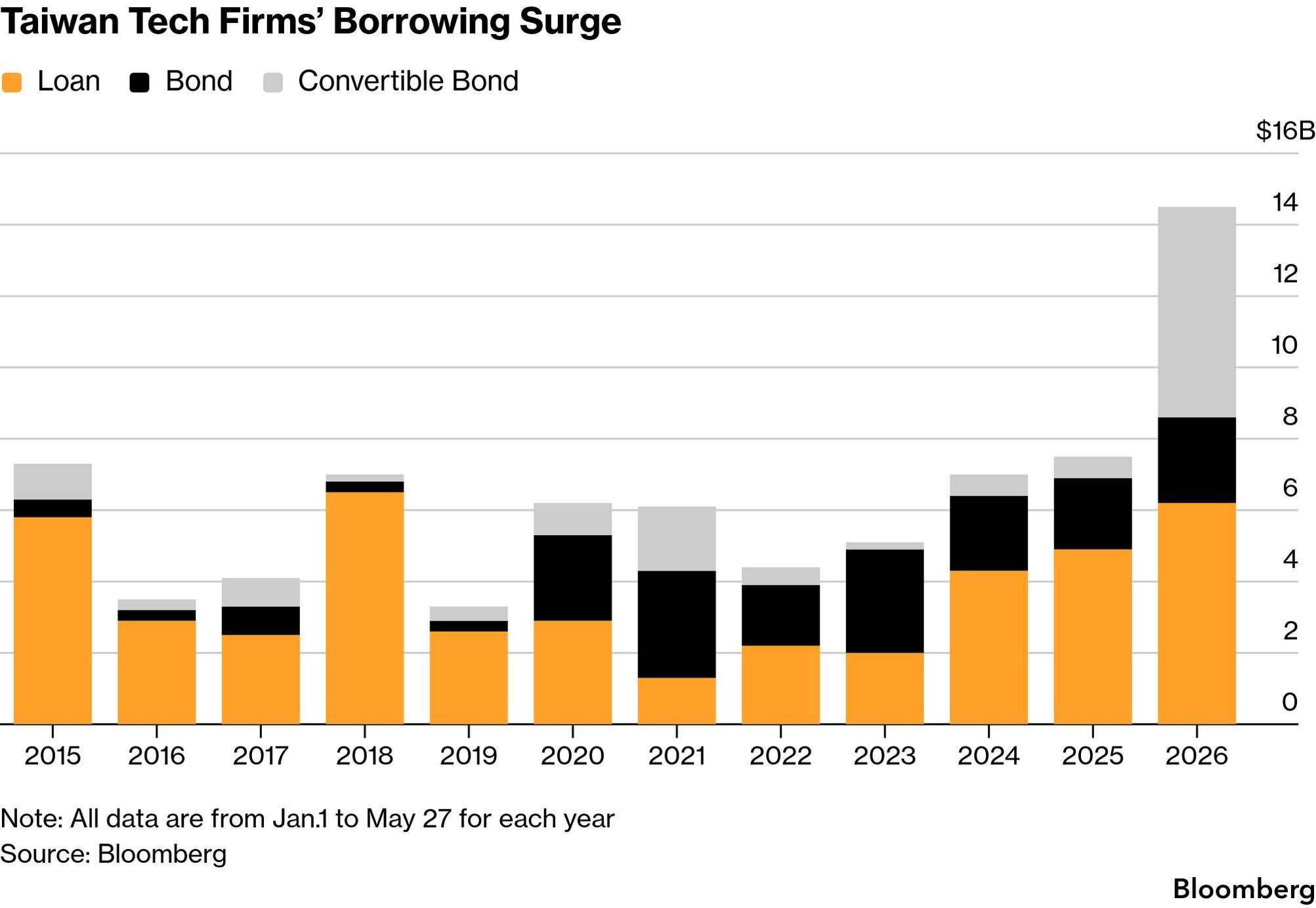
Taiwan makes the magic happen. That’s why Taiwanese tech firms have doubled their borrowing this year to $14.5 billion in order to meet the growing needs of increased AI spending, according to Bloomberg:
Hardware manufacturers such as chip component makers and server builders, vital parts of the global AI supply chain, have been driving the surge in borrowing as procurement and capital expenditure needs accelerate.
The jump is quite insane as the accompanying graphic shows.
TSMC employees promised another big bonus
Samsung managed to avert a strike with its semiconductor workers with potential average bonuses of $300,000, and now it is the turn of TSMC.
Its CEO told staff at a hastily-arranged town hall meeting that they can expect their profit-sharing bonuses to rise by at least 30% this year. That bonus already took a big hike last year, as Bloomberg (again) reports:
TSMC’s overall employee profit-sharing pool grew roughly in line with its bottom line last year. The company allocated about NT$103 billion for the program in 2025, up 46.6% from the year before. The chipmaker in its articles of incorporation has pledged to set aside no less than 1% of its annual profit for its incentive program.
Keeping the staff happy may be TSMC’s biggest crisis to date, argues long-time Taiwan watcher Tim Culpan.
Nvidia doubles down on Taiwan
Meanwhile, Nvidia is doubling down on Taiwan. Well tripling or quadrupling down, according to its ever-quotable CEO Jensen Huang.
“Four years ago, five years ago, Nvidia was spending about 10, 15 billion dollars a year in Taiwan. Now we’re spending 100, going to 150 billion dollars in Taiwan each year,” he said at the launch of its new headquarters, which will begin production in 2030 and is said to cost $5 billion.
Rival AMD last week announced plans to invest $10 billion into building its capacity and infrastructure in Taiwan.
In other news:
China is overhauling its surveillance network with AI that automates real-time tracking, behavioral analysis, and unrest prediction, in the most significant upgrade to the decade-old system yet. [FT]
CXMT (ChangXin Memory Technologies), the world’s fourth-largest memory maker and a key part of China’s self-sufficiency strategy, got approval for an IPO that could raise at least $4.3 billion and become China’s largest listing for nearly five years [Bloomberg]
SK Hynix crossed the $1 trillion valuation mark as the AI spending boom continues to lift its business [CNBC]
Samsung Electronics plans to invest $1.5 billion in Vietnam to build a semiconductor testing plant [Reuters]
The founder of disgraced edtech Byju’s is said to be close to a settlement after being sentenced to six months in jail for contempt of court [Economic Times]
The former CEO of defunct crypto lending platform Hodlnaut was charged in Singapore with six counts of fraud over allegedly misleading statements about the company’s exposure to the TerraUSD collapse [The Block]
Kuaishou beat first-quarter estimates with $5 billion in revenue thanks to the commercialisation of its AI video generator Kling [SCMP]
PDD Holdings, the parent of Temu, missed quarterly revenue on account of tough domestic competition [Bloomberg]