


Welcome to Asia Tech Review Daily, your curated digest to keep up to date with tech news across Asia.
That’s right. This email is coming today (Wednesday) as we look to make ATR more useful and insightful to our readers. We will send you 2-3 of the most important items from Asia Tech from the previous day, and a list of other news you’ll want to know.
Get in your touch with your thoughts. What do you like, what do you love and what doesn’t work for you.
Old money and new money are coming together in Southeast Asia
I’m here at Money2020 Asia in Bangkok where agents, payments and “web 2.5” are the agenda. This event felt vibrant when it was in Singapore in pre-Covid times, but the Bangkok version feels a little quieter with some founders in Singapore skipping it altogether.
The core themes look to be around financial connectivity. There’s lots of chatter about cross border payments, which has become a major area for innovation across Southeast Asia. That’s thanks to national QR payment systems gaining strong adoption and national systems themselves connecting. Payment infrastructure sounds boring, but making things easy takes an orchestra and a lot of plumbing behind the scenes.
Digital assets are also bleeding into traditional investment and finance. That’s not new per se, I wrote about this last year, but it’s striking how many crypto companies want to offer investment products that mirror those of a bank and banks are dabbling in digital assets themselves. Stablecoins are a great example of this.
Payment provider Nium, one of the few companies to expand globally from Southeast Asia, linked up with Coinbase to enable stablecoin money transfers worldwide. More locally in the Philippines, crypto exchange Coins.ph now lets its users spend stablecoins through the national QR payment system. Added to that, somehow I missed Thailand’s Kasikorn Bank and Grab coming together two weeks ago to announce a blockchain-based system to let Thai customers pay with Grab in Singapore.
No tech event would be complete without AI, and in payments that focuses around its use in areas like money laundering and fraud detection and, of course, agents. The concept of automating payments on your behalf feels like a huge area for development, albeit that crypto companies are running with this ball for now.
A number of fintechs at the event are talking up their potential to build guides and guardrails for agentic payments, though. Singapore-based MetaComp, for example, launched a framework that will govern how AI agents operate in the regulated financial services space. We can usually turn to crypto for a sign of the future and Singapore’s Cobo took things further with the launch of a crypto wallet specifically for agents.
We have a number of interviews from the event, so stay tuned for more.
Razorpay reportedly set for IPO filing at apparent $5-6B valuation
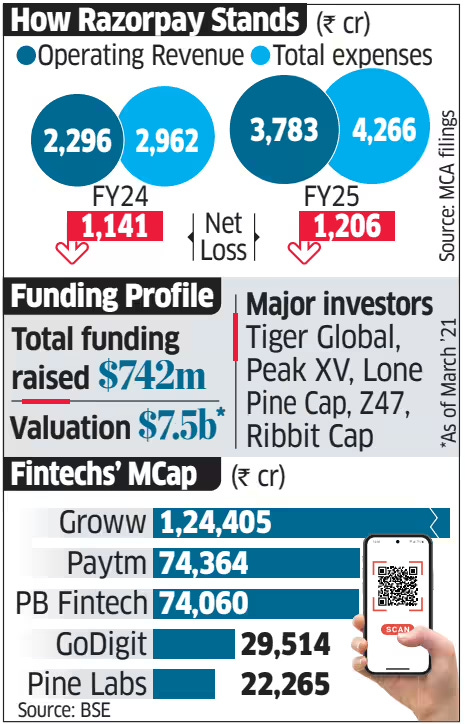
India’s IPO pipeline is about to get a major boost with reports that Razorpay, the fintech valued at $7.5 billion four years ago that’s akin to a ‘Stripe For India’, will file to go public in the coming few weeks.
The business may take a valuation haircut, with Economic Times speculating a possible $5-6 billion tag, but a raise of $600-$700 million would be a massive boost to the country’s IPO pipeline.
Last year, India was flushed with IPOs as listings from Groww, Meesho and Pine Labs earned investors like Sequoia billions of dollars in returns. In 2026, however, the mood has fallen. PhonePe paused its plan to go public last month citing volatile markets and geopolitical concerns, but it was widely reported that the company struggled to land the $15 billion valuation it had targeted following an investor roadshow.
A big blockbuster listing is exactly what can restore positive sentiment and kick start listings from other companies. To state the obvious, that’s important as investors see returns and those exits give others the confidence to do more deals, all of which is good for startups that want to grow. No exits or returns makes that a lot harder, as anyone in Southeast Asia can readily testify.
There’s not a tonne of information on the Razorpay prospectus right now, which makes sense as it hasn’t been filed, but we know it is coming. The company completed its ‘reverse flip’ aka redomiciling its business to India nearly one year ago, therein fulfilling a key requirement for a domestic IPO.
In other interesting news you won’t want to miss:
A robot from Honor, the smartphone brand spun out of Huawei, ‘won’ a Beijing half-marathon and smashed the (human) world record in the process. [SCMP]
ByteDance’s net profit dropped by 70% in 2025 due to massive spending on AI, and in spite of serious revenue growth from TikTok Shop. [Yicai Global]
Moonshot, one of China’s prominent AI companies, released a highly-rated new AI model that might compete with its US peers when it comes to coding. It is also open source. [Kimi]
Google expanded access to its Gemini in Chrome feature, which brings its AI into your browser, in Asia with launches in Australia, Indonesia, Japan, the Philippines, Singapore, South Korea and Vietnam. [TechCrunch]
Tencent jumped into the Kazakhstan market after it bought a 3.2% stake in fintech and e-commerce business Kaspi.kz for just over $500 million. [Tech In Asia]