


Welcome back to Asia Tech Review, your curated digest to keep up to date with tech news across Asia.
Yes, Jensen Huang has returned to Nvidia. Let’s have a newsletter that doesn’t cover that shall we? Done. Today we’re looking at a major consolidation in Singapore’s telecom industry, and why one of India’s major home services businesses is making a major move into AI in the US.
To keep up with our issues, follow us on LinkedIn or WhatsApp. Please do share Asia Tech Review with people you know who want to get smart about Asia tech.
For news as it happens, follow ATR Bulletin, our real-time news site that keeps you in the know.
Singapore catches Southeast Asia’s telecom consolidation bug
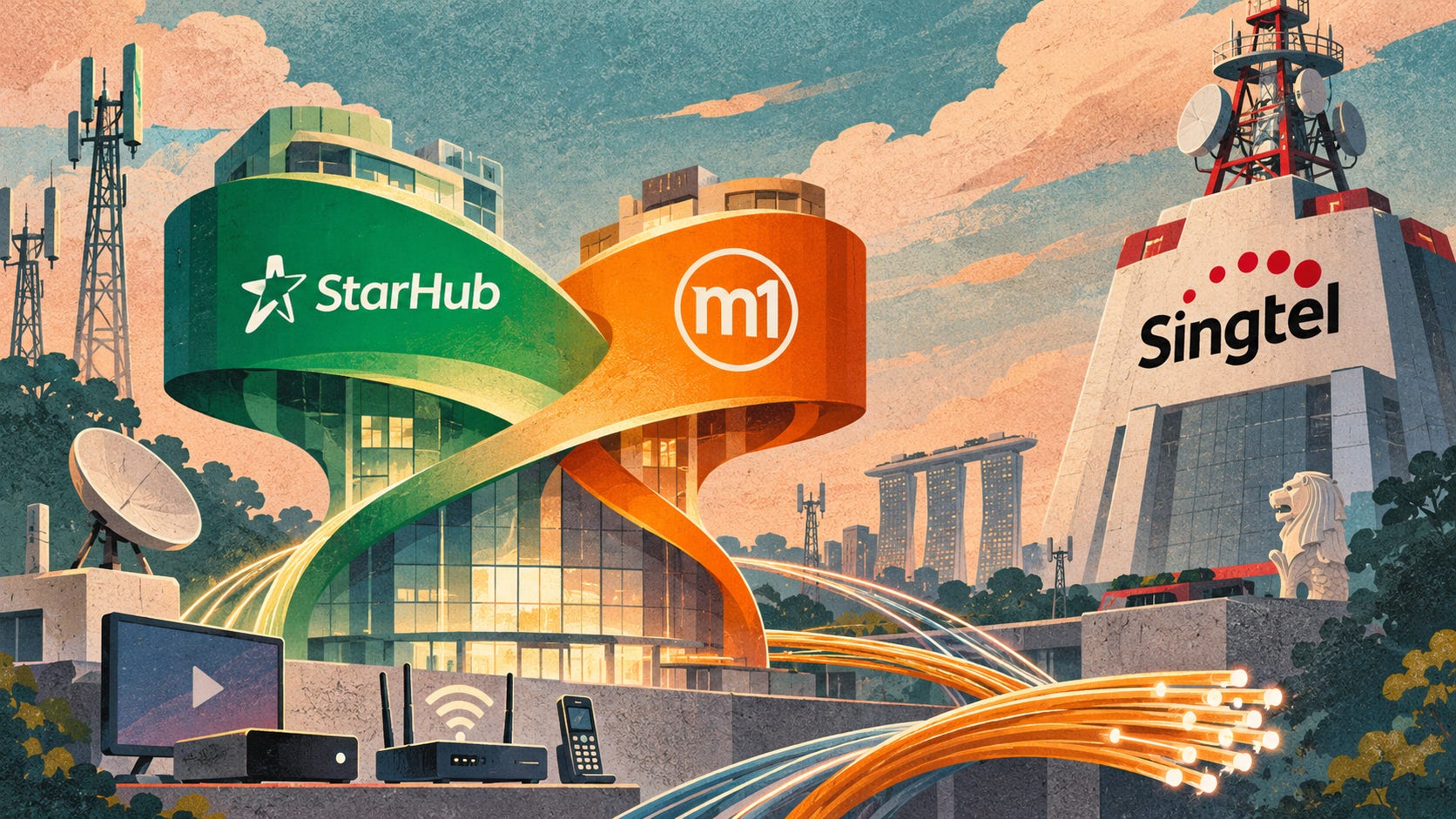
Singapore’s telecom market is set for its largest shakeup in decades after StarHub announced plans to merge with rival M1 in a deal worth S$1.1 billion ($852 million).
The deal will create a combined entity to rival market leader Singtel if it goes through, the target is in the first half of 2027.
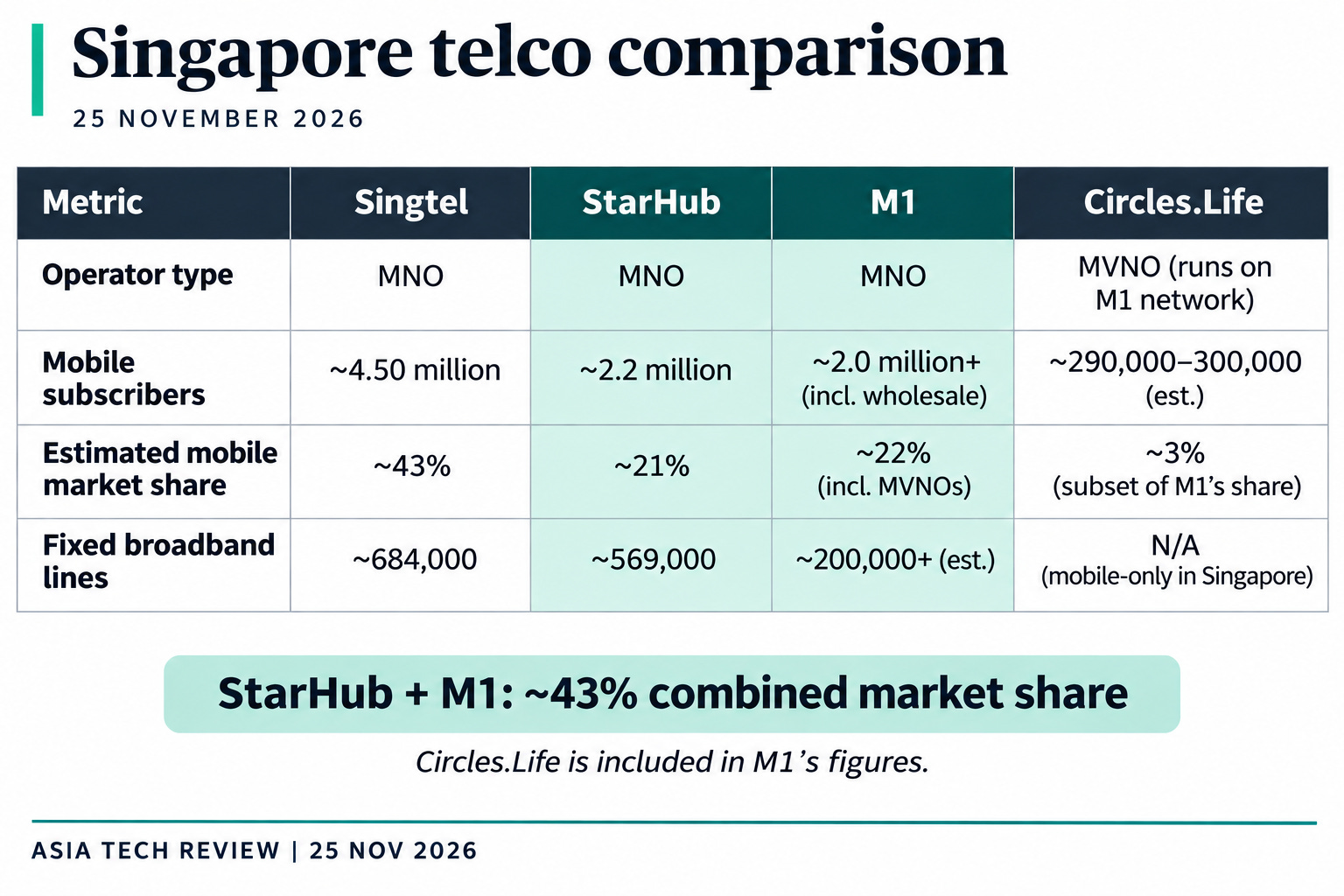
Currently, Singtel holds an estimated 43% of the operator market with around 4.5 million mobile subscribers. StarHub and M1 together would represent 4.2 million subs, while the deal will also include Circles.Life, the telco startup that rents spectrum from M1, is also being acquired in a separate deal. (That’s estimated at around 290,000 subs.) Essentially, StarHub is buying the wholesaler and one of its major retail customers.
The ownership structure is notable, too. StarHub will own 100% of M1 and Circles.Life’s Singapore business, with M1 shareholders taking a 27.4% share in the merged business. Keppel, the industrial conglomerate that’s M1’s majority owner, has been clear that it wants to exit what it calls a “non-core business,” and this deal enables that.
Keppel has been trying to exit M1 for some time. A merger with Simba fell through in May. Interestingly, Singtel suggested it had been keen to take part in the consolidation deals but antitrust issues prevented it from doing so. As it happens, Singtel’s major rival StarHub stepped in.
StarHub has been making moves to beef up its business with other M&A deals, including the acquisition of MyRepublic’s mobile business last month, albeit that acquisition accounts for less than 100,000 subs.
This glut of deals comes amid tough competition among operators in Singapore, which is keeping prices low. Analysts note it could take two years for repricing which means there will be plenty of pressure on their businesses.
Singapore’s telecom landscape opened to new players like Circles.Life over the last decade, but now the move is consolidation. We have seen this trend in other markets, with True acquiring Dtac in Thailand, Indonesia’s XL Axiata and Smartfren merging and Maxis and U Mobile coming together in Malaysia. Now it is Singapore’s turn.
Elsewhere: A Macquarie-led group is in talks buy telecom assets of Malaysia’s Axiata for US$1.2 billion
India’s Pronto is turning its home services business into a US AI lab
When it comes to pivots, moving from home services to AI is quite the pivot but that’s exactly the turn that India’s Pronto is taking.
The company is said to be in the process of raising up to $50 million from investors including G Squared, Founders Fund and Andreessen Horowitz under its new guise as a physical AI lab, according to MoneyControl. Physical AI is one of the big buzzword phrases in the world of technology today, and it essentially relates to robotics and other devices that connect AI smarts to the physical world.
In the case of Pronto, the link is that it has been training AI using home services, for example laundry, folding and other tasks. Now it plans to turn those offerings into data and processes that can enable home services robots.
The contours are evident from the MoneyControl story:
Earlier this month, Provision announced it has acquired Mumbai-based Basilisk Industries, bringing its founder Shourya Watwani on board to lead hardware development and work on its in-house post-processing models. Sardana said the team had developed a metric 3D hand-tracking model, redesigned its perception hardware and built an initial version of a tactile glove.
Pronto has previously also introduced an opt-in programme, Pronto Verified, under which service sessions are recorded and anonymised footage is used for AI training. The company has not publicly detailed the extent to which data generated through Pronto will be shared with or used by Provision.
Despite the evidence, which has included authorities investigating the data collection, Pronto isn’t commenting on its plans right now.
Pronto previously raised more than $60 million from investors at a valuation that reached $200 million. Founder Anjali Sardana created a US subsidiary, Provision Labs, last year and now that will acquire the Pronto home services business.
Physical AI will be a major focus next year, and Pronto is already emerging as an early contender through its links between the US and India.
Deals
China’s Simplexity Robotics raised $100 million at a $1.6 billion valuation in a pre-Series A led by Ant Group, with Alibaba, Tencent, HongShan Capital and Lanchi Ventures also backing its push into physical AI [Bloomberg]
Singapore’s MetaOptics secured a share subscription facility of up to S$32 million ($25 million) from GEM Opportunities Fund to support its glass-based metalens business [MetaOptics]
Around 300 early-stage Chinese AI startups raised a record 26 billion yuan ($3.9 billion) this year as researchers leave Alibaba, ByteDance and other established players to start specialist labs, even as Chinese AI stocks have shed $1.7 trillion since the summer [Bloomberg]
Enterprise AI startup Aiden AI raised $32 million from A91 Partners in its first institutional round, backing its work helping large businesses, particularly banks and insurers, deploy AI across legacy systems [Economic Times]
CortexSpark Ventures is launching a ₹1,000 crore ($108 million) deeptech fund with an option to raise another ₹400 crore ($43 million), targeting around 20 startups across six sectors with investments averaging $4 million to $5 million [Economic Times]
DeepSeek founder Liang Wenfeng’s estimated wealth is now at $55 billion even though his stake fell from 81.65% to 67.4% following the $15 billion funding round months ago [Bloomberg]
Markets
India’s Oyo is reportedly eyeing a January–March IPO at a valuation of 200 billion to 220 billion rupees ($2.1 billion–$2.3 billion), roughly in line with its last fundraising two years ago [Economic Times]
Southeast Asian IPO proceeds fell 22% to $5.1 billion from 89 listings through 20 November, with Malaysia contributing $1.77 billion from 57 deals while Indonesia and Thailand managed just $120 million and $35 million respectively [Nikkei Asia]
Earnings
Xiaomi’s September-quarter revenue fell 5.2% to 107.2 billion yuan ($16.1 billion), its third straight quarterly decline as memory shortages squeeze smartphone makers; the fall was smaller than analysts’ 6% forecast, but net income dropped 68% to 3.9 billion yuan ($586 million) [Bloomberg]
AI and Chips
Tencent has brought in China’s Fangcun AI and Israeli-American firm Alice to assess its open-weight Hy4 model before release, becoming the first major Chinese tech company to disclose independent safety checks ahead of a model launch [SCMP]
Samsung and SK hynix could face a sharp fall in memory prices if hyperscalers rein in their AI spending, a prominent US semiconductor analyst warns [The Korea Times]
Taiwan Power plans NT$109.6 billion ($3.5 billion) of transmission and substation upgrades to shore up electricity supplies at Tainan Science Park, where TSMC is preparing for 1nm chip production [Economic Daily News]
Chinese military researchers fear US advances in AI could help American forces find and destroy China’s nuclear missiles before it can retaliate, even as Beijing explores using the technology to make its own missiles harder to detect [NYT]
Z.ai unveiled GLM-5.4, which reuses neural network layers to improve reasoning without adding parameters, claiming it matches systems with 2 trillion to 3 trillion parameters and can generate videos, games and 3D environments [Z.ai]
Use of Anthropic’s Claude by Japanese companies and organisations is up tenfold in a year as demand grows and the company concentrates on corporate customers [Nikkei Asia]
Ant Group opened two LingSante medical AI models to researchers and developers on Hugging Face, including the 124-billion-parameter LingSante-3.1-air-VL, which supports medical reasoning and image analysis with a 256,000-token context window [Hugging Face]
Huawei and Chinese partner Phlexing Technology say their homegrown Tau EDA chip-design toolkit offers an answer to US restrictions on software dominated by Synopsys and Cadence, supporting next-generation smartphone and server chips [Nikkei Asia]
Crypto
South Korea’s Financial Services Commission is expected to publish a draft Digital Asset Basic Act this week, building on its 2024 investor-protection law with clearer rules for the crypto industry [The Block]
US prosecutors are seeking to seize more than $1 billion in cryptocurrency allegedly stolen in a $6.3 billion Binance hack linked to North Korea, identifying wallets they believe held some of the proceeds [Bloomberg]
Policy
The US added Megaspeed to its Entity List, requiring American suppliers to obtain a licence before selling it advanced AI chips and other technology [NYT]
Researchers uncover a network of fake social media accounts believed to be linked to China pushing pro-Beijing messages ahead of Taiwan’s elections, raising concerns about AI-assisted influence campaigns [NYT]
India’s tax authorities uncovered an alleged ₹2,700 crore ($291 million) payment network serving Chinese-controlled gaming and betting platforms through shell companies posing as digital-art businesses; intermediary 1stPe earned ₹170 crore ($18.3 million) over 40 months, while authorities seized about ₹6.2 crore ($667,000) in undeclared crypto [Economic Times]
Malaysia will advise data centre operators to stop hosting or serving seven companies added to the US trade blacklist, seeking to prevent its growing industry from being used to circumvent technology restrictions [Bloomberg]
Singapore’s Lawrence Wong warns companies against routing advanced US chips to China through the city-state in breach of export controls, following US scrutiny of Megaspeed over alleged Nvidia chip smuggling [FT]
India’s IT ministry favours letting sectoral regulators tailor AI rules to their industries rather than imposing centralised safeguards, with a consultation paper set to outline shared principles on safety, inclusivity, skills and risk [Economic Times]
China extends its suspension of export controls on germanium, gallium and antimony shipments to the US until 27 January, prolonging a trade truce after the Xi Jinping–Donald Trump summit [FT]
The US adds Alibaba’s Singapore subsidiary Apex Enterprise Solutions to its Entity List, restricting its access to AI chips and other advanced technology as Washington broadens its crackdown on Megaspeed [Bloomberg]
In other news:
Chinese dramas are finding overseas audiences through YouTube recommendations and streaming platforms, with Chinese titles making unprecedented appearances in Netflix’s global non-English TV rankings [Bloomberg]
Ninja Van is weighing an exit from Indonesia, where it operates as Ninja Xpress, after shutting its express delivery business in Vietnam in September 2025 [DealStreetAsia]
Singapore raised its 2026 growth forecast to around 6%, its third upgrade this year, as AI demand helped third-quarter GDP growth reach 6.1%, ahead of the government’s 5.4% estimate [Bloomberg]
Alice Huang, under scrutiny over an alleged network moving restricted Nvidia chips to China, rose from a small town built around a weapons factory into finance and technology [NYT]
Researchers found more than 3.5 billion usernames, passwords, identity numbers and documents exposed in two unrelated databases, including over a billion records linked to China [Wired]