


Welcome back to Asia Tech Review, your curated digest to keep up to date with tech news across Asia.
The Philippines looks set to record its largest ever IPO with Mynt, the operator of the country’s largest digital wallet, securing nearly $600 million of initial backing from global and domestic investors. This is not your typical startup, it was founded by conglomerates, but it could start the pathway for others to go public, as we explore today.
To keep up with our issues, follow us on LinkedIn or WhatsApp. Please do share Asia Tech Review with people you know who want to get smart about Asia tech.
For news as it happens, follow ATR Bulletin, our real-time news site that keeps you in the know.
Can the Philippines’ largest digital wallet lead other startups to IPO?
The Philippines most popular payment app is about to usher in what could be the country’s largest IPO to date, and a listing that could prompt similar exits for tech companies.
Mynt, which owns and operates the GCash app, announced it planned to go public in the Philippines back at the end of June. On Friday, it confirmed it secured commitments from more than 20 cornerstone investors who will anchor the IPO with capital. Those key backers include HSBC, IFC, Lazard, Ninety One and T Rowe Price, as well as domestic investment firms such as BPI Asset Management and Metrobank. Notably, IFC backed rival payment firm Maya
We won’t get final details on the price and raise size until October 1, but already those investors have agreed to put in 36.5 billion pesos, just over $580 million, which is nearly half of the potential raise, according to Reuters.
The IPO could raise up to 80.3 billion pesos ($1.3 billion), making it the largest share sale on record in the Philippines if priced at the top end of the range, surpassing Monde Nissin’s 55.89 billion peso IPO in 2021.
That would not only be a record, but it would smash the amount raised in the country’s listings this year to date, which sits at under $230 million, Reuters said citing LSEG data.
Southeast Asia has cried out for exits over the last decade as investors in tech companies seek to find returns on their investments. Mynt raised more than $1.2 billion from investors that include Alibaba’s Ant Group, Japan’s MUFG bank, private equity firms Warburg Pincus and Bow Wave and its founding corporate backers telecom firm Globe and conglomerate Ayala. Many of those put in capital at valuations of $2 billion or less, with Mynt last valued at $5 billion in 2024.

On the positive side, this deal could chart a route for other tech companies to reach an IPO in the Philippines. Already, Maya’s chairman has said his company is “on track” to list next year.
That’s promising, but these two companies aren’t reflective of the average tech company in the Philippines, or even Southeast Asia. They’re well backed by investors, who have ploughed in vast sums most founders can only dream of, and had the privilege of being started by conglomerates who gave them immediate unfair advantages on talent, tech, partnerships and more.
Not every startup has huge firms vying to get a return on their investment and experience in public markets. But the IPO train has to start there, and the Philippines ecosystem will hope Mynt can have a broad impact on the market, the same way that its GCash app pioneered the nation’s digital economy.
Is Southeast Asia finally producing world-class AI startups?
We spoke to US-Singapore-based VC Shiyan Koh, co-founder of pre-seed-focused investor Hustle Fund, and JX Lye, co-founder of fintech startup Acme, on Southeast Asia’s growing AI startups and features. Podcasters Jeremy Au (Brave) and Michael Smith (The Generalists) reflected on how the region has evolved in recent years.

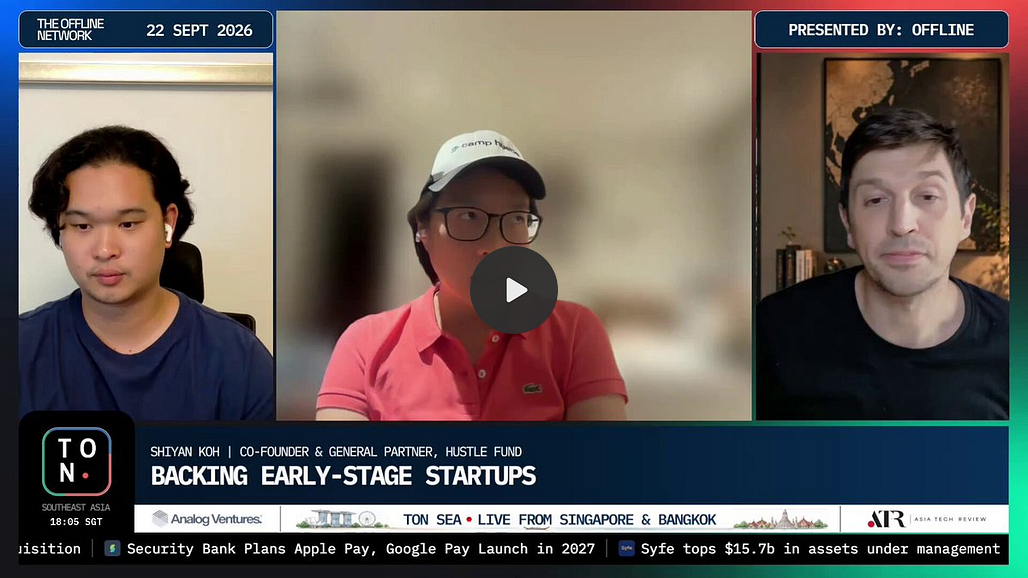
Follow TON SEA on LinkedIn and X for video highlights. Live shows run from 6pm Singapore time every Tuesday and Thursday on our YouTube channel.
ChatGPT gets ads in Southeast Asia and ties up with Grab’s workforce
Anthropic just announced plans to open its first Singapore office in October, OpenAI announced a series of updates in Southeast Asia that show the lead it already has in the region.
The US firm announced a collaboration with Grab that will see 30,000 drivers, delivery workers and merchants given training on practical AI skills, including three-months of free access to ChatGPT Plus. The initiative is rolling out in Singapore, with plans to reach Thailand, Indonesia and the Philippines later this year.
Elsewhere, OpenAI also switched on advertising for its free ChatGPT offering in Singapore, Indonesia, Malaysia, the Philippines, Thailand, Vietnam and Taiwan, following its launch in India and north Asia earlier.
Southeast Asia and India are prime targets, given the popularity of freemium products in these markets, but this is a global push. ChatGPT ads are available in over 60 markets worldwide, with the company claiming it reached a $1 billion ARR less than 200 days after launch. That’s a useful statistic in the run-up to an IPO.
Deals
India’s Brahma AI raised $150 million at a $2 billion valuation to build AI-generated audiovisual tools for enterprises [Economic Times]
India’s Skyroot Aerospace is reportedly in advanced talks to raise $280–300 million at a $2.8–3 billion valuation, with Fidelity, General Catalyst and Benchmark said to be among the prospective backers [Moneycontrol]
Singapore-based iPiD, which helps banks and financial institutions tackle payment fraud, raised $16 million in a Series A led by Foundation Capital, with Citi, HSBC (which work with the startup on payment verification) and existing backers joining [Fintech News SG]
Lightspeed is apparently raising $250 million for a new India early-stage fund, about 80% of which is already committed [TechCrunch]
Markets
Singapore-based data-centre operator DayOne is reportedly pressing ahead with plans for an IPO as early as November [Reuters]
Chinese chipmaker CanSemi Technology is seeking to raise about 6.16 billion yuan ($919 million) in a Shenzhen IPO [Bloomberg]
Used-car marketplace Carro is said to be considering an SGX listing alongside its planned US IPO, which could make it the first company to use the exchange’s new dual-listing mechanism with Nasdaq [Bloomberg]
SK Hynix’s US unit Solidigm is considering an IPO as early as next year that could raise $15 billion at a $150 billion valuation [Reuters]
Earnings
DeepSeek’s annualised revenue run rate has reportedly passed $1 billion, more than doubling in a few months, as it targets a 50 billion yuan ($7.5 billion) fundraise at a 500 billion yuan valuation [The Information]
AI and Chips
Anthropic reported disrupting a Beijing-aligned operation to monitor religious leaders and diaspora communities, including a DC-based advocacy group for Tibet [WSJ]
Chinese authorities are surveying Broadcom switches in state-controlled data centres as Beijing presses operators to cut reliance on foreign AI infrastructure [FT]
London-based neocloud provider Nscale disclosed ByteDance’s role as a customer only in an obscure IPO filing, despite the Chinese company accounting for nearly three-quarters of its sales last year [FT]
DeepSeek published DSec, a training method intended to help AI agents learn more efficiently while reducing unwanted behaviour [Bloomberg]
Israel’s Tower Semiconductor plans its largest optical-communications chip hub in Japan as demand builds for silicon photonics in AI servers [Nikkei Asia]
India’s Sarvam AI launched Vision 2.1, a vision model aimed at making forms, tables and handwritten records easier to digitise across India’s regional scripts [Economic Times]
India’s government says Tata Group’s $14 billion semiconductor and electronics investments will proceed despite a leadership dispute at the conglomerate [Bloomberg]
India is considering an anchor commitment of Rs 15,000–20,000 crore (about $2 billion) for a frontier-AI fund to finance GPU clusters, specialised data centres and other infrastructure [Economic Times]
Crypto
US prosecutors charged Vietnamese national Trung Nguyen Van over an alleged role in a crypto pig-butchering scam that drew about $16 million from one victim [The Block]
Policy
Thailand approved its first national semiconductor and advanced-electronics strategy, targeting about $80 billion in cumulative investment and $150 billion in annual industry revenue by 2050 [Thailand Board of Investment]
Singapore launched SG Semiconductor, a national identity for the industry focused on advanced packaging, silicon photonics, power electronics and chip design, backed by S$800 million ($590 million) in R&D through 2030 [Singapore EDB]
Cambodia will host a two-day anti-scam conference in Phnom Penh with officials from more than a dozen countries as it seeks to demonstrate a crackdown on industrial-scale fraud compounds [Reuters]
India is investigating LG Electronics and Samsung over allegations they paid lower tariffs on imported OLED display components [Reuters]
India’s food regulator has begun action against Amazon, Flipkart, Swiggy, BigBasket and Zepto over alleged misbranding, misleading claims and prohibited food products [Bloomberg]
Vietnam is preparing food-safety rules that would require delivery platforms such as Shopee and Grab to show sellers’ registration details and provide reporting channels [Nikkei Asia]
In other news:
An Indonesian court cut former Gojek founder Nadiem Makarim’s prison sentence to nine years from 10 on appeal in a graft case tied to laptop procurement [Reuters]
India’s Dixon Technologies is moving beyond smartphone assembly into higher-margin components as it aims to become one of the world’s five largest electronics manufacturers within a decade [Bloomberg]
India’s battery-cell ambitions are running into Chinese technology restrictions, with JSW pausing plans for a 50GWh LFP plant in Odisha after failing to secure a partner [Nikkei Asia]
Amazon plans to invest $3 billion in India’s quick-commerce business by 2030, including $1 billion by the end of 2027 [Reuters]
Amazon’s Kuiper received a Vietnamese licence to operate a private satellite telecommunications network linking satellites with ground infrastructure [TechNode]
Tencent launched a competitor to Alipay for visitors to China wanting to use digital payments. Its TenPayGo service is essentially WeChat Pay, without the need for the messaging app, which has a complicated sign-up process for international users. Alipay is still the go-to, but this may be a decent insurance policy bet if you do travel to China. [TenPay on X]
For news as it happens, follow ATR Bulletin, our real-time news site that keeps you in the know.