


Welcome back to Asia Tech Review, your curated digest to keep up to date with tech news across Asia.
KakaoTalk is one of Korea’s most successful tech products. It has beaten WhatsApp and iMessage in the country and even has decent usage in overseas markets. It spawned a $10 billion business with services including ride-hailing and payments, but its efforts to bring AI into its core have divided the market as we explore.
To keep up with our issues, follow us on LinkedIn or WhatsApp. Please do share Asia Tech Review with people you know who want to get smart about Asia tech.
For news as it happens, follow ATR Bulletin, our real-time news site that keeps you in the know.
Investors aren’t buying Kakao’s AI Talk
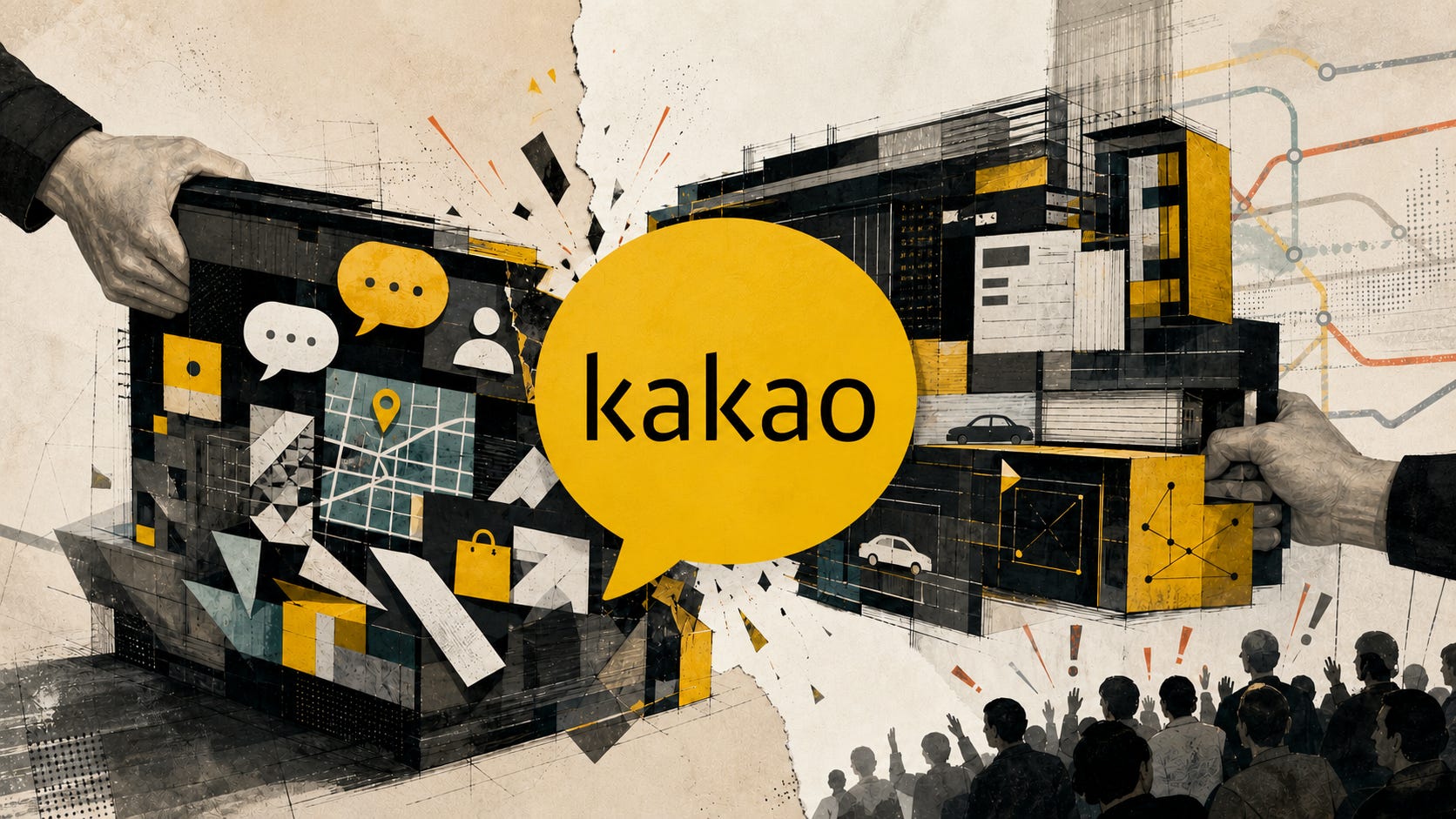
Kakao is one of Korea’s most distinctive new internet companies, but its newest manoeuvre is upsetting shareholders after it planned a split to hive off its AI-focused businesses.
The company plans to hive off its messaging, mapping, advertising and commerce businesses into a new entity that will be called KakaoAI. The remaining units, banking/payments, content, mobility and investments, will run through a second entity called KakaoX.
Kakao is valued at $11.5 billion, but its shares are down by over 75% in the last five years, so this is a major proposal to modernise its value in today’s AI economy.
The split could give Kakao a cleaner structure to raise its AI spending and investment without impacting its more conservative areas of business. Given Korea’s market alignment to AI, another goal may be to make its stock more appealing.
Kakao is putting the consumer products that are best suited to growing with AI related investment or features into one basket. That includes KakaoTalk, its breakthrough and most recognisable product today, and its maps business, which beats out Google. Google Maps was cleared to operate in Korea in February after being held back on security grounds.
It plans to put the more operational heavy assets into KakaoX, but a number of these units are already listed in their own right, including KakaoBank, KakaoPay and KakaoGames. That would allow investors to take varying levels of exposure to the assets.
The proposal is subject to a shareholder vote in December, but that is far from guaranteed.
Many investors aren’t convinced by KakaoAI’s potential to grow its revenue significantly, and see the move as a risk despite the company’s assurances. Kakao forecasts overall sales will nearly double over the next five years, with the AI unit growing at a compound annual growth rate of 20%. That’s despite the AI businesses growing just 3.6% between 2023-2025.
“These mumbo-jumbo words sound nice but they are not believable, especially because they are not backed by enough evidence. The company only had a YoY sales growth of 9.4% in 1H 2026. What is going to cause the company’s total sales growth to suddenly double in the next several years? Due to AI? Many investors are not buying this story,” wrote South Korea-focused analyst Douglas Kim.
Kim wants more evidence before the vote, and others appear to have similar sentiment. The Korean market has been blessed with an AI stock boom that’s focused on the here and now, with in-demand memory firms like Samsung and SK Hynix, not big number projections. How does Kakao square this?
Meanwhile: Kakao Mobility, the company’s ride-sharing business, filed for a US IPO that could raise $1 billion. The company, which is backed by US PE fund TPG, scrapped a planned domestic listing in 2022, but there’s no timeframe or further details at this point.
China’s Bilibili plans global expansion to rival YouTube
China’s open weight AI success might be giving the country’s tech companies reason to believe they can crack international markets after video site Bilibili reloaded its global push.
Semafor reports that the company has relaunched its international app, which it shuttered a year ago, and it is now actively posting job openings for business development and country managers in markets including Brazil, Mexico, the US and the UK. The roles are focused on areas such as deals with local creators, independent studios and IP holders, as well as building the company’s presence at festivals and other industry events.
Like other Chinese media companies, Bilibili has focused on being a front door for Chinese internet users wanting to learn about international topics through its collaborations with creators like Mr Beast, who has more than 500 million YouTube subscribers. Mr Beast has nearly 9 million subscribers on Bilibili after posting more than 30 translated videos to the site. Going after non-Chinese audiences outside of its domestic market will require a very different approach, and plenty of capital.
We might hear more this week when the company’s newest Q2 earnings drop. The previous quarter saw revenue rise 7% to nearly $1.1 billion with advertising, memberships and games the top earners.
Deals
Nvidia is in early talks with South Korean AI chip startup Rebellions about a technical partnership, investment or possible acquisition, giving the US chipmaker another route into Asia’s custom AI silicon market [Bloomberg]
Japanese space startup Letara raised ¥2.6 billion ($16 million) to expand from satellite propulsion systems into larger rockets for space, defence and security markets. Headline Asia, JIC Venture Growth Investment and Incubate Fund co-led the round [TechCrunch]
Malaysia’s Johor state claims to have attracted more than 5 billion ringgit ($1.2 billion) in potential investments after a visit to Singapore, with proposed projects spanning optical technology, health tech and semiconductor manufacturing equipment [Bloomberg]
Markets
Shein is seeking to raise up to HK$13.9 billion ($1.8 billion) in a Hong Kong IPO, valuing the fast-fashion retailer at as much as $26.8 billion ahead of a planned September 1 trading debut [Bloomberg]
China’s YMTC moved closer to a 33 billion yuan ($4.9 billion) Shanghai listing after the STAR Market accepted its IPO application, as AI demand lifts the country’s memory chip sector [Reuters]
Samsung Electronics expects shareholder returns of 90 trillion won to 110 trillion won ($65 billion to $80 billion) in 2026, capping a big week for South Korean chip payouts after SK Hynix’s buyback plan [FT]
Alibaba is seeking to raise about HK$80 billion ($10 billion) through a share sale as it ramps up spending to compete for global AI leadership [Bloomberg]
AI and Chips
Nvidia plans to use its $6 billion Poolside deal to help build one of the world’s most powerful open-weight AI models, taking aim at Chinese rivals including DeepSeek and Kimi K3 as well as OpenAI and Anthropic [WSJ]
Elsewhere, Nvidia is reportedly preparing small-batch shipments of a China-focused AI chip by year-end, with local buyers already placing orders for a processor designed to work alongside GPUs and speed up chatbot responses [The Information]
Nvidia denied a report that it plans to ship a new China-focused AI chip by year-end, keeping the company’s China strategy under scrutiny as export controls reshape the market [Reuters]
Harvey, the legal AI startup backed by OpenAI, built its first in-house AI model on Moonshot AI’s Kimi K3 [SCMP]
Brazil will invest about 2.3 billion reais ($444 million) in its AI ecosystem, splitting projects between US and Chinese companies while putting more than half the funding into a Rio de Janeiro supercomputing project with Huawei and iFlytek [Reuters]
Super Micro said an independent probe found no evidence that current senior management knew of an alleged scheme to divert Nvidia-powered servers to China, following US charges against co-founder Wally Liaw and two others [Bloomberg]
Japan will provide another ¥150 billion ($944 million) to Rapidus, deepening state support for the chip startup’s attempt to challenge global foundry leaders [Bloomberg]
South Korea plans to create a Future Response Fund that channels semiconductor tax windfalls into youth support programmes and investments in AI and other growth industries [Reuters]
DeepSeek launched V4 Flash Vision Exp, a multimodal addition to its V4 family that initially runs on its paid developer platform and beat V4 Flash on six of seven benchmark tests [SiliconANGLE]
The company has begun charging off-peak API rates on weekends to drive more usage of its models [Bloomberg]
China’s three state-owned telecom operators are making billable AI tokens a growth metric as computing demand rises [SCMP]
Inner Mongolia is becoming China’s AI infrastructure hub, with nearly 100 data centres announced or under construction in Ulanqab and companies including DeepSeek, ByteDance and Alibaba investing in local compute capacity [Wired]
South Korean students are turning to semiconductor cram schools as Samsung Electronics and SK Hynix compete for chip talent, helped by record AI-driven profits and richer employee bonus schemes [FT]
Policy
Former Google engineer Linwei Ding had part of his AI trade-secrets conviction overturned after a US federal judge tossed portions of the verdict tied to allegations he benefited two Chinese companies [Reuters]
Chinese visa restrictions on Indian executives are slowing robotics and hardware startups in India, delaying R&D and business development while forcing some teams to look at Hong Kong, Taiwan and Singapore for supply-chain alternatives [Economic Times]
Suspected China-based military hackers used AI to develop malware for a cyberespionage campaign against Central Asian governments, with researchers identifying five previously undocumented strains in the SilkParasite operation [The Record]
A US Department of Energy laboratory is probing whether Chinese-made lidar sensors could create security risks if widely deployed in American vehicles [TechCrunch]
India ordered Google to shut hundreds of Firebase accounts after finding the platform was being used to impersonate major banks and run online scams [Reuters]
China ordered its biggest-ever automotive recall over retractable door handles, covering nearly 3 million Teslas and over 1.3 million vehicles from eight Chinese automakers [NYT]
A 600-megawatt generation failure in Kyrgyzstan triggered outages across Kazakhstan, Uzbekistan and Tajikistan, exposing pressure on Central Asia’s grid as the region builds more power links and energy-hungry data centres [Nikkei Asia]
In other news:
AI is accelerating fraud and other cross-border crime in Southeast Asia, cutting costs for scam networks and forcing authorities into a cat-and-mouse game as crackdowns push groups to relocate [Nikkei Asia]
China approved its first private-sector commercial trial for satellite IoT services, giving Geely-backed Geespace a two-year permit as Beijing starts opening satellite communications to private capital [SCMP]
Flipkart Minutes is delivering 1.1-1.2 million orders a day, up from roughly 400,000 in November, narrowing the gap with Swiggy Instamart while still trailing Blinkit and Zepto [TechCrunch]
China’s Tiangong Ultra humanoid robot ran 100 metres in 9.39 seconds at the World Humanoid Robot Games in Beijing, beating Usain Bolt’s men’s world-record time on paper and giving state media a ready-made robotics headline [Reuters]