


Welcome back to Asia Tech Review, your curated digest to keep up to date with tech news across Asia.
Southeast Asia just got a major acquisition as Singapore’s Tazapay got scooped up by stablecoin giant Circle in a $400 million deal. But the most interesting part of the company is that it is a global business not simply one from Southeast Asia, as we explore today.
To keep up with our issues, follow us on LinkedIn or WhatsApp. Please do share Asia Tech Review with people you know who want to get smart about Asia tech.
For news as it happens, follow ATR Bulletin, our real-time news site that keeps you in the know.
Tazapay’s move into crypto pays off handsomely
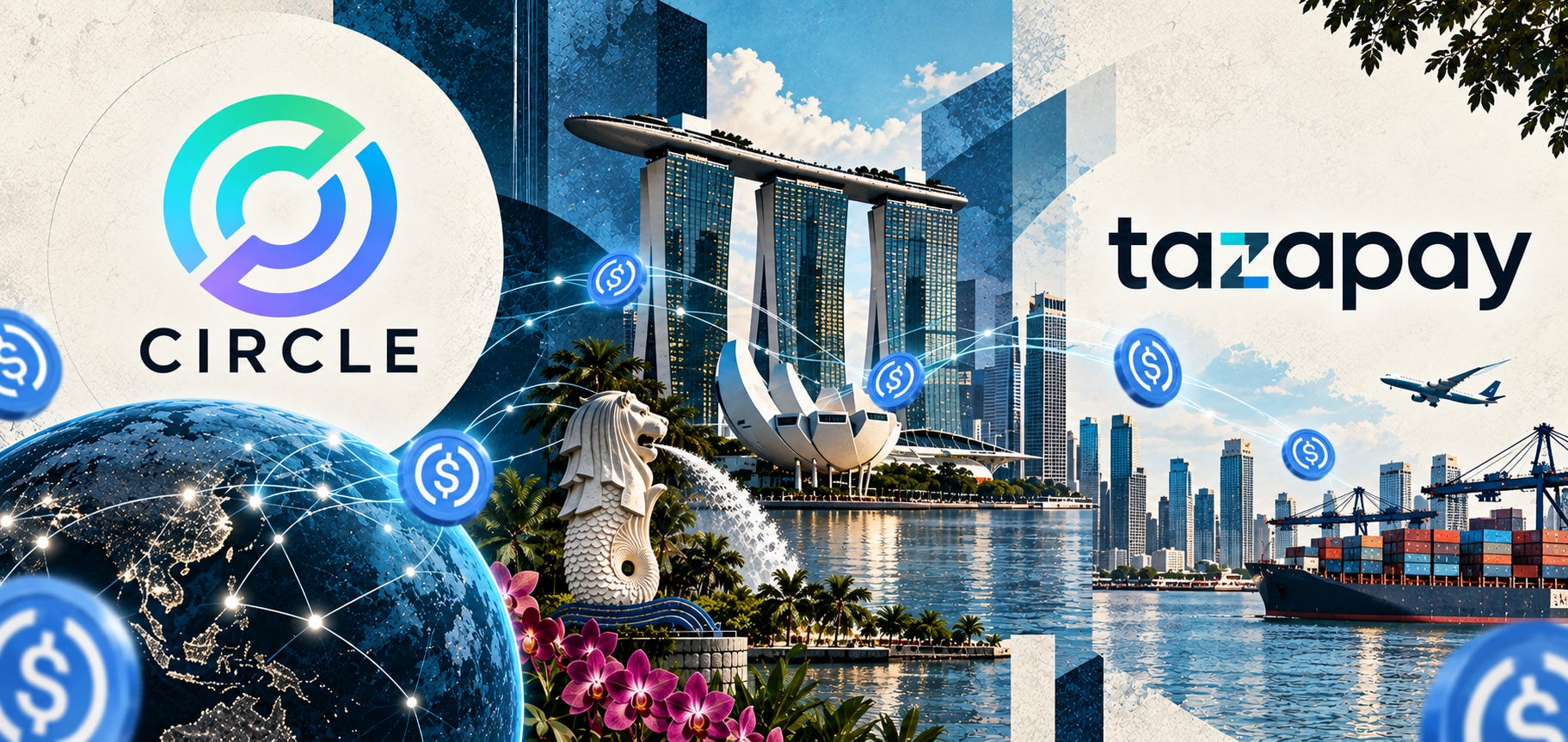
Asia has another stablecoin exit after US-listed Circle announced it will buy Singapore-based Tazapay in an all-stock deal worth $400 million. The price itself wasn’t announced, but it is mentioned in a filing—god bless public company reporting…
Circle and Tazapay are well acquainted as Circle Ventures took part in the startup’s Series B round one year ago, before leading a $36 million extension in March of this year. Tazapay raised more than $60 million in total and beyond early backers like Peak XV and Saison Capital, it also counts crypto firms Ripple and Coinbase’s VC arm on its cap table.
This deal comes just months after Payward, the parent of US crypto exchange Kraken, agreed to buy Hong Kong-headquartered stablecoin platform Reap for $600 million. While Reap helps companies bring stablecoins into their financing and operations, Tazapay comes from the opposite direction. Its payment rails handle cross-border transactions and in recent years it has added stablecoins.
Circle is one of the largest stablecoin issuers in the world, and one of the few crypto companies to go public with a US IPO. Its share price gives Circle a valuation of $26.5 billion while its USDC stablecoin daily trading volume is around $15 billion.
Six-year-old Tazapay started out as a pure payments play. That’s unsurprisingly given CEO Rahul Shinghal is a 10-year veteran of PayPal and previously led Stripe’s revenue and growth in APAC, but that focus changed in recent years.
Tazapay became a Circle partner in 2025, enabling payments in Circle’s USDC stablecoin, and it added those aforementioned crypto investors as backers around the same time. That appears to have been transformative. Today, around 60% of its $25 billion of annualised payment volume comes from stablecoins, according to the press release announcing the deal. That’s more than double the $10 billion volume it disclosed when it announced its Series B in August 2025.
This deal ranks among the largest exits for a Southeast Asian startup (it is notably Circle’s first acquisition since its NYSE IPO in 2025), but Tazapay’s real strength and appeal is that it has built a global business that goes well beyond its home region. It claims to have more than 60 banking and fintech partners, and local payout rails that span 100-plus markets, a licence from the Monetary Authority of Singapore, and registrations with FINTRAC in Canada, AUSTRAC in Australia, and FinCEN in the United States.
This is exactly why Circle is splashing the cash (stock) to bring the business in-house. Buying Tazapay instantly gives it payment rails for USDC that it can grow immediately to help its stablecoin adoption expand beyond the typical crypto market and user base.
“Over time we expect this [acquisition] to mean more routes, wider coverage, and the ability to move money in more corridors and outside local banking hours. When those are available, we will share the news,” Shinghal wrote in a blog post for Tazapay.
So the deal isn’t selling Southeast Asian startups per se, but it is an endorsement for why Singapore is an ideal location to build a global fintech service that can be acquired by the world’s biggest companies.
Paytm launches enterprise AI business
AI agents are everywhere, with even Meta launching its own today, and India’s Paytm is zoning in after it launched a dedicated enterprise business called Paytm Intelligence, or Pi. Nice alias, and the business could do decently too. Bloomberg reports that the focus is on offering AI agents for financial institutions in India and the UAE, so AI agents for sales, customer service, operations and more.
Paytm is getting back to its roots here. The company first emerged as a services business long before fintech was a thing, and upselling agentic AI is a wholly logical play given the connections it has. Barely a day goes by without a new enterprise AI business emerging, Anthropic has its own such is the opportunity. Enterprise sales are about relationships, trust and connections which Paytm should tap into here.
After losing its payment bank arm in 2024, Paytm has gone after value added services and earlier this year it forecast stronger annual revenue growth.
Deals
Indian satellite-imaging startup Pixxel raised $100 million in a round co-led by Temasek and Seraphim Space, valuing it at an estimated $400 million to $450 million [Economic Times]
Samsung led a €3 billion ($3.48 billion) investment round in French AI startup Mistral AI at a valuation of more than $24 billion [WSJ]
Singapore’s Circles Group is spinning off its telecom-operator software business and could raise several hundred million dollars from a strategic or financial investor [Bloomberg]
Markets
In an effort to boost its IPO pipeline, Thailand’s stock exchange will lower the minimum market capitalisation for new-economy listings, including electronics and robotics, to 5 billion baht ($151.9 million) from 7.5 billion baht ($227.9 million) [Nikkei Asia]
Chinese memory-chip maker Longsys raised HK$7.08 billion ($903 million) in its Hong Kong IPO, but opened flat after pricing the shares at a 44% discount to its Shenzhen-listed stock [Bloomberg]
AI
OpenAI signed a multiyear deal with Australian firm Firmus for capacity at two Malaysian data centres [Reuters]
The Philippines unveiled a seven-year $34.4 billion plan to lift AI data-centre capacity from 50 MW to 1.5 GW, with $21 billion expected from private investors [Nikkei Asia]
ByteDance is developing a real-time spatial video-generation model that could be used in robotics and autonomous systems, with founder Zhang Yiming personally overseeing a potential launch next month [Bloomberg]
China is pushing computing capacity into its north and northwest, with Inner Mongolia’s Ulanqab emerging as a data-centre hub and more than half the national pipeline now outside the crowded east [Bloomberg]
DeepSeek plans to hire about 150 senior backend engineers to rebuild systems strained by its rapid user growth and compute-heavy AI agents [SCMP]
Moonshot AI, MiniMax and other Chinese AI firms are selling subscriptions through Alibaba’s new Tmall AI Space Station in a new way to find consumers [SCMP]
Researchers used advanced AI models to build a computer worm that can hijack WeChat accounts and spread across iOS and Android devices without victims opening a link or message [NYT]
Chips
Malaysia is considering Huawei chips for a 2 billion ringgit ($494 million) sovereign AI project [Bloomberg]
Huawei says its new Kirin 9050 Pro delivers 42% higher performance through its LogicFolding architecture, testing whether it can boost chip performance without lithography equipment blocked by US sanctions [SCMP]
Huawei is backing Chinese suppliers developing semiconductor equipment and components, including an advanced DUV lithography machine being tested by SMIC and Huawei [FT]
China aims to build AI computing clusters of up to 100,000 accelerator cards and targets 9,800 exaflops of capacity by 2030, alongside 3.8 trillion yuan ($532 billion) of information-infrastructure investment [SCMP]
TSMC plans to adopt ASML’s high-NA EUV lithography machines in 2030, following Samsung’s 2028 target and Intel’s earlier production plans as chipmakers race for more powerful AI processors [Nikkei Asia]
Policy
Huawei has gone on trial in Brooklyn over US accusations that it stole trade secrets and confidential information from competitors while building its global business [FT]
Belgian prosecutors detained a Chinese-Belgian former chip executive on suspicion of spying for China in a case involving gallium nitride semiconductors [Reuters]
Chinese export controls on indium are creating a supply risk for semiconductor makers, whose high-speed data-transmission products depend on indium phosphide substrates [Bloomberg]
In other news:
India’s China Plus One gains remain concentrated in a handful of sectors and regions despite booming iPhone production, limiting the broader employment impact of its manufacturing push [India Dispatch]
Logitech turned China into its fastest-growing market by building a dedicated local operation that designs and markets products for Chinese consumers before taking successful ideas global [Semafor]
Japan’s Terra Drone is developing autonomous interceptor drones designed to destroy low-cost attack drones without using multimillion-dollar missiles [WSJ]
Southeast Asia’s content-commerce GMV is expected to reach $77.9 billion in 2026, up from $49.7 billion last year as live and short-video shopping become core ecommerce channels [TechNode]
South Korean battery-materials maker EcoPro is developing high-nickel cathodes and solid-state batteries for humanoid robots, with commercial production of its sulphide-based solid electrolytes planned for next year [Bloomberg]
For news as it happens, follow ATR Bulletin, our real-time news site that keeps you in the know.